Showing posts with label Sharon Fawcett. Show all posts

Thursday, August 14, 2014

Serendipity Doo-Dah

It was a Cinderella story.

We dedicated the old, private Nixon library, where I served as director beginning in 1990, on an oppressively hot day that July. We had four presidents at the dedication ceremony, including Richard Nixon and the incumbent, George H. W. Bush. We threw a glittering fairy tale ball at the Century Plaza in Los Angeles with an open bar, attended by the noblest political hacks from every corner of the kingdom.

We called what we had constructed in Yorba Linda, around Nixon's humble birthplace, a presidential library. It had gleaming new galleries, shiny terrazzo floors, exquisite bathrooms, and a stately reading room for scholars.  It cost a then-princely sum of $25 million. The epic buildings and grounds definitely looked presidential. But the shoe didn't fit, because we were a stepchild, reaching for a birthright to which we weren't entitled.

It wasn't hard to see why. Within our heavily fortified walls, in all our 13 acres, there wasn't a presidential document to be found -- not a memo, a letter, a scribble, a tape, or even a tape gap. Someone claimed we had secret UFO records, which would've been useful if it were true. But Nixon's White House records, including the infamous secret tapes, were all back in Washington.

We opened an archive with pre-presidential records in 1991, but it didn't convince scholars that our hearts were pure. Besides, the phone book didn't say we were the Nixon pre-presidential library. As at all new libraries, our museum put the best face on our man's legacy. But unlike our better-heeled cousins, we couldn't say that scholars and the public could walk around the corner and get the straight story of Nixon's presidency in the records. To see those, people had to visit a National Archives and Records Administration (NARA) facility in Alexandria, Virginia or, later, College Park, Maryland.

We buried Mr. Nixon on the grounds in 1994, beside his first lady, who had died the year before. In the years that followed, as his co-executor I helped settle two pieces of federal litigation that had kept the Yorba Linda stepchild from joining the libraries which, beginning with Herbert Hoover's, are all run by NARA. One lawsuit had to do with access to Nixon's tapes, the other compensation for Congress's taking of all his White House records.

That done at last, we notified Uncle Sam that we were prepared to receive callers. But he was a reluctant suitor. For several years, the phone never rang on Saturday night. If you think I'm about to stretch the metaphor to include a dowry, you're right. We finally had to pay a lobbyist with ample Democratic bona fides $1 million to get legislation written in the House permitting NARA to ship Nixon's records out of Washington to Yorba Linda and paying for an archives wing for the documents, gifts, and tapes.

Along the way we withstood Nixon's fractious family (which torpedoed my first effort to federalize the library in 1996-97 because they thought, wrongly as it turned out, that there would be a bigger pot of gold if we kept fighting in court) and political hacks hanging around at court who were mad that we were paying big bucks to fancy Democratic lobbyists instead of good Nixon cloth coat lobbyists.

Finally, it all came together. By the spring of 2006, our courtship was on the brink of consummation. The glass slipper was tickling our toes. All we needed was a federal director -- somebody who was, frankly, not I. Archivist Allen Weinstein and his deputy, Sharon Fawcett, asked me for names. I gave them just one: Timothy Naftali, a Cold War scholar who had run a groundbreaking presidential tapes project at the University of Virginia's Miller Center. Within days, they'd offered him the job. In an article announcing the Naftali appointment, the LA Times' Christopher Goffard wrote:
John H. Taylor, executive director of the Richard Nixon Library & Birthplace Foundation, called Naftali "an independent-minded straight shooter" and "an ideal choice" for the job.

Taylor said Naftali's work with presidential recordings was particularly relevant, because the National Archives plans to transfer nearly 4,000 hours of Nixon's presidential tapes to the library, many of which are difficult to hear.
Tim meets the press
After we handed the library over to the feds in 2007, I remained as Nixon foundation chief. Though friends now, Tim and I had our ups and downs. When I complained about Tim to Allen Weinstein, he reminded me that Naftali had been my idea. When I complained to Naftali, he reminded me that I'd asked him to take the job. Weinstein compared us to squabbling brothers. Our skirmishes were trivial compared to the systematic although impotent assault that the John Dean-hating disciples of disgraced Nixon aide Bob Haldeman mounted against Naftali to try to stop his new Watergate exhibit, which opened in 2011.

I left the library in 2009, pleased, at least, that it was safely in federal hands. I never expected anyone to celebrate my years in Yorba Linda. Tim and I both are here to say that if you want to make friends, don't be director of Nixon's library. My able successor at the Nixon foundation, former Nixon chief of staff Kathy O'Connor, who also ran afoul of the good old Haldeman boys, can sympathize.

And yet I write today to battle for my footnote in Nixon library history. Two weeks ago, from their publicist at Houghton Mifflin Harcourt, I received a complimentary copy of The Nixon Tapes by Douglas Brinkley and Luke A. Nichter. Their 758-page book of transcripts is a vital addition to the Nixon bibliography. In the acknowledgements, the authors mention Naftali's work with presidential recordings at the Miller Center and then write:
[S]o it was serendipitous that the National Archives selected him in 2006 to be the first director of the federalized Richard Nixon Presidential Library...
Serendipity is chance, accident, or coincidence. Naftali's appointment was none of these, and saying it was not only obscures my role, incidental though it may have been, but also suggests that the then-archivist of the U.S., no mean scholar himself, had blundered into a smart pick, like Percy Spencer's accidental discovery of the microwave oven.

I actually thought that this was a small thing among gentlemen of the realm. I have a passing acquaintance with Brinkley. He reached out to me when it seemed the Nixon estate might be in the position to help with access to the tapes. I've also known Nichter for several years. I admired his efforts to make the Nixon tapes more broadly available to the public. We had lunch a few months ago. Last week in Washington, he graciously acknowledged the NARA archivists who faithfully cared for and processed the Nixon records while absorbing undeserved, politically inspired criticism, including from those of us on the Nixon side.

So I wrote them both an e-mail praising their work but saying that I felt as though I'd been written out of the story. I asked that they alter the wording in subsequent editions. I didn't suggest how that might be done, but as I look at their phantasmagorical sentence, it seems to me that just changing "serendipitous" to "appropriate" would do it.

Brinkley didn't reply, but Nichter did. Rejecting my claim, he plunged his lance in deep. "This is the first book of its kind," he wrote. "We expected that one of the criticisms we would get is that we didn't do enough in some shape or form. That often happens to those who are trying to start an entirely new conversation." So I'm not only out of line with my request. I'm nipping predictably at the heels of courageous visionaries. It's after midnight, anyway. I'll just head back to my pumpkin.

Tuesday, June 12, 2012

The Charlottesville Massacre (Almost)

In an April 30 talk at the Miller Center at the University of Virginia, where he worked for eight years before I recommended him as the first federal Nixon library director, Tim Naftali revealed that over cocktails in Charlottesville, Virginia one evening in June 2010, Reagan library director Duke Blackwood (left) and Naftali's boss, assistant archivist of the U.S. Sharon Fawcett (below), demanded his resignation -- as a sop, Naftali said they claimed, to loyalists of disgraced Nixon chief of staff Bob Haldeman:
If I would resign, I would get my [Watergate] exhibit....They wanted to give my head to the archivist of the United States on a platter...[Then] maybe the Nixonians would stop pushing. I thought this was outrageous...[They said,] "Tim, this is the only way your Watergate exhibit is going to happen. You've got to resign."...I didn't, of course.
Beginning in the fall of 2009, Richard Nixon and Haldeman's lower-level, non-policy operatives had been waging a ruthless campaign to stop Naftali's Watergate exhibit at all costs. They failed. The National Archives opened the exhibit in March 2011, generating the most publicity for the Nixon library since it opened 22 years ago. But there's no question that it was a close call for Naftali, since, as he tells it, his bosses at the Archives were at war with one another over how to handle the demands of Haldeman's operatives. That Blackwood was essentially carrying the Watergate for them is especially significant since he's a federal official who is paid a six-figure salary by U.S. taxpayers -- just like the Nixon factotum-turned-U.S. senator, Lamar Alexander, who also had Naftali in his sights, at the behest of one of Nixon's advance men.

Why roll out all that firepower? According to Naftali, the Haldeman tribe wanted to perpetuate the Watergate coverup by keeping the public from seeing videotape in which operatives such as Fred Malek discussed counting Jews in the federal government and Dwight Chapin, jailed for Watergate-related crimes, accused Nixon of being present when 1972's campaign dirty tricks were launched. "They were defending themselves," Naftali said of those who had taken control of the Nixon foundation. "It was no longer about the president."

Naftali knew he would have been crazy to submit to Blackwood and Fawcett (a colorful account of Blackwood's maneuver was first published, without his name attached, by historian and blogger Maarja Krusten). Later events revealed by Naftali in his hour-long Miller Center talk made clear that some at the National Archives (presumably including Fawcett, or so Naftali implies) were willing to replace his Watergate text with an outline dictated by the foundation's Watergate truth squad, of which perjurer Chapin was the most notable member. If Naftali had quit, it's a good bet that the custodians of the Declaration of Independence and U.S. Constitution, faithfully preserved all these centuries, would have shredded his exhibit before the ink dried on his severance check.

Instead, the archivist of the U.S., David Ferriero, ultimately and unmistakeably backed Naftali. Fawcett announced her own resignation and reportedly received a consultancy offer from Haldeman's men. Based on Naftali's public comments, many questions remain about her role. Why did Fawcett need Blackwood's help in trying to axe Naftali? Did Ferriero know she was using one of his library directors to leverage the ouster of another (some NARA observers are certain that she acted on her own authority)? Did Fawcett, a canny civil service lifer, really think the scholarly community would've stood by while she greased the skids for a widely respected Cold War historian for the sake of the reputations of Bob Haldeman, Fred Malek, and Dwight Chapin?

Whether we learn the answers to any of these questions, Naftali's triumphant if emotionally charged presentation at the Miller Center proves that the dictum about history being written by the winners also applies to scrappy public historians who defeat shadowy private interests. The library director with nine lives even scores a late hit on his would-be executioner by critiquing the Reagan-adoring federal museum in Simi Valley, California, which in 2011 finally added a full exhibit on the Iran-contra scandal. That effort doesn't impress the curator of the Nixon library's warts-and-all-gate. "'Mistakes were made'; passive voice," Naftali said, summing up Blackwood and his colleagues' handiwork on the Reagan scandal, which some argued was worse than Watergate. "Reminds me of Pravda."

Tuesday, May 1, 2012

Friendly Fire

Tim Naftali, the former director of the Nixon library, has enough of secular outlook that he didn't know (or perhaps jokingly claimed not to) that he had inherited his surname from one of Jacob's fractious sons. Still, his Yorba Linda years comprised a wilderness experience of Hebrew Testament proportions. As he sometimes reminded me, I was the one who first beckoned him into the trackless wastes. I also helped give him his toughest challenge: Replacing the private library's relentlessly pro-Nixon Watergate exhibit. I'm sorry about the times I made his work unnecessarily difficult and grateful that he beat disgraced Nixon chief of staff Bob Haldeman's boys and finished what history had called him to do.

No public historian since the Enola Gay controversy at the Smithsonian Institution had a harder challenge. He was uniquely qualified for it. He was a highly regarded, non-ideological scholar of Nixon's defining crisis, the Cold War. A few years before he came to Yorba Linda, Tim and I had worked together a little on presidential tapes, by which Nixon's historical reputation is utterly bound and tied, for better and worse. Tim wasn't a Nixon booster, and I think he ended up deeply discouraged about Nixon's character as a result of his forced curatorial march through the Watergate swamp. Yet he and the last elected moderate Republican president would have disagreed on relatively few domestic or foreign policy issues. Perhaps most important given the odds he faced, he displayed the quality Nixon prized most of all. It turns out that Tim Naftali was tough as hell.

The archivist of the U.S., Allen Weinstein, was so excited by the idea of making Tim our first federal director (the library opened in 1990 as a private institution) that he offered him the job a few days after my call. When things were going well at the library, Weinstein would stress that Tim was his man. When things got rocky, he'd remind me that it had all been my idea. Tim and I labored together for over three years, rarely disagreeing about substance but having a series of pitched battles about Tim's independence vs. the Nixon foundation's right to be consulted on exhibits and programs, space use on our shared campus, and even Tim's lower-case library logo, which he thought invoked the '60s and '70s, when Nixon was president, but we thought unstatesmanlike.

We got important work done anyway. I permitted him to open foundation-owned records to scholars and funded his oral history interviews with Nixon policy heavyweights and White House operatives. Our disagreements never became public nor interfered materially with our shared mission of establishing the federal Nixon library as the successor of a private museum and archive that had earned something of a reputation of partisanship (which, if it was a fair criticism, was no one's fault but mine). Tim's bosses at the National Archives fully embraced the same mission -- Weinstein, of course, and his deputy Sharon Fawcett, who had both worked hard to bring Nixon's library in from the cold.

Having bargained with them for hundreds of hours to launch the federal library, Kathy O'Connor (shown here with Fawcett), Nixon's longtime aide and last chief of staff, and I would sometimes call or write Weinstein and Fawcett to complain about Tim. We never got anywhere. They backed him unequivocally. The most I could pry out of the avuncular Weinstein was his theory that Tim and I were brothers at heart who clashed because of unacknowledged similarities in temperament and outlook. After we each had stated our grievances, he would smile and send us back to Yorba Linda to work it out. While I never fully accepted that I was Dan to Tim's Naphtali, Kathy and I both loved Tim's mother, Marjorie, a delightful Anglican from his home town of Montreal (Tim's late father, a builder, was Jewish). One problem may have been that I was having trouble letting go after spending two decades planning and running the library. By the same token, we felt that Tim, in his actions and public statements, was trying too hard to put distance between himself and the ancien regime, namely us. We didn't become close until I left to begin full-time ministry in February 2009, which, now that I think about it, is often the way with siblings.

Thanks to Kathy, my able successor as head of the Nixon foundation, relations with Naftali and NARA quickly improved. But her journey toward the promised land of happier collaborations with our federal colleagues was interrupted and cruelly ended by the Haldeman renaissance. After Tim invited Nixon White House counsel John Dean to give a speech in June 2009, Nixon's White House and CREEP aides (including some involved in Watergate or Watergate-related activities) and their friends, thanks to enablers on the foundation board, surged to positions of influence or even fiduciary authority.

They were wrong about Dean's appearance, which was inevitable and also appropriate as part of the library's transition to public control. The self-described lynchpin of Watergate, he is pivotal historical figure. Tim and we had already played host to Watergate reporter Carl Bernstein. Bob Woodward visited in 2011 without incident or controversy. The actions of Haldeman's acolytes weren't based on what was best for the library, the public, or Nixon's reputation. They lashed out because they despised Dean for helping send fellow operatives to jail for Watergate crimes and then grasped for power because they believed it was their right and their turn. As Naftali told the Los Angeles Times, "It's a very special tribe that has never accepted the nation's verdict on Watergate."

By the fall of 2009, Tim had been at work for two years on the library's new Watergate exhibit, which Weinstein and Fawcett had ordered him to undertake, also at my suggestion. It was part of complex deal in which the feds paid millions to build an archives wing for Nixon's vast collection and agreed to take over the library in May 2007 and move the records from College Park, Maryland. Shaking hands with our federal partners, we and the Nixon foundation board had promised both our acquiescence in an exhibit that would be acceptable to historians and in library-controlled public programming, including appearances by Nixon critics.

But once under the control of Haldeman's tribe, Nixon's foundation broke its promises. Most of their harsh if ultimately impotent actions are part of the public record. They denounced Naftali publicly for inviting Dean. An operative wrote on the foundation web site that he should go run a museum for traitor Alger Hiss. They recruited Sen. Lamar Alexander (right), a former Nixon aide, to put a secret hold on the nomination of a new U.S. archivist to pressure or get rid of Naftali. They assembled a Watergate truth squad including convicted perjurer Dwight Chapin and attacked Tim's Watergate exhibit draft, calling for friendlier treatment of Haldeman and trying to prevent the public from seeing videotape in which operatives discussed dirty tricks and counting Jews in the federal government. A former foundation employee who'd opposed the NARA handover wrote a column associating Tim with "the left." Another operative filed a FOIA request to read Tim's e-mails. Yet another accused him publicly of sending coded signals about his sexual orientation. His wife publicly accused Tim of leaking prejudicial Nixon tapes to the media.

When Tim offered one of Nixon's daughters a tour of the library's new quarters, she accepted only to denounce him in front of her fellow foundation leaders and demand that he leave. He was shocked that his adversaries had gone that far. As I had learned over a decade before, when Nixon put me instead of his family in charge of his estate, the withdrawal of the favor of political offspring is a powerful weapon. Lucky for Tim, it's not quite as potent when the taxpayers rather than the offspring are paying your salary. Though the massive assault on his professionalism and character must've been upsetting and sometimes dispiriting, it can't help but have reassured Tim that he was on the right track.

Besides, his colleagues at NARA must've had his back. Officials in Washington and around the country, especially at other libraries, had to be aware of what he was up against as he did the difficult job the archivist of the U.S. had given him. When all Nixon's men went to war against a federal director in the last battle of Watergate, the blue coats would obviously know where their loyalties belonged.

Not so much, astonishingly. At some point, the Weinstein-Fawcett hard line weakened. After the public learned of the Haldeman truth squad's critique in the late summer of 2010, there were signals from Washington that it was receiving a respectful review. That's right: The National Archives, custodian of documents signed by Thomas Jefferson, was paying serious attention to a Watergate narrative co-signed by Dwight Chapin.

And it gets worse. I remembered Weinstein and Fawcett's stony imperviousness to Kathy's and my minor complaints as I read historian Maarja Krusten's reference to Tim being cussed out not by a Haldeman operative or Nixon family member but by one of his fellow presidential library directors. Someone had figured out how to reach deep into the government and enlist a taxpayer-paid NARA official for a flanking attack on Tim Naftali. Which director was it? What was the official trying to accomplish? Was it part of an effort to get Naftali out of the Nixon library or alter the content of the Watergate exhibit? Did top NARA officials know about or sanction it?

It's hard to imagine Barack Obama's new archivist, David Ferriero, doing so, especially after the senior senator from Tennessee held up his nomination. Besides, I agree with Krusten that he's a stand-up dude. As for Fawcett, I'd always found her to be a straight shooter. But we know from press reports late last year that she'd sided against Naftali and that the Nixon foundation offered her a consultancy after her retirement. All the library directors, including the one who dissed Tim, had reported to her. It's also important to know if Haldeman's operatives played a role. In 2009, the Nixon foundation tried unsuccessfully to get the other presidential foundations to join it against Naftali. Lamar Alexander isn't the only current or recently serving government official with ties to the Haldeman clique.

However it happened, a federal official with a six-figure salary was carrying Watergate for Nixon's men. Maybe this inside move against Naftali was just further proof (as if it were needed) of the wisdom of the scriptwriter who put the words "follow the money" in Watergate leaker Mark Felt's mouth in "All the President's Men." Krusten writes that the director told Naftali, "You're going to ruin it for the rest of us." Perhaps he was speaking on behalf of cash-strapped presidential libraries from Simi Valley to Boston, where private foundation money can still buy a considerable amount of hagiography for the entertainment of credulous museum-goers. Too many balanced and thorough museum exhibits -- torture, Monica Lewinsky, Iran-contra -- and the gravy train might dry up as ex-presidents' rich friends tire of underwriting an undesirable degree of objectivity. For creating (and in March 2011 successfully opening) the Watergate exhibit that his bosses and historians had demanded and that the public deserved instead of the one Dwight Chapin wanted, Tim Naftali had become the ultimate skunk in the Rose Garden.

Monday, February 20, 2012

An Historian Errs On The Nixon Library

Former Nixon archivist Maarja Krusten raises questions about historian Benjamin Hufbauer's review in a scholarly journal of the Nixon library's Watergate exhibit, particularly the transfer of the private library to the National Archives. We first tried to get the library into NARA in 1995-6, not 2005, as Hufbauer writes. This passage in his review is especially egregious:
[M]embers of the foundation thought they could still have a shrine to Nixon but have the government pay for it. They were wrong. In 2006 when NARA took over, the newly installed Archivist of the United States, Allen Weinstein, personally recruited Timothy Naftali to be the first director of the Nixon Library under federal management. Naftali and Weinstein agreed that the primary goal for the museum would be a detailed and historically accurate account of the Watergate events.
It is Hufbauer who is wrong. As library director and Richard Nixon's co-executor, I conducted the negotiations with NARA along with Kathy O'Connor, Nixon's last chief of staff. Before the handover, we agreed that the Watergate exhibit would be replaced. For the first federal director, I recommended one name to deputy archivist Sharon Fawcett: Tim Naftali, Cold War historian and presidential tapes expert. Within days, she'd placed a call inviting him to be considered. Archivist Allen Weinstein told me later that my idea had been brilliant and that the same notion "had occurred to me."

After Naftali was named, I suggested to Fawcett and Weinstein, and they agreed, that Naftali should redo the Watergate exhibit rather than our trying to design one that would be acceptable to the government. Before NARA had even taken possession of the museum, Natftali asked my permission to tear out the old exhibit, which I granted.

Hufbauer's account was apparently informed solely by the Bob Haldeman revanchists who took over Nixon's foundation in the fall of 2009 after Naftali invited John Dean to give a speech (see here, here, and here), who battled him relentlessly over the Watergate exhibit, but who had no involvement in the handover negotiations with NARA.

Thanks to my sister blogger Maarja for sending me the article.

Photos: Nixon library handover ceremony, 2007: (f) Foundation chairman Don Bendetti and Archivist of the U.S. Weinstein; (b) Fawcett, Taylor, Naftali, and O'Connor. Right: Naftali and O'Connor

Tuesday, December 13, 2011

Turning On The Fawcetts

This morning historian and blogger Maarja Krusten writes:
John Fawcett retired in 1994 and became an archival consultant. NARA staff told me in the 1990s that he was advising the Nixon Foundation at one point but I only have anecdotal evidence of that. (I know John Taylor worked with Fawcett. I’ll have to ask John if this occurred in the form of a consultancy in addition to Fawcett having worked at NARA.) I thought of that, when I read [journalist Andrew] Gumbel state that the Nixon Foundation offered Sharon Fawcett a consultancy after she retired from NARA late this spring. Interesting echo, perhaps. Given the wording in Gumbel’s article, I don’t know if Sharon actually accepted the offer.
John and Sharon used to be married. John finished his long National Archives career at the beginning of the Clinton administration. His last post was assistant archivist for presidential libraries. Sharon served in the same capacity for many years and retired earlier this year. Both ended up being offered consultancies by the private Nixon foundation. Krusten is struck by the symmetry. I don't blame her.

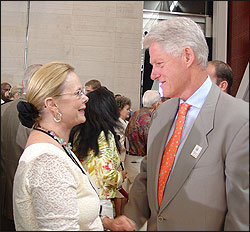
Despite their considerable influence across many years over how White House records are handled, they've managed to stay more or less below the radar. Though she's shown here with Bill Clinton, most of Sharon's Internet hits are consequences of the Nixon wars. A cursory Google search reveals no photos of John.

To answer Krusten's question, in the early 2000s, when I was Nixon foundation chief, I hired John (by then retired from NARA, where he helped engineer a curious, brief tilt to Nixon) as we prepared for the handover of the private Nixon library to the National Archives. Since 1991, our private reading room and archives had been operated by Susan Naulty. She was doggedly opposed to making the Nixon library part of NARA and later became a critic of director Tim Naftali, associating him with the left for inviting former White House counsel John Dean to Yorba Linda. Years before, during the battle between the Nixon foundation and Tricia Cox over the $19 million bequest of Nixon buddy Bebe Rebozo, Naulty developed a unwonted media profile by discussing the size of her staff with the Los Angeles Times. Her comments dovetailed with attacks by Cox ally Irv Gellman, who claimed that the library was poorly managed because we didn't give Naulty more resources. Gellman, Naulty, and her assistant had worked together closely when he was researching his book The Contender.

When we'd settled our lawsuit against Cox and Rebozo's money was safely ensconced in our endowment, we began to focus on facilitating a government handover. The headline on an earlier post reflects our midset: "Take My Library. Please." I became more curious about the differences between Naulty and NARA practice. Would we be able to stretch our resources further if she stopped refusing to use computers and processing records document by document, typing up one or more index cards for each letter, telegram, or memo (yes, Virginia, we had a card catalog)? The government processed folder by folder. So I invited John Fawcett, then working as an archival consultant, to take a look. He concluded that it would take Naulty hundreds of years to finish preparing our small cache of Nixon's pre-presidential records for scholars. When I hired a former Reagan library archivist to oversee a transition toward NARA practice, Naulty quit.

We don't know anything about the consultancy those now controlling Nixon's foundation have reportedly offered Sharon Fawcett. She and I agreed in 2006 that Naftali should redo the library's Watergate exhibit. I'm curious (and no doubt Krusten is as well) about why in 2010 she, as a top National Archives official, seems to have sided against Naftali in favor of the Nixon-turned-Haldeman foundation and a Watergate truth panel that included perjurer Dwight Chapin. As for John Fawcett, ironically enough, back in the day he helped the Nixon foundation nudge a little closer to National Archives practice and procedure.

Saturday, December 10, 2011

Separating The Woman From The Boys

Journalist Andrew Gumbel has published an article about the last battle of Watergate: Impotent efforts by aging acolytes of disgraced Nixon chief of staff Bob Haldeman to chase off Nixon library director Tim Naftali before he could install a new Watergate gallery. Importantly, Gumbel reveals what happened after I left my job as Nixon foundation chief in February 2009 and was replaced by Richard Nixon's longtime aide and last chief of staff, Kathy O'Connor. Among her first (and last) challenges was managing the outrage of Haldeman's minions over Naftali's speaking invitation to former White House counsel John Dean in June 2009:
She established a more fruitful working relationship with Naftali, but quickly met a wall of resistance from some at the foundation because she expressed understanding for the Dean invitation. Naftali said she was called a “wimp” in a meeting he attended and effectively frozen out by her foundation colleagues.
That sounds just like the Haldeman boys' name-calling. But she's nobody's wimp. Instead, she was encountering the Watergate generation at their weakest and angriest. To Kathy, Dean was an inevitable if ill-timed choice as a speaker at the newly federalized library -- a major historical figure, after all, thanks to his pivotal Watergate testimony. But to those who soon seized control of Nixon's foundation, he was a rat who had helped send their buddies to jail for their Watergate crimes. One operative's wife complained on the foundation web site about how hard the criminal investigations and trials had been on the defendants and proclaimed that perjury wasn't even a crime -- pleasing news, one imagines, to Dwight Chapin, newly influential at the foundation, who was among those who did federal time for perjury. He's shown here telling Naftali in an oral history interview that Nixon was in on the 1972 campaign's dirty tricks from the very beginning.

Kathy went to work for Nixon six years after his resignation and was holding his hand when he died 14 years later in April 1994. It's true she hadn't been with the old man in the White House when it really counted, as Watergate-era veterans often grumbled. By the same token, she hadn't organized any dirty tricks, ordered any burglaries, participated in any coverups, counted any Jews in federal agencies, or sicced the FBI on any journalists. As a result, her focus was on the old man's peacemaking legacy, not his aides' spotty reputations. Besides, over the years a few of them had kept scheming. Kathy and I were frequently pressured to get Nixon's campaign and non-policy aides more involved. The Nixon foundation had plenty of involvement with highly-respected heavyweights such as Henry Kissinger, George Shultz, Jim Schlesinger, and Pete Wilson. But we'd spent too much time protecting Nixon and his library from certain lower-level elements of the so-called old guard to be enthusiastic about letting them near the safe in Yorba Linda.

As Gumbel suggests, Kathy's advocacy of a mature response to the Dean invitation presented an opportunity for Nixonian payback. An operative publicly denounced Dean for being disgraced and disbarred, failing perhaps to recall that the same could be said of the library's namesake. Soon Kathy's career of distinguished, confidential service to 37 and his fractious family was drowned in a post-Watergate gusher of twilight testosterone as the good old boys massed in Yorba Linda. Ironically enough, Naftali's decision to commemorate the 37th anniversary of the Watergate break-in with a visit from Dean helped transform the Nixon foundation into the Haldeman foundation. A key if unwitting player in this process was a socially ambitious Orange County printer then serving as the foundation chairman who quit in a huff in 2010 after the operatives spurned his bid for a new, jumbo-salary foundation "president" job.

Their first move against Naftali was the secret enlistment of powerful friends in Washington to get him fired, but the wiry youngster from Quebec outmaneuvered the lumbering veterans. Then they assembled a truth squad featuring perjurer Chapin and tried to force the feds to water down the Watergate exhibit. In this effort, Andrew Gumbel and others report, they won key support from Sharon Fawcett, the National Archives official in charge of presidential libraries. Gumbel reveals that the archivist of the U.S., David Ferriero (a stand-up dude, as historian and blogger Maarja Krusten might say), sided with Naftali against Fawcett, who quickly retired and was offered a consultancy by Haldeman's operatives.

We need more details about how they won Fawcett (shown here with Kathy in happier times, at a Nixon Center dinner). If her pivot had worked, Naftali would have been finished. Instead, he finished the work he was called to do: Establishing the Nixon library as an equal partner among other presidential libraries by moving Nixon’s records home to Yorba Linda and installing a Watergate exhibit that would pass muster with the scholarly community. In that accomplishment, Kathy O'Connor, who had served Nixon best of all by being tough enough to protect him and his library from more than one scheme and embarrassment, shares considerable credit.

Wednesday, April 27, 2011

Watergate And Floodgates


At the March 31 opening of the Nixon library's new Watergate exhibit, director and exhibit curator Tim Naftali, coming to the end of his months-long struggle against Nixon-Haldeman operatives, choked up for a moment while talking about his charming mother, Marjorie, and, well, a friend. A bit John Boehner-like, as Naftali smilingly notes; and might we also say Nixonian? In her comments, archives official Sharon Fawcett, with whom Kathy O'Connor and I worked for years to get the Nixon library into the federal system, appeared to overlook the first generation of archivists who worked on the Nixon White House materials.

Monday, March 21, 2011

The Final War Of Watergate?

Historian Stanley Kutler wrote a book called The Wars Of Watergate. Has the final one come to an end at last? In a press release today, the Nixon library announced that its new Watergate gallery will be unveiled on March 31 at a ceremony attended by the archivist of the U.S., David S. Ferriero, his presidential libraries chief, Sharon Fawcett, and the library director and organizer of the exhibit, Cold War historian Tim Naftali. According to the release, here's what the public can expect:
The Watergate Gallery chronicles the events beginning in June 1971, with the Pentagon Papers leak and the formation of a clandestine White House group known as the Plumbers and ending with former President Richard Nixon’s public explanations of Watergate after he left office. Through documents, recordings, and oral histories, the Gallery addresses issues such as abuses of governmental power, secret Presidential taping, and the role of the three branches of government and the media in this constitutional crisis. The exhibition includes a timeline of Watergate events with eight interactive screens that draw from the White House tapes and 131 oral history interviews done by the Richard Nixon Library with key participants like G. Gordon Liddy, Bob Woodward and Charles Colson. The exhibit concludes with Watergate’s legislative legacy and an interactive resource center of documents, oral histories, excerpts from the White House tapes, and television coverage from the era.
The public first saw smoke from the battlefield in Yorba Linda last summer, when the New York Times revealed that the former Nixon White House operatives now controlling his foundation, including individuals involved in Watergate or Watergate-era activities, had gone to war against Naftali over the exhibit's contents. These ended up being no secret, since they were available on the library's web site. Among Naftali's interviews is one in which convicted perjurer Dwight Chapin (shown above) says that Nixon was present when chief of staff Bob Haldeman ordered him to set up a dirty tricks unit for Nixon's 1972 campaign.

As Nixon's chief of staff in the late 1980s, I oversaw the design and writing of the private Nixon library's exhibits, most of which are still on view in the federal library. But in the spring of 2007, as we prepared to give the keys to the feds, I authorized Naftali to remove the Watergate gallery which, while never successfully challenged on a factual basis, had outlived its usefulness as a museum exhibit principally because of its polemical tone. It was former U.S. archivist Allen Weinstein along with Sharon Fawcett who, at my suggestion, assigned Naftali to come up with a replacement -- a four-year-long struggle which, as details become known, history may well remember as the toughest, most thankless job ever undertaken by a public historian. Among other things, there will no doubt be lots to learn about the secret role of politics, influence, and money when it comes to curating the people's business.

Naftali (shown below with Nixon's last chief of staff, Kathy O'Connor) must be happy March 31 is coming. Nixon's former White House operatives obviously aren't. But it's a day that has to come before Nixon, at least, can get his richly deserved shot at redemption. It will help when the rest of his tapes are finally opened as well, since their periodic piecemeal openings always seem to push him a rung or two down in the public's estimation.

Still, in ten days, nearly 21 years after it opened, the Nixon library will finally be complete, a full account of what Nixon called his peaks and valleys featured in its museum, the rich story of his far-reaching, course-changing presidency in its archives.

It's about time. As 37 himself might have said, 465 months of Watergate is enough.

Monday, February 28, 2011

Library Lucre

Mario Trujillo covers today's presidential libraries hearing on Capitol Hill. The National Archives' $72.6 million budget for its 13 libraries was indeed at issue, hence the game if dubious assertion in the prepared remarks of Reagan library director Duke Blackwood that scholars working at libraries reach millions of taxpayers through their books, articles, and blog posts and even more than that (tens of millions? gazillions?) once they go on TV. Whether or not that's true, critics of the library system have always argued that scholars could provide the same benefit to the American people if they did their research in a centralized repository of presidential records.

There's no denying that the libraries are remarkable institutions. Museum visitors and researchers can gain a deeper appreciation of a president by doing their work in his birthplace or home town. As I saw during 19 years as director of the Nixon library in Yorba Linda (shown here from the air), a community can take great pride in playing host to a favorite son's and someday daughter's library.

But such intangible benefits aside, in an age of federal austerity can we afford a burgeoning archipelago of presidential monuments? It probably depends on technology and how much leverage the National Archives is prepared to withstand from rich donors.

Because of Congress's post-Watergate reforms, presidential records have automatically become the property of the U.S., which has to store them someplace. Since it was launched by FDR, the library system has been a distinctive model of public-private partnership in which presidents' rich friends have provided them and the public with expensive, high-tech warehouses.

It'll be interesting to see whether President Obama chooses Honolulu or Chicago for his library. You can bet that both cities are vying for the privilege. Either way, it might end up being smaller than his predecessors'. If his office is anything like yours and mine, he's using a lot less paper than he would have ten years ago, resulting in fewer acid-free Hollinger boxes stuffed with memos and letters.

Let's look at the raw numbers. The Nixon library says it has 46 million pages of records from a five and a half-year presidency in which IBM Selectric typewriters were state of the art. The Reagan library has 50 million pages covering its still-pre-high tech eight years. One-term President Bush has 40 million pages. But then eight-year President Clinton, at 77 million pages, couldn't quite double 41's total. The George W. Bush library, now under construction in Texas, says it has "millions." Maybe they're still counting them.

Experts on electronic records can say for sure, but I'd think that the volume of paper will decline as more and more governmental business is transacted digitally. It's true that the libraries also house gifts, photographs, and myriad other items. For some things, the White House will always use paper. If we declare war or adopt a $2 trillion budget, I want to see more than a text message or an exchange of e-mails. But now that the textual output of an administration can be housed on a few MacBooks, Congress has to be wondering whether we really need a new $250 million warehouse (the projected cost of Bush 43's library) every four to eight years, especially when taxpayers foot the bill for running them.

To help with expenses, as Trujillo's article also notes, the National Archives has an eye on the tens of millions of dollars private presidential foundations hold in trust. It would already have some of those funds in hand if the history of the Nixon library were different.

In 1996, as Nixon's legal co-executor I worked with the feds on a $26 million settlement of a lawsuit he'd brought to be compensated for the government's taking of his records after Watergate in 1974. We were days away from inviting his daughters to Washington for a signing ceremony when the settlement was blocked by members of the Nixon family. They thought we could get more money by trying the case in federal court.

In April 1997, someone leaked the news of the $26 million to the Washington Post. "The settlement is dead," Tricia Cox told me confidently. She was right. But the Nixon family's legal eagles were wrong. The Nixon foundation and estate ended up with millions less. The National Archives got a worse deal, too, since we'd promised to put a portion of the $26 million in an endowment to help operate the library and reduce the bill for taxpayers.

As pressure grows on the federal budget, the National Archives will need even more private money to help it carry out its public trust as stewards of our history. Watergate's deathless admonition was "follow the money." When a president's friends pay for the museum in his library, how much influence do they and the president or his family have over content? Quite a bit, judging by most new libraries' hagiographic museums.

Politics and money can also be a factor when older museums, aiming for more balance and objectivity, decide to update exhibits about controversial questions. Thirty-eight years after Nixon's resignation, Nixon library director Tim Naftali, trying to complete an assignment he received from NARA official Sharon Fawcett (shown above left with Nixon's last chief of staff, Kathy O'Connor), encountered resistance from Nixon's former White House aides -- some of whom have links to the scandal, such as Dwight Chapin (shown here) -- when he tried to install a new Watergate exhibit.

It's now finally under construction. Was the delay a result of behind-the-scenes political pressure, the National Archives' increasingly desperate need for foundation cash, or some combination of both?

Whatever the answer, it may be a moot question before long. The only reasons president-friendly museums exist is that the National Archives finds it profitable to put up with them in exchange for the storage space. If a president and our national librarians ever decide to splurge on those MacBooks and learn to make do with a more modest warehouse in the Washington area for the rest of the collection, no one will have to deal with the toxic politics of curating scandals, because there won't be any more presidential museums. If that happens in the wake of the Nixon library wars, helping kill off the library system could be yet another of Richard Nixon's historic firsts.

Nixon Library, Momentarily Redeemed

Take this, Stanley Kutler! In his critique of Bill Clinton's library, columnist Dave Gibson holds up Richard Nixon's as the gold standard of historical objectivity:

One of the exhibits deals with Clinton’s impeachment, which the library claims was purely political. Part of the permanent display claims: "The impeachment battle was not about the Constitution or the rule of law, but was instead a quest for power that the president's opponents could not win at the ballot box."

The truth is, Bill Clinton lied under oath to protect himself from a woman accusing him of sexual harassment. The investigation ended with his impeachment and the surrender of his law license… Period.

Historians have ranked Bill Clinton last, behind President Nixon on "moral-authority."

Nixon resigned in disgrace and later opened a library which presents a candid look at the facts about the Watergate scandal. Nothing is hidden, nothing is spun. Visitors to the Nixon Presidential Library are given the opportunity to draw their own conclusions.

The canny Nixonian blogger would just let that pleasing assertion lie (so to speak). But as Nixon's ex-chief of staff, having overseen and edited all the exhibits at the Nixon library when they were being written, designed, and constructed by contractors and assistants during 1988-90, I can tell you that we spun Watergate harder than a Whirpool on steroids. Our talking points were exactly the same as the Clinton library's: The president's opponents used the scandal for political payback.

As with all good spin, ours embodied some truth. Impeachment is always a political act. Just ask Andrew Johnson. While our Watergate gallery was never popular with journalists and historians, critics such as David Greenberg tried and failed to identify errors.

The problems were matters of thoroughness as well as tone. After Nixon died in 1994 and we decided that his privately operated library should be part of the National Archives, it was obvious to the feds and me (I was then running the library) that the exhibit had to go, if for reasons of common sense alone. In museum exhibits, polemics work just like in newspaper columns like Gibson's and blogs like mine. If you agree, you're satisfied; if you disagree, you're offended; and if you're open-minded, you're inclined to be suspicious that you're not getting the whole story.

That why in 2006, at my suggestion National Archives official Sharon Fawcett assigned the Nixon library's first federal director, historian Tim Naftali, to create a new Watergate exhibit that would (using Dave Gibson's words, ironically enough) give visitors the opportunity to draw their own conclusions about modern political history's worst scandal. Nixon's White House aides, some of them personally involved, resisted it, just as Clinton spurned a neutral narrative about his troubles.

It took the Reagan library until this year to uncover the Iran-contra scandal, which occurred 24 years ago. Thirty-eight years after Nixon's resignation, Naftali's Watergate installation is now underway. Perhaps he should invite Gibson to the ribbon cutting -- along with his NARA colleagues in Little Rock and elsewhere who might learn from his experience, warts, scars, and all. Deficit permitting, hazardous duty pay may even be in order.

Friday, February 4, 2011

Presidents' droit du seigneur

Richard Nixon was famous for collecting "historic firsts." His friendly rival Ronald Reagan has beat him to the last one. While Yorba Linda continues to wallow in Watergate, the Reagan library, 20 years after it opened in Simi Valley, California, has finally uncovered the scandal that buffeted Reagan's presidency in 1986-87:

Before the [about-to-be-unveiled] renovation, the Reagan library made scant mention of the Iran-Contra scandal, the secret U.S. sale of arms to Iran despite an embargo. The sales were an attempt to induce Iranian-backed guerrillas in Lebanon to free American hostages, but some of the proceeds went to fund anti-communist Contra rebels in Nicaragua.

The new library devotes a section to Iran-Contra, including a recording of Reagan's 1987 speech in which he admits responsibility for the affair.

The long-awaited gust of fresh air in Simi Valley is in the way of all things presidential librarian. Because their millions give them leverage over the National Archives, ex-presidents' friends and families get to see hagiographic museums when libraries first open. It's one price federal archivists pays to get state-of-the-art storage facilities which enable them to preserve White House records for scholars and researchers.

The museums usually last 5-10 years before being renovated or replaced, when objectivity begins to intrude. With the federal Nixon library's new Watergate exhibit evidently still tied up by the Watergate-era Nixon friends who now control his foundation, have the Reaganites outdone the Nixonites in historical transparency?

No and yes. When we opened the Nixon library in 1990, it was an exception to the rule for at least two reasons. The first is that it was privately rather than publicly run. The second is that it had a substantial exhibit on Watergate, the ugliest episode in Richard Nixon's career. That set it apart from the public Johnson and Reagan libraries, whose first-generation museums neglected Vietnam and Iran-contra.

In Yorba Linda, we knew we'd be pilloried for overlooking Watergate. Our solution was a large, polemical exhibit which attracted considerable criticism from reporters and historians over the years, though none managed to find an error. (Trying to do so, historian David Greenberg committed a couple of his own.) In 2006, in my 17th year as Nixon library director and in the midst of our second attempt to turn it over to the taxpayers, NARA's presidential libraries chief, Sharon Fawcett, and I agreed that the new federal director, distinguished Cold War historian Tim Naftali, was the best person to plan and install the second-generation Watergate exhibit.

But while a pro-Nixon Watergate exhibit was one thing, the no-holds-barred rendition Naftali envisioned (based on extensive interviews with Nixon men such as Dwight Chapin, shown here) was quite another. The public learned last August of Nixon operatives' attempts to derail the new exhibit. One can also imagine secret maneuvers. Were other presidential foundations perhaps given the impression that Naftali and Fawcett were trying to take away presidents' traditional droit du seigneur when it comes to their precious reputations? Just think of a Nixon hand clutching a glass of chardonnay and whispering in the ear of someone from the George W. Bush foundation, "If they get their way on Watergate, you'll have to open your museum with a torture exhibit."

But that was never the point. At 21 years old, the Nixon library has reached the age of historical maturity. Besides, no matter how defensive some of his men may be about their own reputations when it comes to the full range of Watergate-related activities, the reputation of the Nixonite who actually thought of going to China can withstand telling the full story. And now Ronald Reagan has beat him to it.

Thursday, February 3, 2011

Public Museum, Private Interests

Writing at an archivists' forum about the reorganization of the National Archives, historian and former Nixon Project archivist Maarja Krusten reads the tea leaves at The Episconixonian:
John Taylor doesn't sound optimistic about [Nixon library director] Tim Naftali getting his Watergate exhibit up. He wrote at his blog yesterday that "So far, the new exhibit at the federal Nixon library has evidently been blocked by friends and former White House colleagues of [Fred] Malek and [Dwight] Chapin who now control Nixon's foundation."
Despite the considerable pressures on Naftali, I actually do feel guardedly optimistic about his chances. I also feel rueful that NARA official Sharon Fawcett and I saddled him with the task of interpreting Watergate and Watergate-related activities at a presidential library where the affiliated private foundation is now run or influenced by some who were directly involved. Knowing what Naftali originally planned to include in the exhibit, I and others will be studying it carefully when it finally does open, to find out what hidden interests have permitted taxpayers to see in a federally run museum.

Wednesday, December 22, 2010

Fingers In The Watergate Dike

In 2005, as we prepared to hand the Nixon library over to the federal government, I suggested to Archivist of the United States Allen Weinstein that he consider a brilliant Cold War scholar, Tim Naftali, as our first federal director.

For one thing, Naftali (shown here giving Richard Nixon's last chief of staff, Kathy O'Connor, a tour of the library's breathtaking "Treasures from the Vault" exhibition) had done state-of-the-art work with secret Kennedy and Johnson tapes while at the University of Virginia's Miller Center. Tapes would be something of which the Nixon library would have an abundance.

Weinstein said that the same thought had occurred to him and gave Naftali the director's job. Within months, I'd essentially given him a less enviable one: Watergate expert-in-chief.

As part of our negotiations with NARA, the Nixon foundation had agreed to redo our Watergate gallery. In the spring of 2006, with Naftali on board, I told Weinstein's deputy, Sharon Fawcett, that it would make more sense for NARA to design the new exhibit itself. My view was and remains that while Nixon's reputation as a peacemaker and domestic policy pragmatist will outweigh the burden of Watergate, the scandal's story has to be fully told and understood before any balanced assessment of his vast legacy is possible.

And who better to do it than the government's new historian-director? Fawcett quickly and enthusiastically agreed, and in May 2006 I handed our work product over to Tim. After conducting extensive interviews with key Watergate players -- one of whom, Dwight Chapin (right), makes an especially startling claim about Nixon's personal involvement in 1972 campaign dirty tricks -- Naftali had the exhibit ready to install this year, only to come under attack from White House friends of Chapin who now control Nixon's foundation.

Former NARA tapes expert Maarja Krusten reviews the matter here and poses an apt if direct question:

By agreeing that the federal government would put up a replacement exhibit after it established a NARA administered library at Yorba Linda in 2007, the Foundation made a commitment to the National Archives. What is unclear is the extent to which it considered that NARA operates under a statute that requires it to reveal “the full truth” about “governmental abuses of power."

Well, I certainly did -- and remember, we passed the torch of curatorial responsibility from the private to the federal Nixon library in 2006. Again, we trusted that Nixon's reputation would withstand even the deluge of Watergate. NARA's statutory responsibility notwithstanding, those who really care about his legacy don't help matters by trying to keep their finger in the dike. But, of course, there are other reputations at stake besides Nixon's.

Wednesday, December 15, 2010

May All Her Future Libraries Be Less Interesting

To illustrate another fascinating post about the policy, politics, and personalities swirling around Richard Nixon's White House records, former Nixon archivist Maarja Krusten reproduced this photo, which I took in Washington the week before President Obama's inauguration. That's Kathy O'Connor, Nixon's last chief of staff (she was holding his hand when he died) and former acting executive director of the Nixon foundation, with National Archives official Sharon Fawcett, with whom Kathy and I worked for countless hours to bring the Nixon library into the federal fold in 2007. At her blog, Maarja and I traded observations about the pressure that Fawcett is undoubtedly still under in connection with the Nixon library, especially when it comes to the opposition of Nixon's former White House aides to a new Watergate exhibit.

Sunday, February 22, 2009

Balancing Scholarship And Spin

As she celebrates a distinguished 40-year (so far) career with the National Archives, Sharon Fawcett, the assistant archivist of for Presidential libraries who helped shepherd the Nixon Library into the federal fold in 2007, discusses challenges and opportunities at these unique institutions.

Hat tip to Jack Nesbitt

Tuesday, January 13, 2009

A Monday In An Expectant Washington

They say five million people are coming to Washington to see Barack Obama inaugurated next Tuesday, but this week, it felt empty and expectant. On Monday morning, the bookstores and sidewalk vendors had plenty of Obama merchandise ready, but shoppers were few. The chairs were in place for the VIPs on the west side of the Capitol. To accommodate the rest of the audience, Porta Sans are arrayed along the Mall all the way back to the Lincoln Memorial.

My Nixon Foundation colleagues Kris Elftmann and Kathy O'Connor and I felt as if we had the town to ourselves as we walked from our hotel in Georgetown to the Capitol -- until we saw a smiling friend standing next to us at a stoplight on Pennsylvania Avenue. Even though Tim Mead, legendary communications VP for our home town Angels, was on the way to the White House for a meeting with the President, he graciously paused to let Kris experience the heft of a World Series ring.

Our destination was the lavish new Captiol Visitor Center, the $621 million installation you access from an underground entrance halfway to the Supreme Court in order to protect Sen. Harry Reid from smelly tourists. Again, we expected to be battling crowds, but it was pretty much we and the statue of Po'pay from New Mexico. Perhaps 20 others were along for a breathtaking new film about the Congress and a guided tour of the Capitol.

Naturally, I looked for Christian highlights among the artworks in our greatest secular temple. In John Gadsby Chapman's 1840 painting "The Baptism of Pocahontas," on display in the rotunda, that's her brother turned away in protest as one of my fellow Anglicans, the Rev. John Whiteaker, does the deed, evidently a prerequisite for her marriage to John Rolfe. (Our gracious young guide said the protester was her father, but the Architect of the Capitol sets him straight.)

Wandering around the Obama-fixated capital, I remembered Garrison Keillor's rueful "We're all Republicans now" from the early years of the Bush Administration. These days the rue is on the other foot. As I walked up 12th Street, I passed the headquarters of the Republican Committee of the District of Columbia, where the party's pervasive dysfunction was appropriately expressed by a word-processed sign announcing that the doorbell was out of order.

Republicans associated with The Nixon Center, the Nixon Foundation's nonpartisan foreign policy think tank, were feeling somewhat more au courant Monday evening at the Four Seasons in Georgetown. After all, we were honoring the exceedingly relevant Admiral Mike Mullen, who as chairman of the Joint Chiefs will be President Obama's chief military adviser at least until late 2009. The smart money says he'll be reappointed for a second two-year term. Besides, The Center's foreign policy realism, halfway between isolationism and neoconservatism, corresponds neatly with the Obamian Zeitgeist. Recall that realist prophet Brent Scowcroft remained pointedly neutral during the fall campaign while staying in touch with Obama.

During the reception, I spotted the peripatetic Steve Clemons, whose influential "Washington Note" blog is also known for its humane, realistic perspective on international affairs. I asked him to pose with Singapore's ambassador to the U.S., scholar Chan Heng Chee, a loyal friend of The Center for many years. Steve graciously stooped to be photographed, since he's 6'5", and Ambassador Chan is not. Later Steve was seen giving my wife and colleague Kathy a foot rub at her table, which is a long story.

After paying tribute to President Nixon's foreign policy vision, Admiral Mullen called on the U.S. to make better use of its diplomatic and economic clout in addition to its military power. Good intelligence also plays a vital role in the war on terror, which meant that Orange County's Julia Argyros, wife of Nixon Center founding chairman George Argyros, was in a unique position to get up to date during her dinner conversation with Michael V. Hayden, director of Central Intelligence.

Meanwhile, Kathy (left) was getting caught up with Sharon Fawcett, deputy archivist of the U.S. in charge of all the Presidential libraries. We've been working with Sharon for many years on Nixon records matters in general and, most recently, the complex process of adding the Nixon Library to the Federal system, which culminated last year in the handover of the library and museum to the National Archives.

Sharon was having a little breather before returning to the gargantuan task of preparing President Bush's records for the long ride down to Texas and the soon-to-be-built Bush Library at SMU. She and her Archives colleagues face unprecedented technological challenges. She told us, for instance, that all the electronic records created by previous Presidents equal 2% of W.'s e-records. Among Sharon's most vital responsibilities: Making sure scholars can still read all those e-mails and attachments in 50 or 100 years without making hard copies of everything. Try getting an old file from a five and a quarter-inch floppy, for instance.

By the time all that's done, there'll be an Obama Library to plan -- in four or eight years, depending on whom you ask. But we're getting ahead of ourselves. Godspeed on Tuesday, 44!