Showing posts with label White House tapes. Show all posts

Thursday, August 14, 2014

Serendipity Doo-Dah

It was a Cinderella story.

We dedicated the old, private Nixon library, where I served as director beginning in 1990, on an oppressively hot day that July. We had four presidents at the dedication ceremony, including Richard Nixon and the incumbent, George H. W. Bush. We threw a glittering fairy tale ball at the Century Plaza in Los Angeles with an open bar, attended by the noblest political hacks from every corner of the kingdom.

We called what we had constructed in Yorba Linda, around Nixon's humble birthplace, a presidential library. It had gleaming new galleries, shiny terrazzo floors, exquisite bathrooms, and a stately reading room for scholars.  It cost a then-princely sum of $25 million. The epic buildings and grounds definitely looked presidential. But the shoe didn't fit, because we were a stepchild, reaching for a birthright to which we weren't entitled.

It wasn't hard to see why. Within our heavily fortified walls, in all our 13 acres, there wasn't a presidential document to be found -- not a memo, a letter, a scribble, a tape, or even a tape gap. Someone claimed we had secret UFO records, which would've been useful if it were true. But Nixon's White House records, including the infamous secret tapes, were all back in Washington.

We opened an archive with pre-presidential records in 1991, but it didn't convince scholars that our hearts were pure. Besides, the phone book didn't say we were the Nixon pre-presidential library. As at all new libraries, our museum put the best face on our man's legacy. But unlike our better-heeled cousins, we couldn't say that scholars and the public could walk around the corner and get the straight story of Nixon's presidency in the records. To see those, people had to visit a National Archives and Records Administration (NARA) facility in Alexandria, Virginia or, later, College Park, Maryland.

We buried Mr. Nixon on the grounds in 1994, beside his first lady, who had died the year before. In the years that followed, as his co-executor I helped settle two pieces of federal litigation that had kept the Yorba Linda stepchild from joining the libraries which, beginning with Herbert Hoover's, are all run by NARA. One lawsuit had to do with access to Nixon's tapes, the other compensation for Congress's taking of all his White House records.

That done at last, we notified Uncle Sam that we were prepared to receive callers. But he was a reluctant suitor. For several years, the phone never rang on Saturday night. If you think I'm about to stretch the metaphor to include a dowry, you're right. We finally had to pay a lobbyist with ample Democratic bona fides $1 million to get legislation written in the House permitting NARA to ship Nixon's records out of Washington to Yorba Linda and paying for an archives wing for the documents, gifts, and tapes.

Along the way we withstood Nixon's fractious family (which torpedoed my first effort to federalize the library in 1996-97 because they thought, wrongly as it turned out, that there would be a bigger pot of gold if we kept fighting in court) and political hacks hanging around at court who were mad that we were paying big bucks to fancy Democratic lobbyists instead of good Nixon cloth coat lobbyists.

Finally, it all came together. By the spring of 2006, our courtship was on the brink of consummation. The glass slipper was tickling our toes. All we needed was a federal director -- somebody who was, frankly, not I. Archivist Allen Weinstein and his deputy, Sharon Fawcett, asked me for names. I gave them just one: Timothy Naftali, a Cold War scholar who had run a groundbreaking presidential tapes project at the University of Virginia's Miller Center. Within days, they'd offered him the job. In an article announcing the Naftali appointment, the LA Times' Christopher Goffard wrote:
John H. Taylor, executive director of the Richard Nixon Library & Birthplace Foundation, called Naftali "an independent-minded straight shooter" and "an ideal choice" for the job.

Taylor said Naftali's work with presidential recordings was particularly relevant, because the National Archives plans to transfer nearly 4,000 hours of Nixon's presidential tapes to the library, many of which are difficult to hear.
Tim meets the press
After we handed the library over to the feds in 2007, I remained as Nixon foundation chief. Though friends now, Tim and I had our ups and downs. When I complained about Tim to Allen Weinstein, he reminded me that Naftali had been my idea. When I complained to Naftali, he reminded me that I'd asked him to take the job. Weinstein compared us to squabbling brothers. Our skirmishes were trivial compared to the systematic although impotent assault that the John Dean-hating disciples of disgraced Nixon aide Bob Haldeman mounted against Naftali to try to stop his new Watergate exhibit, which opened in 2011.

I left the library in 2009, pleased, at least, that it was safely in federal hands. I never expected anyone to celebrate my years in Yorba Linda. Tim and I both are here to say that if you want to make friends, don't be director of Nixon's library. My able successor at the Nixon foundation, former Nixon chief of staff Kathy O'Connor, who also ran afoul of the good old Haldeman boys, can sympathize.

And yet I write today to battle for my footnote in Nixon library history. Two weeks ago, from their publicist at Houghton Mifflin Harcourt, I received a complimentary copy of The Nixon Tapes by Douglas Brinkley and Luke A. Nichter. Their 758-page book of transcripts is a vital addition to the Nixon bibliography. In the acknowledgements, the authors mention Naftali's work with presidential recordings at the Miller Center and then write:
[S]o it was serendipitous that the National Archives selected him in 2006 to be the first director of the federalized Richard Nixon Presidential Library...
Serendipity is chance, accident, or coincidence. Naftali's appointment was none of these, and saying it was not only obscures my role, incidental though it may have been, but also suggests that the then-archivist of the U.S., no mean scholar himself, had blundered into a smart pick, like Percy Spencer's accidental discovery of the microwave oven.

I actually thought that this was a small thing among gentlemen of the realm. I have a passing acquaintance with Brinkley. He reached out to me when it seemed the Nixon estate might be in the position to help with access to the tapes. I've also known Nichter for several years. I admired his efforts to make the Nixon tapes more broadly available to the public. We had lunch a few months ago. Last week in Washington, he graciously acknowledged the NARA archivists who faithfully cared for and processed the Nixon records while absorbing undeserved, politically inspired criticism, including from those of us on the Nixon side.

So I wrote them both an e-mail praising their work but saying that I felt as though I'd been written out of the story. I asked that they alter the wording in subsequent editions. I didn't suggest how that might be done, but as I look at their phantasmagorical sentence, it seems to me that just changing "serendipitous" to "appropriate" would do it.

Brinkley didn't reply, but Nichter did. Rejecting my claim, he plunged his lance in deep. "This is the first book of its kind," he wrote. "We expected that one of the criticisms we would get is that we didn't do enough in some shape or form. That often happens to those who are trying to start an entirely new conversation." So I'm not only out of line with my request. I'm nipping predictably at the heels of courageous visionaries. It's after midnight, anyway. I'll just head back to my pumpkin.

Friday, December 30, 2011

I'm Willing To Go To The Matt This Time

I've been playing second banana for years to Nixon gags by OC Weekly's deft polemicist, Matt Coker. In 1999 the alternative weekly ran a full page, which I attributed to him, on my attempts to cast a favorable light on President Nixon's White House tapes. My wife and Nixon confederate Kathy O'Connor had it framed.

Now Coker's ended an article about my Nixon-Rebozo post with the indelible image of 37, Bebe Rebozo, and aerosol valve inventor Bob Abplanalp (also not gay, not that it would have mattered if he were) window-shopping on Martha's Vineyard. He writes, "Nope, nothing gay-sounding there." Kathy reminds me that all three of these dudes loved to shop. Why, when we were in Beijing-- But what's the use? It may finally be time for Coker and me to meet man to man and settle our differences over lattes and fistfuls of petite vanilla scones.

Saturday, December 10, 2011

Separating The Woman From The Boys

Journalist Andrew Gumbel has published an article about the last battle of Watergate: Impotent efforts by aging acolytes of disgraced Nixon chief of staff Bob Haldeman to chase off Nixon library director Tim Naftali before he could install a new Watergate gallery. Importantly, Gumbel reveals what happened after I left my job as Nixon foundation chief in February 2009 and was replaced by Richard Nixon's longtime aide and last chief of staff, Kathy O'Connor. Among her first (and last) challenges was managing the outrage of Haldeman's minions over Naftali's speaking invitation to former White House counsel John Dean in June 2009:
She established a more fruitful working relationship with Naftali, but quickly met a wall of resistance from some at the foundation because she expressed understanding for the Dean invitation. Naftali said she was called a “wimp” in a meeting he attended and effectively frozen out by her foundation colleagues.
That sounds just like the Haldeman boys' name-calling. But she's nobody's wimp. Instead, she was encountering the Watergate generation at their weakest and angriest. To Kathy, Dean was an inevitable if ill-timed choice as a speaker at the newly federalized library -- a major historical figure, after all, thanks to his pivotal Watergate testimony. But to those who soon seized control of Nixon's foundation, he was a rat who had helped send their buddies to jail for their Watergate crimes. One operative's wife complained on the foundation web site about how hard the criminal investigations and trials had been on the defendants and proclaimed that perjury wasn't even a crime -- pleasing news, one imagines, to Dwight Chapin, newly influential at the foundation, who was among those who did federal time for perjury. He's shown here telling Naftali in an oral history interview that Nixon was in on the 1972 campaign's dirty tricks from the very beginning.

Kathy went to work for Nixon six years after his resignation and was holding his hand when he died 14 years later in April 1994. It's true she hadn't been with the old man in the White House when it really counted, as Watergate-era veterans often grumbled. By the same token, she hadn't organized any dirty tricks, ordered any burglaries, participated in any coverups, counted any Jews in federal agencies, or sicced the FBI on any journalists. As a result, her focus was on the old man's peacemaking legacy, not his aides' spotty reputations. Besides, over the years a few of them had kept scheming. Kathy and I were frequently pressured to get Nixon's campaign and non-policy aides more involved. The Nixon foundation had plenty of involvement with highly-respected heavyweights such as Henry Kissinger, George Shultz, Jim Schlesinger, and Pete Wilson. But we'd spent too much time protecting Nixon and his library from certain lower-level elements of the so-called old guard to be enthusiastic about letting them near the safe in Yorba Linda.

As Gumbel suggests, Kathy's advocacy of a mature response to the Dean invitation presented an opportunity for Nixonian payback. An operative publicly denounced Dean for being disgraced and disbarred, failing perhaps to recall that the same could be said of the library's namesake. Soon Kathy's career of distinguished, confidential service to 37 and his fractious family was drowned in a post-Watergate gusher of twilight testosterone as the good old boys massed in Yorba Linda. Ironically enough, Naftali's decision to commemorate the 37th anniversary of the Watergate break-in with a visit from Dean helped transform the Nixon foundation into the Haldeman foundation. A key if unwitting player in this process was a socially ambitious Orange County printer then serving as the foundation chairman who quit in a huff in 2010 after the operatives spurned his bid for a new, jumbo-salary foundation "president" job.

Their first move against Naftali was the secret enlistment of powerful friends in Washington to get him fired, but the wiry youngster from Quebec outmaneuvered the lumbering veterans. Then they assembled a truth squad featuring perjurer Chapin and tried to force the feds to water down the Watergate exhibit. In this effort, Andrew Gumbel and others report, they won key support from Sharon Fawcett, the National Archives official in charge of presidential libraries. Gumbel reveals that the archivist of the U.S., David Ferriero (a stand-up dude, as historian and blogger Maarja Krusten might say), sided with Naftali against Fawcett, who quickly retired and was offered a consultancy by Haldeman's operatives.

We need more details about how they won Fawcett (shown here with Kathy in happier times, at a Nixon Center dinner). If her pivot had worked, Naftali would have been finished. Instead, he finished the work he was called to do: Establishing the Nixon library as an equal partner among other presidential libraries by moving Nixon’s records home to Yorba Linda and installing a Watergate exhibit that would pass muster with the scholarly community. In that accomplishment, Kathy O'Connor, who had served Nixon best of all by being tough enough to protect him and his library from more than one scheme and embarrassment, shares considerable credit.

Thursday, March 17, 2011

President Nixon And Gen. Chang

When they were working together on Richard Nixon's secretly recorded White House tapes in the 1980s, Fred Graboske and Maarja Krusten had a Star Trek thing going on. Now a government historian, Krusten is shown here in Vulcan makeup during her NARA days.

As Nixon's chief of staff from 1984-90, I wasn't a Trekkie, but I was definitely Trek friendly. That might've been the basis for some dialog with Fred, Maarja, and their colleagues. But as I reflected tonight, in a comment on a Krusten post about the tension between Nixon and the archivists, I'm not sure we would've been interested in detente:

I’m sure we all remember the old Vulcan proverb: Only Nixon could go to China.

And yet I fear we Nixonians failed the test Kirk ultimately passed in “The Undiscovered Country.” (I labored for a while over a Gorkon vs. Chang paragraph but, you’ll be relieved to to read, abandoned it.) The idea that two Nixon voters (at least) were laboring, without any guidance from agency lawyers, to do the best they could to apply the law and regs to the unique reality of the Nixon records would have been completely alien (think Romulan!) to us on Nixon’s team. I obviously can’t say to what extent the NARA side appreciated Nixon’s overpowering frustration at being a class of one when it came to the processing of a collection over which he and his family had had no oversight whatsoever before the countdown to massive and potentially humiliating openings began.

What I do know (with the useless wisdom of hindsight) is that if we’d all sat down in a room together, we at least could’ve understood one another better — though NARA’s legal and regulatory strictures might not have enabled much of a change in the release schedule. And that might be the rub. Maybe the Nixon side didn’t want understanding. We wanted our shot at the timing of a donor library, and we could only get that by unleashing Gen. Chang and Shakespeare’s dogs of war, which is to say legal maneuvers and political pressure.

The empathetic hearing we got from NARA management beginning in 1989 came as as big a surprise to us as to you. I especially regret the impact on individual careers and lives. As I’ve discussed with Maarja off-line, Kathy O’Connor (Nixon’s last chief of staff; she was holding his hand when he died) and I now have a personal understanding of how painful it can be to be pawns on a hidden chessboard (three-dimensional!).

When "Star Trek VI: The Undiscovered Country" was released in 1991, I faxed Nixon a memo from the Nixon library, which I was then running, telling him that he'd been mentioned, and by Mr. Spock, no less. I don't believe he was any more impressed by this news than by my report on "Nixon In China" a few years before.

Monday, February 21, 2011

Nixon's Best And Worst Ex-President's Days

Richard Nixon's best recent ex-president's day may have been the Feb. 2 Metropolitan Opera premiere of "Nixon In China." There's no doubt about his worst: The December 2010 opening of a secretly recorded White House conversation in which he and Henry Kissinger talk about whether it would've been an issue for the United States if the Soviet Union decided to murder all its Jews.

Reconciling the grand and tawdry in Nixon's complicated legacy should be the business of both historians and his dwindling cohort of intimates. Instead, Nixon's operatives chose to fight the battle of Yorba Linda over the contents of a Watergate gallery in which some of them play starring roles alongside 37. Here's hoping future Presidents Days will see that matter settled, at least, and historians hard at work in the Nixon library reading room, sifting through the immense record of the most copiously documented public person in the history of humankind.

As that record will show, Nixon was a great man, for good or ill. Being the subject of an opera makes him a grand one as well. In 1987, when I was his chief of staff, John Adams' "Nixon In China" was premiered in Houston and then in New York, at the Brooklyn Academy of Music. I conducted a reconnaissance by attending one of the BAM performances. I'd bragged to Nixon that I'd gone to prep school with the director, Peter Sellars, the infant phenomenon of 1980s international opera. But attending Sellars' one-man "Winnie-the-Pooh" in the Andover theater lab hadn't prepared me for the moment when a big, flat Air Force One glided onto the stage to thrilling orchestral fanfares and Nixon (baritone James Maddalena) stepped through the door and began to sing.

While I didn't care for the way the Nixons and especially Henry Kissinger were portrayed, I figured that having an opera written about you had to be a net plus unless your name happened to be Othello. But Nixon received my report with even more of his studied reserve than usual. He assumed his enemies were up to something, and besides, as he understood better than anyone, nothing could beat the drama of the real Nixon going to the real China in the real airplane.

At least to me, he never expressed any interest in seeing it himself. When his last chief of staff, Kathy O'Connor, was serving as acting executive director of the Nixon foundation in 2009, she also took a pass when the foundation was offered the opportunity to collaborate with a Long Beach Opera production. She feared that those closest to the Nixon family would appear to be blessing the opera's sometimes cartoonish characterizations. In particular, Kathy said the producers would have to be willing to change portions of the third act, in which Pat Nixon appeared to be drunk. The Nixon family had long battled against allegations that the first lady drank heavily in the White House during Watergate. One of my own first decisions as Nixon library director in 1990 was to remove the Nixon library cocktail glasses a marketing consultant had ordered for the gift shop.

Kathy's decision on the Long Beach production proved to be final. But some at Nixon's foundation still craved the spotlights, greasepaint, and mao tai (a fiery rice wine used by the Chinese for toasts that Nixon, as I saw during a 1985 trip to China, couldn't hold). They finally got the chance to raise their glasses in New York two weeks ago when assorted Nixon factotums, and even members of the Nixon family, attended the glittery Met premiere and were photographed backstage with Maddalena, who reprised his role as Nixon, and other cast members.

One especially knowledgeable guest, former Kissinger aide and ambassador to China Winston Lord, was deeply offended by what he saw. Like my theater critic father and godfather used to do, he was taking detailed notes on his program. Lord later found a sympathetic ear in journalist Gay Talese, who described his views in a "New Yorker" article:
[M]aking Kissinger a lecherous, cruel character is beyond the pale. It turns a heroic figure into a cardboard monster. There is no artistic rationale that explains this. One can only suspect a personal vendetta by the creators.
Lord stuck up for Kissinger where I'd failed to in my 1987 report to Nixon. Kissinger, in turn, had far more advocates than Nixon in December, when both attracted international condemnation for their taped remarks about Soviet Jews in 1973, in the midst of debates about Soviet emigration policy. Kissinger is heard saying that a Soviet holocaust would have been at best a humanitarian concern and by no means a U.S. interest; Nixon replies that it wouldn't be worth a thermonuclear war.

Their conversation was gross but not impossible to explain. Kissinger's friends weighed in, but no one now running Nixon's foundation stepped up to the plate to say that the Nixon they'd known and served wouldn't have permitted such a a foul genocide.

He wouldn't have. That the tapes make it appear otherwise pinpoints the greatest problem for Nixon's legacy and the greatest opportunity for scholars who are willing to open their minds to the ambiguity bequeathed to them by Nixon's tapes and temperament.

His taping system was the worst idea in the history of the modern presidency. He either had no idea how his private discourse would play publicly or no conception of ever losing control of the tapes. For someone who was so careful about his public persona, it was the ultimate nightmare. In the early 1990s, I got a call in Yorba Linda from Carlos Narvaez, who worked for Nixon in the National Archives. "The tapes must never come out," he said. "His reputation will never recover." After Nixon died in 1994, I prayed our friend Carlos was wrong as I negotiated a deal under which the tapes were opened beginning in 1996 and were supposed to be fully opened by 2000.

It now looks as though it will take the National Archives until at least 2012 to complete the laborious process. That's too bad. The battering Nixon's reputation takes from each successive tapes opening -- Watergate reporter Bob Woodward called it the gift that keeps on giving -- keeps a balanced view of his legacy under wraps. So does history's failure to appreciate his deeply introverted temperament, which made each of his public appearances a trial, each meeting with associates an intricate minuet of conflict avoidance, and each conversation with the few people he really trusted an opportunity to release all the tension and anger of being a wartime INTJ.

Nixon's toxic theories and statements about race are especially problematical. It will take scholars decades to sort it all out. When they do, I remain hopeful that they'll understand that he was a far more serious, diligent, and gracious person than history now remembers. For 37, there should be countless better Presidents Days ahead. In the meantime, remember that Nixon went to China, and they're still singing about it.

Above left: Nixon in Hangzhou, China in 1993 with his chief of staff, Kathy O'Connor. Behind them is a tree he planted during his historic 1972 visit.

Wednesday, December 29, 2010

My Kind Of Nixon Tape


For nearly three weeks, the only Nixon news has been more fallout from his controversial White House tapes -- with the exception of the ongoing work of the Nixon Center, which favorably associates 37's name with current international events, just as he hoped it would when he launched it a few months before his death in 1994. Here Center president Dimitri Simes, appearing Monday on PBS, discusses the conviction of Russian oil tycoon Mikhail Khodorkovsky, calling it "not just selective justice, but no justice at all."

Tuesday, December 28, 2010

Commander-In-Relief

I've been blogging more than usual about Mr. Nixon, I realize, what with the newly opened tapes and his White House aides' efforts to block the federal Nixon library's new Watergate exhibit. Even as I hiked through the Joshua Tree National Park this afternoon, there he was. I ran into Dr. Kissinger out here last year.

U.S. Vs. Russia And Nixon Vs. Reagan

Sparked by newly opened Nixon White House tapes, the duke-out continues on the Washington Post op-ed page over who gets credit for enabling more Jews to leave the Soviet Union during the Cold War. Richard Nixon and Henry Kissinger have always argued that their private negotiations with Soviet leaders resulted in an increase in Jewish emigration. Gal Beckerman says that what really worked was public pressure, including the U.S. Congress's Jackson-Vanik amendment, in Nixon's era but especially Ronald Reagan's:
When [Mikhail] Gorbachev came to power in the mid-1980s and tried to save the Soviet Union from economic ruin, he understood that he would also need to reform his society, including opening the gates. "We have to resolve the Jewish question, the most burning among human rights problems," Anatoly Chernyaev, Gorbachev's closest foreign affairs adviser, wrote in his diary in 1986. After two decades of pressure, the price the Soviets would have to pay was clear. With Gorbachev eager for U.S. economic assistance, the exodus began. He let out 71,196 in 1989, 181,802 in 1990 and 178,566 in 1991 - all before the Soviet Union's demise.
This essay at the Jewish Virtual Library provides useful background, without picking a favorite presidential policy. Its writer says that Soviet Jews' interest in leaving for Israel spiked after the Six-Day War in 1967. Whether Nixonian or Reaganite tactics worked better in helping them achieve their dreams is closely related to recent arguments in foreign policy circles about whether realism or U.S. ideals evangelism is preferable.

The Nixon approach was born of necessity and Nixon and Kissinger's temperaments. Governing in the midst of toxic politics and an unpopular war, they made a fetish of secrecy. They also abhorred linkage, whereby the Soviets would obtain advantages from the U.S. in exchange for treating their people better. First, Nixon always believed that the Soviet leaders had a massive inferiority complex and would react better to behind-the-scenes pressure than public tongue-lashings. Second, it was often Congress that did the linking, as with Jackson-Vanik in 1974, which predicated U.S.-Soviet trade relations on the Jewish emigration issue. Nixon and Kissinger felt they could handle foreign policy by themselves, thank you very much. (If after reading this, you decide you like linkage, try it this way: "Dear China: Unless you start permitting free elections and freedom of expression, we won't let you buy any more of our Treasury bonds so we can run the federal government for the next three months.")

Beckerman probably discounts Nixon's "backroom diplomatic dealings" too much, whereas control-conscious realpolitikians probably underestimated the effectiveness of factors they couldn't control such as massive international pressure on the dying, desperate Soviet system.

What sent Nixon around the bend (when I was his chief of staff during the 1980s, I heard this in person, many times) was the idea that Ronald Reagan was ending the Cold War with his oratory and threats to build a missile defense system. Nixon might have been more open to the idea that Reagan was playing his appropriate role as goad in the Soviets' last days if Reagan hadn't based his whole approach, beginning in the 1976 presidential election, on the contention that the Nixon-Kissinger policy had been a failure or worse.

In fact, they regularized the U.S.-Soviet relationship and decreased the chances of a catastrophic conflict while giving no ground to Soviet adventurism. For the first time, they gave our most dangerous adversary a stake in peace. They may even have given us a road map to solving the Iranian problem short of an Israeli or, or if the Saudis get their way, U.S. war that could be disastrous for us and the world. Instead of devoting so much attention to what Nixon and Kissinger said, we might look again at what they did.

Sunday, December 26, 2010

Hiss Or History? Part II

Richard Nixon's defenders (0f which I've been one lo! these many years) are wont to say that his tape-recorded comments shouldn't always be taken as official policy, or even a perfectly accurate expression of his real views, since he was prone to let off steam in conversations with trusted aides. The theory is that just because he said, in the heat of his rage over the leak of the Pentagon Papers, that he wanted his men to burglarize the Brookings Institution didn't mean they really should. Just because he kibbutzes with Kissinger about hypothetical Soviet pogroms doesn't mean he'd stand by and let another holocaust occur.

Such defenses of Nixon's blaring taped outbursts often -- usually -- fall on deaf ears. Some are understandably reluctant to accept that the most powerful man in the world didn't usually mean what he said.

But now the family of a disgraced Vietnam-era officer, Maj. Gen. John D. Lavelle, is marshaling evidence from the tapes, namely yet more Nixonian outbursts, to show that the general was carrying out his commander-in-chief's orders. Charles A. Stevenson, a Johns Hopkins University lecturer who used to be a U.S. Senate staffer, opposes the restoration of Lavelle's honor -- and sure enough, he too has discovered that, with 37, presidential commentary doesn't always add up to presidential action or culpability:

Stevenson...noted that Nixon blew a lot of hot air in his Oval Office meetings, rants that shouldn't be mistaken as official policy.

"Nixon said an awful lot of things to his staff, that his staff wisely did not implement," Stevenson said. "Nixon had a practice of saying outrageous things as if they were orders."

Hat tip Maarja Krusten

Saturday, December 25, 2010

Bashing Nixon To Build Up Reagan

On Tuesday, Michael Gerson used the distasteful Nixon-Kissinger conversation about a hypothetical Soviet holocaust against Jews to promote the ideology that Ronald Reagan brought about the fall of the Soviet Union. He goes so far as to imply, outrageously, that Nixon really would've let Soviet Jews be gassed:
[F]rom this historical episode, it is clear that repeated doses of foreign policy realism can deaden the conscience. In President Nixon's office, a lack of human sentiment was viewed as proof of mental toughness - an atmosphere that diminished the office itself. Realists are often dismissive of Manichean distinctions between good and evil, light and darkness. But in the world beyond good and evil, some may be lightly consigned to the gas chambers.
Gerson's comment is especially appalling in view of an historical reality which he neglects to mention, namely that Jewish emigration from the Soviet Union reached its Cold War apogee as the direct result of Nixon's policies. That means Russia's Jews were safer because of Nixon, and yet Gerson claims to have gotten a whiff of gas. While the taped Nix-Kiss exchange is impossible to defend on its merits, it's nothing but hot air.

Since the tape was opened earlier this month, Kissinger's friends have defended him strenuously. No word yet from Nixon's men -- except, now, Kissinger himself. Knowing him, I'd say his response became inevitable after Gerson used the opportunity of the tapes opening to suggest that the Jackson-Vanik amendment (which tied U.S.-Soviet trade relations to rates of emigration and ended up making it far harder for Jews to get out than it had been under Nixon) somehow helped end the Cold War. In response, Kissinger took to the Washington Post op-ed page on Christmas Eve. He began by apologizing for his loose talk in the White House and then took aim at his Reagan-boosting critic:

Gerson ascribes the collapse of the Soviet Union in part to the Jackson-Vanik Amendment. The amendment played no significant role in what resulted from imperial overstretch, incompetent economic management and the determined resistance of a succession of presidents from both parties, culminating in the Reagan period.

Gerson sneers at detente as if it were a kind of moral abdication. Memories are short. The conversation under discussion occurred on March 1, 1973. The Vietnam War had just ended; prisoners had not yet returned.

An effective global strategy was in place with the opening to China, a broad dialogue with the Soviet Union, and major progress in Egypt and on emigration. It was to preserve that policy that the conversation in the Oval Office took place, and it is in that context that it must be viewed.

Wednesday, December 22, 2010

Asleep Again

The self-styled friends of Richard Nixon's legacy have still said nothing about his controversial exchange about Soviet Jews with Henry Kissinger in May 1973, whereas Kissinger's friends, including Mort Zuckerman, wrote as follows to the New York Times on Tuesday:

Just several weeks before this conversation, Mr. Kissinger and Nixon agreed to provide Israel with 100 advanced aircraft and to remove Israeli issues from the State Department to the White House, something strongly sought by Golda Meir, who was then prime minister.

Earlier, in 1969, when only approximately 700 Jews were allowed to emigrate from the Soviet Union, Mr. Kissinger, then the national security adviser, broached the issue with the Soviet ambassador, Anatoly F. Dobrynin. As a result of this conversation, among others, the Soviets allowed the number of émigrés to increase to almost 40,000 by 1972.

Mr. Kissinger consistently played a constructive role vis-à-vis Israel both as national security adviser and secretary of state, especially when the United States extended dramatic assistance to Israel during the 1973 Yom Kippur War, when Israel’s very existence was at stake.

Over the decades, many of us have heard Mr. Kissinger speak out forcefully on behalf of the security and independence of Israel, and never have we heard him speak in a disparaging way about the Jewish community.

The critics of Mr. Kissinger should remember the context of his entire life and ask whether that judgment is fair. We think the answer is obvious.

Sunday, December 19, 2010

Who Really Bottled Up The Nixon Tapes?

A comment I left tonight at NixoNARA:
Ironic that while Nixon’s interest while alive may have been to delay the opening of tapes, now that he’s dead, it would be better to get them out ASAP so balanced assessments might begin. Further irony: Nixon legal pressure, political pressure, or a combination of both delayed tape openings from 1987 until [Stanley] Kutler’s lawsuit in, what, 1992? With no apparent external pressure whatsoever, NARA will have taken from 1996 (when the Kutler suit was settled) until 2012 (est.) to open the entire collection of non-Watergate tapes.

In Need Of One Good Book

It's easy to understand people's revulsion at the racial and ethnic commentary on the newly opened Nixon White House tapes, especially the exchange between Richard Nixon and Henry Kissinger about a hypothetical Soviet holocaust against Jews. As his chief of staff, library director, and legal co-executor, I cringe myself.

That being said, during thousands of hours of conversations with me over a 15-year association, he rarely if ever talked this way. Even as a former president, he devoted most of his time and energy to substance -- articles, books, and speeches, as well as his voracious consumption of and commentary about political and policy news.

Having spent plenty of time with the Nixon tapes, my sense is that their 4,000 hours embody a comparable disproportion between substance and triviality. But today's snarling editorial in the New York Times goes out of its way not to take a balanced view. Again, anger about racism and anti-Semitism is understandable. But I'm sure the Times also realizes that Nixon was a serious person of considerable accomplishment whose legacy of foreign policy innovation and domestic pragmatism can still teach us a lot in our era of terrorist threats from abroad and ideological warfare at home.

But frankly, I really shouldn't be picking on the Times, which has been left a clear field. With the exception of the measured insider's perspective at Maarja Krusten's new NixoNARA, it's astonishing how few people have piped up for 37 since the new tapes were opened. Pleased finally to find some relatively friendly commentary about Nixon on another, unfamiliar blog the other day, I went to the home page and realized it was operated by white nationalists. The Nixon White House aides who have devoted so much effort to trying to block the Nixon library Watergate exhibit in which some of them play starring roles appear to have gone home for Christmas now that the tapes beg for friends and associates to stand up and say, "That's not the totality of the man I knew."

One Nixon family member who was especially prone to defeatism repeatedly expressed a fear to me that Nixon's reputation would never recover from the rancor of his times and racism on the tapes. With each new records opening, I can see why someone could feel that way. The Times notes the devastating irony of tapes Nixon thought would cement his reputation instead having the effect of cement wingtips, dragging his historical standing further down. Having helped negotiate a three-party settlement that envisioned all the tapes being opened by 2000, I regret that the National Archives has taken this long to open the whole collection. The library now says it will take until 2012. Scholars used to blame us Nixonites for holding up the tapes. But we waved the white flag in 1996. Why will historians have had to wait at least more 16 years?

And yet all is not lost. The Nixon Center in Washington continues to promote Nixon's living principles of enlightened national interest as the foundation of the U.S.'s role in a changing world. Not only the thousands of hours of opened tapes but all the records are finally housed or available at the Nixon library -- the richest presidential collection about one of the most momentous eras in modern history. Thanks to my elder daughter Valerie, last Monday I had dinner with a young scholar from Italy who's studying relations between the U.S. and Brazil during 1971-73. She said there were four other readers working at the library last week alone.

If Nixon were still here and I could call to buck him up, I'd actually be the first to mention the Jews. I'd remind him that they wandered in the wilderness for at least 40 years. I'd say, "Mr. President, you've still got a shot at the promised land. All you need is a few historians and biographers who are willing to take the sweet with the bitter. Just one good book from an independent voice: Manna from heaven."

Friday, December 17, 2010

Neverland

The New York Times's Clyde Haberman weighs in on the White House tape recording, opened last week by the Nixon library, in which Henry Kissinger raises the hypothetical specter of a Soviet holocaust against Jews:
“Despicable,” “callous,” “revulsion,” “hypocrite,” “chilling” and “shocking” were a few of the words used this week by some leaders of Jewish organizations and by newspapers that focus on Jewish matters.
And yet would Richard Nixon and Kissinger really have stood by and let such an event occur? Inconceivable.

Tuesday, December 14, 2010

Hiss Or History?

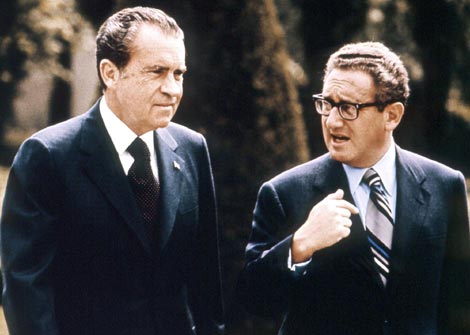
Thirty-six years after Richard Nixon's resignation and and 16 years after his death, his rivalry continues with his partner in peacemaking, Henry Kissinger. One of the most successful in the history of the presidency, their collaboration was rooted in factors other than temperamental affinity.

It's true that they may have liked one another more than they let on. Kathy O'Connor, Nixon's last chief of staff, tells a story about being with him at an event in New York City in the 1990s. She was standing in a hotel hallway outside the men's room door listening to Nixon and Kissinger inside as they teased each other and told corny gags in their growly baritones. In 1986, I sat with them for a hour while they worked out their disagreements over the wording of an op-ed about arms control they were submitting to the New York Times. The almost affectionate quality of their banter showed that they had a brothers-from-other-dimensions thing going on. When the debate finally came down to a choice between two words, after an uncomfortable silence Kissinger looked at me and said, "Vat do you tink?"

While in office, they were wary of each other at best. One of the reasons Nixon installed his taping system was so he could show who had been the principal architect of his administration's foreign and war policies, he or his brilliant, self-promoting professor. It was an historically bad move, because the the tapes' loose talk and vulgarity are so far making a balanced view of Nixon and his presidency almost impossible.

But on the narrow issue of what he feared Kissinger would say about the policy process "to his fashionable, liberal friends" outside the White House, Nixon seems to have had a point. The latest episode in Kissinger/Nixon began last week, when the Nixon library opened a recording made in the spring of 1973 which contained this exchange:
"The emigration of Jews from the Soviet Union is not an objective of American foreign policy,” Mr. Kissinger said. “And if they put Jews into gas chambers in the Soviet Union, it is not an American concern. Maybe a humanitarian concern.”

“I know,” Nixon responded. “We can’t blow up the world because of it.”
Jeffrey Goldberg calls Kissinger's comments "among the most vile ever spoken by a Jew about his own people." Kissinger's severest critic, Christopher Hitchens, also piles on.

I wrote last week about the irony of Kissinger's fears that the tapes would show him reacting fawningly to Nixon's outrageousness. As distasteful as the exchange is, it's possible to see in Nixon's response (avoiding all-out nuclear war is surely an appropriate imperative for a U.S. president to mention, even in this revolting a hypothetical context) the vaguest glimmer of a demur to Kissinger's Frankensteinian realpolitik.

It's also important to note that the Anti-Defamation League, while not defending Kissinger's comments, says they don't mean much compared with his lifetime of support for Israel. (Hat tip to Goldberg for the ADL release.)

Besides, in the end, how much exegesis can one blast of hot air really withstand? Was there a Soviet holocaust? No. Would Nixon and Kissinger have stood by and let one happen? Their harshest critics may think so. But no, they wouldn't have let it happen. How do I know? Because I talked to Nixon for about 12,000 hours over the course of 14 years, and you get to know a person.

While it would seem obvious that this big-guy BS had no operational relevance whatsoever, Marty Peretz, one of the few to rise to Kissinger's defense, thinks otherwise:

I know something about Kissinger's maneuvering for the Jewish state and for the Jewish people. I and a few Harvard colleagues were in touch with him, actually met with him during the dread days of the Yom Kippur War when Israel's very survival was at peril. (Henry Rosovsky, Samuel Huntington, Michael Walzer, Thomas Schelling and I comprised the group.) Dr. K. confided to us how difficult it was to persuade his bigoted boss that a great deal of American arms (and sufficient Lockheed C-130s "Hercules" aircraft to deliver them) were needed and needed instantly. There is no doubt in my mind that Kissinger rescued the third commonwealth with these munitions....

So, if Kissinger needed to flatter Nixon in order to convince him, that flattery was also a blessing.

Yep, there goes Henry again, Mr. President, trying to impress his friends at your expense -- and, this time, succeeding spectacularly. Peretz's argument seems to be that Kissinger made his awful comment in order to burnish his credentials (would that be as a self-loathing Jew?) so that, when the time came, he would have enough leverage to maneuver the beast into an Israel-saving move. The problem (besides that it's a dopey idea) is that there's no evidence that Nixon had to be persuaded by Kissinger or anyone else to send massive aid to Israel during the Yom Kippur War in October 1973. Some actually think it was Kissinger who wanted to hold back on the arms shipments, to improve Egypt's position in ceasefire negotiations (the U.S. was in the process of wooing Egypt away from its reliance on the Soviet Union, a major win for the realpolitikians).

More evidence that the Nixon tapes are both boon and bane, sometimes history, sometimes just hiss.

Thursday, July 30, 2009

Full Field Theory Of Watergate

This explains everything. My Facebook friend Joshua Harrell says Arlo Guthrie's "Alice's Restaurant" is exactly the same length as the famous missing tape segment.

37 Is Still A Lucky Number For Historians

Plenty of news this morning from Nixon historians, present and perhaps future. An amateur scholar working at the National Archives hopes to solve the enduring mystery of the 18.5-minute gap in a 1972 White House recording by trying to figure out what's on a missing page of chief of staff Bob Haldeman's notes from the same meeting. While it's hard to imagine that nobody figured out before now that there was a page missing, we shall see. Meanwhile, back in Yorba Linda, we meet some of the the Nixon Library's 20 summer interns.

Hat tip to Jack Nesbitt

Friday, March 6, 2009

Stanley's Splicer

Fred Graboske, who oversaw the initial review of the Nixon White House tapes for the National Archives, explains why he believes historian Stanley Kutler purposely edited a key Watergate tape to alter its apparent meaning.

Hat tip to Maarja Krusten

Sunday, February 15, 2009

Not Our Fault this Time!

The History News Network asked historian and former Nixon Project tapes archivist Maarja Krusten to explore why all the Nixon White House tapes haven't yet been opened. Though the reasons for the delay remain murky, her analysis makes clear that she doesn't believe the cause is the Nixon family, estate, or Foundation. She concludes:

After 2003, it should have taken 3 to 3-1/2 years to re-screen the remaining chronological segments. I had expected NARA to finish tape releases by the end of 2007 (or by the mid- to late 1990s, had it proceeded with plans formulated by officials in the 1980s). Instead, 32 years after I packed up tape reels in the White House, historians still await access to conversations from 1973.

Thursday, February 12, 2009

Do JFK Tape Gaps Add Up To 18.5 Minutes?

From Robert Dallek's An Unfinished Life, his 2003 biography of President Kennedy, Dallek describes the taping system Kennedy ordered the Secret Service to install in July 1992:
Three tapes, [authors Philip] Zelikow and [Ernest] May add, may have been "cut and spliced, for two of these tapes...concerned intelligence issues and may have involved discussion of covert efforts to assassinate Castro." It is also possible that embarrassing passages involving Marilyn Monroe and Judith Campbell Exner were removed. In addition, a small number of tapes may have been destroyed or lost. There are, for example, unopened transcripts at the Kennedy Library for four missing tapes, which may contain embarrassing revelations or national security secrets.