Showing posts with label John Fawcett. Show all posts

Tuesday, December 13, 2011

Turning On The Fawcetts

This morning historian and blogger Maarja Krusten writes:
John Fawcett retired in 1994 and became an archival consultant. NARA staff told me in the 1990s that he was advising the Nixon Foundation at one point but I only have anecdotal evidence of that. (I know John Taylor worked with Fawcett. I’ll have to ask John if this occurred in the form of a consultancy in addition to Fawcett having worked at NARA.) I thought of that, when I read [journalist Andrew] Gumbel state that the Nixon Foundation offered Sharon Fawcett a consultancy after she retired from NARA late this spring. Interesting echo, perhaps. Given the wording in Gumbel’s article, I don’t know if Sharon actually accepted the offer.
John and Sharon used to be married. John finished his long National Archives career at the beginning of the Clinton administration. His last post was assistant archivist for presidential libraries. Sharon served in the same capacity for many years and retired earlier this year. Both ended up being offered consultancies by the private Nixon foundation. Krusten is struck by the symmetry. I don't blame her.

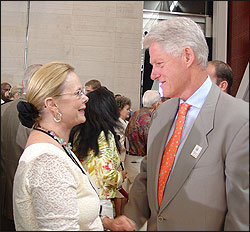
Despite their considerable influence across many years over how White House records are handled, they've managed to stay more or less below the radar. Though she's shown here with Bill Clinton, most of Sharon's Internet hits are consequences of the Nixon wars. A cursory Google search reveals no photos of John.

To answer Krusten's question, in the early 2000s, when I was Nixon foundation chief, I hired John (by then retired from NARA, where he helped engineer a curious, brief tilt to Nixon) as we prepared for the handover of the private Nixon library to the National Archives. Since 1991, our private reading room and archives had been operated by Susan Naulty. She was doggedly opposed to making the Nixon library part of NARA and later became a critic of director Tim Naftali, associating him with the left for inviting former White House counsel John Dean to Yorba Linda. Years before, during the battle between the Nixon foundation and Tricia Cox over the $19 million bequest of Nixon buddy Bebe Rebozo, Naulty developed a unwonted media profile by discussing the size of her staff with the Los Angeles Times. Her comments dovetailed with attacks by Cox ally Irv Gellman, who claimed that the library was poorly managed because we didn't give Naulty more resources. Gellman, Naulty, and her assistant had worked together closely when he was researching his book The Contender.

When we'd settled our lawsuit against Cox and Rebozo's money was safely ensconced in our endowment, we began to focus on facilitating a government handover. The headline on an earlier post reflects our midset: "Take My Library. Please." I became more curious about the differences between Naulty and NARA practice. Would we be able to stretch our resources further if she stopped refusing to use computers and processing records document by document, typing up one or more index cards for each letter, telegram, or memo (yes, Virginia, we had a card catalog)? The government processed folder by folder. So I invited John Fawcett, then working as an archival consultant, to take a look. He concluded that it would take Naulty hundreds of years to finish preparing our small cache of Nixon's pre-presidential records for scholars. When I hired a former Reagan library archivist to oversee a transition toward NARA practice, Naulty quit.

We don't know anything about the consultancy those now controlling Nixon's foundation have reportedly offered Sharon Fawcett. She and I agreed in 2006 that Naftali should redo the library's Watergate exhibit. I'm curious (and no doubt Krusten is as well) about why in 2010 she, as a top National Archives official, seems to have sided against Naftali in favor of the Nixon-turned-Haldeman foundation and a Watergate truth panel that included perjurer Dwight Chapin. As for John Fawcett, ironically enough, back in the day he helped the Nixon foundation nudge a little closer to National Archives practice and procedure.

Wednesday, March 30, 2011

Naftali Is Not The New Graboske

Tomorrow's opening of a new Watergate exhibit at the Nixon library in Yorba Linda should bring to an end a generation of courtroom and backroom wrangling over the residue of modern history's most comprehensive political scandal. In the 1980s, the argument was about what scholars and researchers would see in the archives instead of what the public would see in presidential museums. But in both cases, the same principle may well hold. Full disclosure for Nixon might end up facilitating full disclosure for his successors, and what prudent president would want that?

In the late 1980s, historian Maarja Krusten (shown below) was part of a team at the National Archives headed by Fred Graboske that prepared Nixon's White House tapes to be opened to the public. As they finished their work, NARA was under pressure from President Nixon and his lawyers (I was then his chief of staff) to slow down the process. Our argument was that, new laws and regulations notwithstanding, Nixon had a moral right to expect his materials to be handled more or less like those of predecessors such as Kennedy and Johnson, whose more controversial records, including tapes, remained under tight family control.

We were fighting a losing battle. Most in the federal government, the media, and academe seemed to believe that Watergate, Nixon's resignation, and congressional action had made him sui generis when it came to how his records would be processed.

That all changed in 1989 in the George H. W. Bush administration under archivist of the U.S. Don Wilson and his presidential libraries deputy, John Fawcett, a veteran of the LBJ library in Austin. We were assured that Nixon did deserve some grace after all, that the new laws and regulations actually did permit him to have something approximating the latitude that pre-reform presidents and their families enjoyed when it came to his most sensitive and controversial records.

To say that we were pleased is an understatement. And yet in politics, good news for one person is almost always bad news for someone else. The government's policy change had come at an awkward time, since Graboske's team had completed its work on the tapes, the most explosive records of all. You can study the nuances at Krusten's blog, NixoNARA, but the upshot seems to be that rather than saying to the award-winning Graboske and his colleagues that they'd done well but that the brass had decided to put the tapes back on a shelf for a decent interval, NARA officials decided the tapes needed to be re-reviewed. In other words, the tape review team, it was suggested, had done an inadequate job.

A few years later, after University of Wisconsin professor Stanley Kutler had sued Nixon and NARA to pry loose additional so-called abuse of power tapes that processors had identified, court proceedings as analyzed by Krusten show that the government wasn't entirely on the government's side:
Not only did the government not admit in 1992 that it had considered the Graobske-era processing final, despite contemporaneous documents showing it repeatedly used that term, lawyers working for the George H. W. Bush Department of Justice (DOJ) made selective use in their pleadings of information gathered in the discovery phase of the litigation. They rarely if ever quoted witnesses such as I, who had stated under oath that Graboske displayed no prejudice or bias against Nixon and never had said the president “has no privacy.”
Looking back, I've found it astonishing how solicitous the first Bush administration was toward 37, who had almost no policy or political leverage outside of his trademark issue of foreign policy. I doubt that it was an act of friendship by an incumbent to a former, since the Nixon-Bush relationship struck me as cordial but cool. Another possibility -- and here is where journalists and historians must go where bloggers rarely tread -- is whether the Bush administration had come to the natural-enough conclusion that slowing down the train delivering former President Nixon's records to scholars might have been a helpful precedent for future formers.

If so, the records battle was finally lost (or won, depending on one's perspective). We settled the Kutler lawsuit after Nixon's death in 1994, paving the way for the tapes to be opened by the early 2000s (they'll finally be entirely open in 2012). Presidential records are now managed according to congressional and agency mandates, and while there will always be judgment calls and controversies, the process has been largely regularized for presidents both Republican and Democratic.

But that still leaves the curatorial side of presidential libraries' work and the possible perceived precedent of the no-holds-barred Watergate exhibit that former archivist of the U.S. Allen Weinstein commissioned from the first federal director of the Nixon library, Cold War scholar Tim Naftali. In 2009, the Nixon foundation approached the other private library foundations and tried to get them to criticize Nixon's federal director for inviting Watergate figure John Dean to give a speech. The obvious intent was to panic friends of other formers into thinking that Uncle Sam's John Dean event in Yorba Linda presaged a keynote by special prosecutor Ken Starr in Little Rock and other post-White House horrors. As Naftali proceeded with planning the Watergate exhibit, did those controlling Nixon's foundation try yet again to rally the post-presidential faithful by raising fearful specters of worst-case museum cases: Displays featuring Monica's dress at Clinton, even more room for Iran-contra (a worse scandal than Watergate, some believe) at Reagan, and alleged Bush-Cheney torture policies at Texas's newest presidential library?

If so, then one can imagine that considerable pressure may have been brought to bear on Naftali over the last couple of years. But at least we can say that he's not the new Graboske, because the exhibit's opening tomorrow.