Showing posts with label St. George's Cathedral. Show all posts

Thursday, July 5, 2012

Out On the Palestinian Streets

St. John's pilgrims Ed and Cathy Alosio are pictured on the streets of east Jerusalem near the Holy Land Hotel, headquarters for a week during our recent pilgrimage to Israel and the West Bank.

It was a considerable change of pace compared to my three prior trips, when our groups stayed at the pilgrim guest house of St. George's Episcopal Cathedral. This time we stepped easily into the bustling life of what Palestinians hope will be their capital someday. The main drag, Salah al-Din, was around the corner, which meant we were a few steps from newspapers, the post office, a cafe with cappuccino and croissant, a florist (where pilgrim Kathe Hayden made friends with the proprietor by showing him some arrangement tricks), soccer courts (where Bob and Steven made friends playing baseball), shops selling pistachios and za'atar (a tasty blend of herbs, sesame, and salt; try it on fresh warm bread in the morning), and delicious shawarma (think Arab gyro).

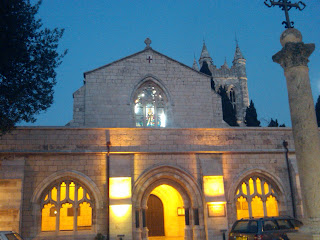
St. George's, which is finishing up with some renovations, has considerable charms. Our friend Canon Iyad Qumri took us by one morning for a visit with the new cathedral dean, the Very Rev. Canon Hosam Naoum, and our LA diocese friend, Deb Neal (pictured with the Rev. Lisa Rotchford, at left), now serving as secretary to the bishop of the Diocese of Jerusalem. The beautiful cathedral close, on a quiet stretch of Nablus Rd., was a longer walk than our hotel from the Damascus and Herod gates, which we pilgrims used for our daily and nightly excursions to the Muslim, Christian, Armenian, and Jewish quarters.

At the comfortable Holy Land, presided over by its courtly Muslim owner,
Zuhair Al-Amad, and his good-humored and patient reception director, Fawaz Takrouri (whose young assistant tore himself away from watching the Euro 2012 tournament in the hotel bar long enough to show me some card tricks), we couldn't help feel more connected to the city and encouraged to explore and rub shoulders, observe the pace and style of commerce, and indulge our curiosity about varying styles of women's dress according to Muslim tradition (a preoccupation of all western pilgrims) as people walked to and from jobs and shopping.

One night Kathy and I and pilgrims Christian, Shannon, and Damian Kassoff were exploring when, shades of Greenwich Village, we encounte
red an art happening -- a group of young people wheeling a projection system along the sidewalk looking for blank walls for their screen. We also organized a pilgrimage to the historic American Colony Hotel, where $130 bought a round of drinks and the privilege of imagining we had spotted the ghosts of Edward Said and Christopher Hitchens drinking and laughing at a table in the corner of the garden.

Tuesday, January 10, 2012

"Merry Christmas," Said The Jew And Muslim

Deb Neal, my Diocese of Los Angeles colleague, is serving as assistant to the Episcopal Bishop of Jerusalem at St. George's Cathedral in East Jerusalem. She's written a moving post about Christmas in the Holy Land, including the trip back to Jerusalem from Bethlehem's Church of the Nativity on Christmas Eve:
And because God is Good, and to remind me what it is really truly all about, and to make the evening truly blessed, as we passed through the horrid wall on our way home, the young Israeli guard wished me Merry Christmas. As you can imagine, I welled up and thought: This is where I see the hope. And oddly enough, the only other person to say Merry Christmas to me (other than in the church) was a Muslim shop keeper in Nablus. Aaah, Peace and Goodwill to all. I like it!

Friday, March 4, 2011

Bishop's Move

As bishop of Jerusalem, the Rt. Rev. Suheil Dawani, a Palestinian, presides over 7,000 Episcopalians in 60 parishes in five countries. The diocese also operates a famous hospital in Gaza and schools that serve 35,000 students (almost all Muslim). I took this picture of him in 2007. This January we St. John's pilgrims were back at his headquarters, historic St. George's Cathedral in east Jerusalem. We didn't see Bishop Suheil, though his colleagues in the diocesan offices seemed to be working late every night.

Now we know why. Since last August, the bishop and his family have been quietly challenging Israel's decision to deny them a renewal of their residency visas. Anonymous parties have made charges about real estate deals which he strenuously denies and which may result from rivalries within the diocese (oh, we church people!). Several governments and Buckingham Palace have all weighed in to try to solve the problem diplomatically. The matter became public this week when he filed a lawsuit. As the British Guardian reports today:

A senior church source outside Israel said: "No one can figure out what the Israelis are playing at. This is not the kind of message they should be sending out. They really don't need to be doing this. Dawani is a very decent, good man and no one has produced any evidence against him. As far as we can tell there is no substance to any accusations."

The bishop's office said: "This situation has continued for over six months as Bishop Dawani attempted to resolve this with restraint and without causing the government of Israel embarrassment. The lack of resolution, despite all the efforts, required [him] to seek legal counsel ... upon the recommendation ... he has chosen to take the case to court, seeking redress through the Israeli legal system."

In London an Israeli embassy spokesman said: "Israel is not interested in any unnecessary delays but the allegations are still under official review. We understand it is causing damage as long as it remains unresolved."

Friday, January 21, 2011

Pilgrims' Progress: A Last Morning In Jerusalem

Beginning before dawn Saturday, we walked along the Via Dolorosa through the Old City of Jerusalem, ending in the Church of the Holy Sepulcher. Each of us had one more moment to touch the rock of Golgotha and hear the chants and the organ and smell the incense and meet the lively eyes of pilgrims from all over the world and come as close as we could to our God in Christ. For that, there are no words, and the best pictures are the ones we can't quite show you. To experience it yourself, ask for God's grace, and if you can, come to Jerusalem. As our guide, we used A Walk In Jerusalem: Stations Of The Cross by John Peterson, former dean of St. George's Cathedral and secretary general of the Anglican Communion.

Fr. Fergus Clarke, a Franciscan assigned to the Holy Sepulcher, told us yesterday that, based on what we know about the first century role of women, if Mary Magdalene hadn't been the first witness to Jesus Christ's resurrection, nobody would have gone to the trouble of making up a culturally incorrect story claiming that she was. Imagine that: Proof both that Jesus rose again and that men are wrong to keep women down in the church. This sculpture hangs behind the altar in the Holy Sepulcher's Chapel of St. Mary Magdalene.

If anyone tells you that Christians can't agree on anything, tell him this: We agree that Jesus rose from the dead at a spot about 20 paces behind pilgrim Andrea. The building, called the Edicule, and the slab it encloses are relatively new. Beneath them is the rock of the tomb itself, which people have venerated since the resurrection moment. Fr. Fergus told us that when the Romans tried to obliterate it in the second century and built a Roman temple in its place, Christians dug a secret tunnel under the temple and found the tomb.

Pilgrim Kathy met a friend at the Holy Sepulcher this morning: Cardinal Theodore McCarrick, former archbishop of Washington, D.C. You may remember him from the memorial service at Washington National Cathedral following the Sept. 11 attacks. Kathy knows him through her work as former President Nixon's last chief of staff. While the cardinal had been to the Holy Sepulcher many times, this was his first visit to the Adam Chapel, where the split rock of Golgotha is visible through a window behind the altar.

Looking Better For Palestine, Worse For Israel

The Middle East is a land of paradox, and the one I've been grappling with during our 12-day St. John's pilgrimage is why Arab east Jerusalem (home of our pilgrim guest house at St. George's Cathedral) seems so calm when prospects for peace between Israel and the Palestinians have dimmed so dramatically over the past few months.

It's not that there's any immediately apparent reason for optimism. Israel has resumed its provocative settlement expansion in the West Bank and east Jerusalem. As U.S.-brokered peace talks languish, Palestinian officials are maneuvering, against U.S. wishes, for a UN resolution to condemn the settlements as a major obstacle to peace -- the first step, perhaps, toward a dangerous unilateral proclamation of a Palestinian state. Israel's security wall, which in places seems to have more to do with separating Palestinians from one another than terrorists from Israel, remains a scar on the landscape.

Yet thanks to Israel, Palestinians are able to move around the West Bank more freely than during my pilgrim visits in 2007 and even 2009. Its economy grew by 9% in the first half of 2010. The Fatah-controlled government in the West Bank is getting higher marks, too, especially Prime Minister Salam Fayyad (below left), who in one friend's book is doing so well that he told me he sometimes worries that extremists on the Palestinian side will be tempted to use extreme measures against him. As with all politicians, not everyone agrees that Fayyad's the savior. Another friend said, "The joke you hear is that for years Palestinians have been praying for salaam [peace], and all they got was Salam."

What seems most promising is that Fayyad is using the region's growing economic clout for jujitsu moves such as forbidding the sale within Palestine of any goods manufactured in Israeli settlements. The West Bank's government got a further boost this week when Russian president Dmitry Medvedev, despite Israeli efforts to interfere, paid the first visit ever by a top Russian leader and reaffirmed Moscow's support for a Palestinian state.

What a change since the Cold War, where the Middle East was a superpower flash point, with the U.S. backing Israel and Moscow, the Arabs. As we made our way back Wednesday from visits to the West Bank towns of Nablus and Zababdeh, we had to slow down briefly because of a highway improvement project funded by U.S. tax dollars. The day before in Washington, the PNA's diplomatic mission in Washington raised the Palestinian flag for the time, with tacit U.S. support. One wonders if it will be much longer before the Obama administration decides to make U.S. aid to Israel contingent on more cooperation in the peace process.

After a while, if Palestine looks, acts, and thrives like a state, it's going to be a state. Perhaps that's the source of the air of optimism we're feeling amid all the tantalizing excuses for pessimism. That a Palestinian state is picking up momentum may also explain why Benyamin Netanyahu seems to be doing everything he can to put on the brakes, because here's no denying that Palestinian statehood is a risky road for Israel.

The other day our pilgrim band heard from Bernard Sabella of Bethlehem University, an Arab Christian who's an expert on the nettlesome problem of Christian emigration from the Holy Land. When I asked him about the recent warning from Arab Israeli journalist Abu Toameh that if Palestinians got a state tomorrow, leaders from the Israel-must-die Hamas party would be in control of its government the day after that, Sabella said, "Not necessarily." How reassuring that must be to Israel. I've also encountered those who believe that a Palestinian state is the first step toward a one-state solution, which would inevitably destroy the viability of a Jewish homeland. Polls make clear that this sentiment is still widespread among Palestinians.

We may hope that the distractions of building their own state would eventually diminish the desire to end Israel's. But while I end my third pilgrimage with a renewed sense of optimism about prospects for Palestinian self-determination, I have a deepening concern about Israel's long-term security. If Israel's current policy is born not of mere intransigence but a feeling of existential threat not just from Iran but also from the increasingly concrete prospect of a future Palestine, I don't see how anyone can realistically expect the policy to change anytime soon.

Wednesday, January 12, 2011

Pilgrim's Progress, Day 2: Transfigured

Hey, preachers! You might consider hanging some ostrich eggs in front of the pulpit, as in one of the ornately decorated Greek Orthodox chapels in the Church of the Holy Sepulcher. We St. John's pilgrims learned from the man in charge that ostriches don't incubate their eggs after laying them. Instead, they watch over them from a certain distance. Accordingly it's thought that ostrich eggs hanging in front of the iconostatis compel the congregation's attentiveness to the preacher.

More modern knowledge about ostriches is considerably more harrowing if also, perhaps, still ecclesiastically helpful. Ostriches do incubate their eggs, though in communal nests, with females (after removing the eggs left by weaker females) sitting on them during the day and males doing the honors at night. So it actually sounds like another good argument for women's ordination.

Ostriches also don't stick their heads in the sand. Nor could we pilgrims this morning, after we had begun our day with breakfast (plentiful pita and humus!) and morning prayer. Our guide, Canon Iyad Qumri, asked each of us to say what we'd left behind and what we hoped to take home from the Holy Land. Some moving stories were told and tears shed. One pilgrim worried about a chronically ill relative. Another said she'd come because this time last year, she collapsed in her home, where she might've died if an attentive church friend hadn't checked up on her.

Shared stories and experiences are already helping our pilgrims, who come not just from California but Iowa (pilgrim Debbie) and Florida (pilgrims Carl and Virginia), bec0me a family -- or at least a highly mobile new congregation. Just today we explored a first-century excavation beneath the Damascus Gate, worked our way through the Muslim Quarter, heard the Book of Acts read out by an Ethiopian priest, lunched at a Lutheran guest house on a sturdy meal of schnitzl, potatoes, and beans (our last meal without humus for the next ten days), left our prayers in the Western Wall, caught a glimpse of the the latest Israeli demolition project roiling the politics of east Jerusalem, said evening prayer in the chapel of historic St. George's Cathedral, and heard a young Nazareth-born Arab-Palestinian-Israeli priest, the Rev. Canon Hosam Naoum, talk about his four-square identity and the challenges of being one of 170,000 Christians left in Israel and the West Bank.

So much more to say about our first day of pilgrimage, and so many extraordinary days to come. The happy obligation of leading compline in a few moments and the lead weight of jet lag tugging on my eyelids prevent my writing more -- except to add that my wife, Kathy, has once again been transfigured by the Holy Land.

Tuesday, January 11, 2011

Pilgrims' Progress, Day 1: Safe At St. George's

While Farid, a member of the staff at St. George's pilgrim guest house in east Jerusalem, always welcomes me (and everyone, I imagine) with a bear hug, this is the first time I stopped and asked where he's from. "Zababdeh, in the West Bank," he said -- and that was a Holy Spirit moment, because we 30 St. John's pilgrims will visit his home town a week from tomorrow. Farid's a Roman Catholic. We'll meet his Episcopal friend and colleague, the Rev. Nael Abu Rahmoun, at St. Matthew's in Zababdeh and get a tour of the Penman Clinic, a ministry of the Episcopal Diocese of Jerusalem, the hosts of our 12-day pilgrimage.

The spirit has surely been with us so far. Because of the storms in the southeast, nearly 2,500 U.S. flights were canceled Monday, mostly in Atlanta. For us to make it to Jerusalem tonight, three Delta flights into or out of Atlanta had to operate -- the two we were on and the one supplying the 777 for our outbound flight to Tel Aviv. Above you'll see a concourse the busiest hub in the world at 8 p.m. Sunday evening. The airport was so empty that the security guard in our part of the terminal spent an hour in the lounge, watching the Oregon-Auburn game with pilgrims Andy and Duane. Sure, we left Atlanta nearly four hours late, which included a noisy, hour-long chemical baptism for the 777, aka a deicing. But it's pretty amazing under the circumstances that we even made it out of California.

Our guide and friend Canon Iyad Qumri met us at Ben Gurion airport and joined us in reading Psalm 87 as we began to make our way by bus up to Jerusalem. It's the psalmist's miraculous vision of a city embodying the fulfillment of God's vision of perfect unity for his people: "Of Zion it shall be said, 'Everyone was born in her'." Within two hours of our arrival in Tel Aviv, we were gathered over a late-night snack in the St. George's dining room, marveling at the practical miracles that had brought us so far against such odds. Pilgrims Kathy and DJ even ventured onto the roof for a glass of pilgrim Chardonnay.

We'll spend tomorrow getting our bearings in the Old City, whose Damascus Gate is a 20-minute walk away down Nablus Rd., past the U.S. Consulate. We'll be the Lutherans' guests for lunch and get our first look at the ineffable Church of the Holy Sepulcher. It will be hard for days 3-12 to top that -- but remember, as people here always say to explain every surprise, ambiguity, and sheer wonderment they encounter: This is the Holy Land. We anticipate a great pilgrimage, and not just because God and Delta Airlines expended a considerable amount of energy getting us here.

Sunday, January 9, 2011

Come With Us Pilgrims. Come To Jersualem!

While there's no wrong time to go to Jerusalem, a moment of trauma -- whether global, national, or personal -- may be the best time of all.

Weather permitting, 30 pilgrims from St. John's Episcopal Church depart tomorrow, LAX-Atlanta-Tel Aviv, and then, on Tuesday afternoon, up to Jerusalem by bus. If the Holy Spirit is at our backs, we should be standing before the Damascus Gate of the Old City by dinnertime, the abundant life of the Muslim Quarter swirling around us. If past experience is any guide, we'll be exhausted -- it will feel like the end of one long day -- and exhilarated at the same time, the way anyone feels coming home after a long journey.

I took the photo above on an earlier pilgrimage, inside the Church of the Holy Sepulcher, where the light seems to embrace the small inner chapel where the church believes that Jesus Christ's body was laid after his crucifixion. Experts' best guess is that his death, burial, and Resurrection all occurred inside of a few hundred square feet. Surely there's no better place -- along with the Western Wall -- to take our prayers for Rep. Giffords and Saturday's other victims, their alleged attacker, ourselves, our families, our church, our country, and all who are in need in our glorious, broken world.

If you like, follow along with us by checking in here every day. Eight nights out of 11, we'll be at the pilgrim guest house at St. George's Cathedral in east Jerusalem, where visitors enjoy the peace of Christ and free in-room wireless.

Tuesday, November 30, 2010

Epiphany In The Land Of Light

From our newly digitized St. John's parish newsletter (thank you, Cindy!), my Advent anticipation of an Epiphany adventure with 29 friends in faith:
As our Vaya Con Dios experiences the flowering of new life, the latest group of St. John’s pilgrims is getting ready to say vamos a Dios. We’re going to God, or, at least, to the place where God did his most mysterious, magnificent work by the Resurrection of our LORD Jesus Christ. We’re heading for the holy city of Jerusalem in January to walk in the footsteps of Jesus and his family and followers, experience the quiet majesty of the Church of the Holy Sepulcher and Sea of Galilee, and leave the prayers of our church and school community tucked into the ancient crevices of the Western Wall.

It will be the second pilgrimage for St. John’s Church and the third for your vicar. We’re taking a group of 30 this time. We’ll divide our time between Jerusalem and Nazareth, with plenty of side trips along the way.

We’ll see ancient sites, and modern ones. We’ll imagine ourselves walking the hills of Palestine in Jesus’s time, and we’ll experience something of the tension and anger between Israelis and Palestinians today.

Why do we go? What’s the most special part of making a pilgrimage? Each pilgrim, you’ll find, will have a different answer. When I visited the Holy Land for the first time in the summer of 2007 with a group of seminarians and fellow priests, I had a feeling of belonging, almost of homecoming. Within a few days, I knew I’d be back – and I was pretty sure I could talk Kathy and some of my St. John’s brothers and sisters into coming along.

Sure enough, about 20 of us visited in the summer 2009. If you saw the presentation in the multipurpose room on our return, you know that we floated in the Dead Sea, touched the damp rock in the Bethlehem cave where the Church believes Jesus was born, and even walked along first-century streets (literally, perhaps, in the footsteps of Jesus, Mary, and Joseph) that had been excavated deep beneath our pilgrim guest house in Nazareth.

Our Epiphany 2011 pilgrimage will be in the Middle Eastern winter, which, we’re told, is a lot like a Rancho Santa Margarita winter. It may be a little chilly at night, and we could get some rain and even snow. Each day, we’ll worship and pray and experience moments of deep fellowship and profound silence. We’ll enjoy quiet evenings in the garden of St. George’s Cathedral in East Jerusalem and explore the labyrinthine streets of the Old City. We’ll laugh, shop, eat and sleep well, and spend a lot of our time with our mouths hanging open as we say to my fellow guide, Canon Iyad Qumri, “Wow!” (He says that’s the word Americans use most often in the Holy Land.)

And when we return, we’ll tell you all about it, and ask when you’d like to go!

Friday, August 20, 2010

Shalom Salaam Peace

Good news: President Obama plans to host Abbas and Netanyahu in September. The talks should be well underway when our St. John's pilgrims arrive in East Jerusalem in January 2011. At the pilgrim guest house at St. George's Cathedral, where Palestinian activist Edward Said went to church, and around the corner in the garden lounge of the famed American Colony, where diplomats and journalists huddle and you half expect to see Graham Greene walk in, and down the street at the Christmas Hotel, where mentioning the name of my spiritual director, Joyce Cottage, will get you a free drink, we'll have plenty of opportunities to to get a variety of Israeli and Palestinian perspectives on the talks and issues even as we walk in the footsteps of Jesus Christ and his family and followers. And we'll pray for the peace of Jerusalem!

Monday, August 3, 2009

Jerusalem Vesper Light

We began our day with a reading from Mark 4, where Jesus beseeches us to let our divine lights, our singular and most authentic selves, shine in the world. Tonight, St. George's Cathedral was making the most of its true lamp stand nature, glowing brightly on a cool, breezy Jerusalem evening.

The first full day of a retreat can feel like a lifetime. So much happens to enliven the senses and spirit and banish the everyday. As the Palestinian National Authority prepares to convene a summit meeting beginning on Tuesday in Bethlehem, the light of Christ shone like a light bulb going off in Canon Iyad's head. With 4,000 PNA soldiers gathering to protect their fractious politicians (as of today, Hamas said it wouldn't permit Fatah members from Gaza to attend), he said we should probably visit Bethlehem today instead of tomorrow. How wise he was, as always. The place was already crawling with soldiers. Tomorrow we might actually have been turned away.

The afternoon light shone in the window of St. Jerome's chapel in Bethlehem's Church of the Nativity, where tradition holds that the great scholar produced the indispensable Latin Bible known as the Vulgate. As a group of Spanish pilgrims sang "Adeste Fideles" during mass in the Franciscan church upstairs, we sang "O Come All Ye Faithful" downstairs. When seven of us took a late-evening walk through darkened maze of the Old City, the fresh-squeezed orange and grapefruit juice we enjoyed seemed to be sunlight itself. I even saw a twinkle in the eye of the young Israeli soldier who came onto our bus at a checkpoint to inspect our passports. Her semiautomatic rifle, half as long as she was tall, banged against our shoulders as she walked down the aisle. She smiled sweetly as she asked how we had enjoyed Bethlehem.

And yet her qualities would have been lost on those West Bank Palestinians whose lives are disrupted by Israeli security measures. Iyad said he used to take groups to Bethlehem just to get ice cream after lunch. Nowadays the eight-mile round trip can take half a day. Palestinian Catholic priests have to show movies about the Church of the Holy Sepulcher because their Arab students find it to hard to visit it in person. So many lovely, gracious people here. So much light and hope. So much faith. So much work to do.
Sent from my Verizon Wireless BlackBerry

Sunday, August 2, 2009

Strength For The Day

At St. George's Guest House in Jerusalem, the hospitality is warm, and the coffee is delicious. Pilgrims from St. John's compared notes on their nights' sleep and cell connectivity while enjoying scrambled eggs and toast, pita and hummus, cucumbers and yogurt, cheese and grapes. We gather in a half hour for morning prayer -- and then we're off!
Sent from my Verizon Wireless BlackBerry

St. George's Jerusalem, Monday Morning

Sent from my Verizon Wireless BlackBerry

Wednesday, July 8, 2009

Jerusalem Meets Anaheim

When 20 pilgrims from St. John's visit Jerusalem, Bethlehem, and Nazareth in August -- whether bobbing in the Dead Sea, touching the rock of Golgotha, or walking streets Jesus Christ may well have known -- we'll be in the tender care of Canon Iyad Qumri, renowned Holy Land guide and interpreter. I caught up with Iyad today at the Episcopal Church's General Convention in Anaheim, where he's a guest along with his wife, Simone, a member of the staff of St. George's Episcopal Cathedral and College in East Jerusalem, where we'll be staying in August. And yes, that's Pastor Karen, our distinguished former associate vicar.

On Friday night, Kathy and I are taking the Qumris to President Nixon's favorite Mexican restaurant. Who knows what it's called?

Thursday, January 1, 2009

What We Do Today And Tomorrow

Israel's attack on the radical Islamist group Hamas in the Gaza Strip is in its sixth day. These details from a New York Times report help underscore the cultural gulf between the combatants in this heartbreaking New Year's war, in which about 400 have died so far (between a tenth and a quarter of them civilians):
The Israeli air force on Thursday afternoon bombed the house of Nizar Rayyan, a senior Hamas leader, killing him along with two of his wives and four children, Palestinian hospital officials said. Mr. Rayyan was the first high ranking Hamas figure killed so far in the Israeli campaign.

The Israeli military confirmed the strike and described Mr. Rayyan, who was 46 and lived in Jabaliya, north of Gaza City, as an extremist who had helped plan suicide bombings and had sent his own son on a suicide mission in 2001.
Rayyan was a polygamist who sent his son to die in a suicide mission and purposely exposed other family members to death today. I don't write that to call him names. They're the bald facts of the life he chose to lead.

Tolerated or encouraged in most of the Islamic world, polygamy is countenanced by the Koran and is thought to have been practiced by the prophet himself. It is said that after his first wife died, he took others to protect them from economic privation. While the practice has its proponents in the West (I was surprised to learn that the Utah ACLU opposes the LDS's ban on multiple wives), it's inconsistent with modern principles of equality and mutuality among free individuals. The Koran, it should be noted, does not permit women to take up to four husbands. Polyandry was never a Mormon practice, either.

By devaluing women, polygamy seems to encourage the kind of deep-set thinking whereby a military leader is excused and even celebrated by others in his culture for keeping his family close to him even when he's being targeted by an enemy, as Rayyan has known to be the case since the Israeli bombardment began. Instead, the Times recounts, he refused to leave his home, and even took reporters up on the roof to to call further attention to himself (and of course the women and children living downstairs). Had he survived, as the wording of the article suggests, he had even more women and children to offer as martyrs. After all,
Mr. Rayyan was known in Gaza ...as a popular Hamas preacher who openly extolled and championed the idea of martyrdom.
Women such as Rayyan's wives are victims both of historical circumstance and the males in authority in their culture and families. As long as they are willing to keep following orders and give their lives for the sake of destroying Israel, the war will go on.

In fairness, something similar (but not the same) can be said about those who are willing to serve in the Israeli Defense Forces. All wars ultimately depend on the willingness of soldiers to fight. But that is as far as the moral equivalence goes. Whatever Israel's own sins or excesses, Hamas is getting exactly what it wanted this week. The purpose of its missile attacks on Israel was to provoke a disproportionate response that would emasculate the Palestinian Authority's president, Mahmoud Abbas, who heads the more moderate Fatah party in control of the West Bank. Protesters filling the Arab street are playing their parts as well, condemning an attack on Hamas that Hamas did everything it could to bring about. This wasting circular logic will continue until someone, or a preponderance of someones, finally says, "Stop."

As I wrote in March 2008 after Al Abu Dhaim's murderous attack on a seminary in Jerusalem:
The operation fit perfectly into Hamas’s plan to promote chaos by provoking Israel and ultimately discrediting Abbas in the eyes of his people. It’s what violent extremists so often do — destroy hope by attacking the center and by exposing everyone residing there to the temptation of becoming violent extremists themselves in their grief, rage, and sheer frustration.

So how can the world’s responsible voices not join in support for Olmert and Abbas, Bush and Rice? How can we not keep faith with the hope that Israel and Palestine will someday live in peace, side by side? How do we keep extremists from wresting control of events from those who are committed to peace? Palestinians I know seem prepared for this work..., prepared to live into the truth that God wants them to share the Holy Land. Last summer I spent over a week in Al Abu Dhaim’s own east Jerusalem, albeit in the cloistered grounds of St. George’s Cathedral, seat of Jerusalem’s Episcopal bishop. Bright young Arab Palestinian Anglicans (better read that twice) working, studying, and worshiping at St. George’s reminded me of Cold War-era Muscovites in that they were capable of sitting up until after midnight one night after another talking about politics. Their brief against Israel is as heartfelt and seemingly cogent as Israelis’s against them. One is tempted to choose sides and then compelled not to, both by a newcomer’s humility as well as the feeling that Israelis and Palestinians could play they-did-it-first all the way back to Abram and the Amalekites without resolving anything. In the end, all that matters (this is admittedly a theological statement more than a sophisticated political position) is what we do today and tomorrow.