Showing posts with label Jerusalem. Show all posts

Wednesday, July 18, 2012

A House Divided (And Not Beelzebub's)

Covering this week's Christians United for Israel rally in Washington, D.C., Natasha Mozgovaya gets to the nub of the matter thanks to one of the speakers, Rabbi Shmuley Boteach, who's running for Congress in New Jersey:
Boteach [discussed] the notion that such Christians are interested in Israel only to bring about the second coming of the messiah. "Judaism is clear that action is more important than intention, it's not motivation that matters. I also don't buy it that Christians love for Israel is a pre-condition for the return of Christ. I do believe it's sincere. I think it's based on a true desire to connect to the origins of Christianity,” said Boteach.
While their love is undoubtedly sincere, I don't think there's any question that the main source of conservative evangelicals' relatively new-found passion for Israel's security is what they think the Book of Revelation foretells about Jesus Christ's return at the end of days. In pursuit of their vision, some have made common cause with ultra-Orthodox Jews in Israel who are planning to rebuild the Jewish temple -- on the Temple Mount, that is. You can make a contribution to the non-profit organization in Jerusalem that is already manufacturing the furnishing and fixtures. Of course there's the small complication that building the Third Temple would require the destruction of two medieval installations to which the world's Muslims are considerably attached, the al-Aqsa mosque and Dome of the Rock, as well as the recommencement of ritual animal sacrifices by temple priests. These Jews are trying to set the stage for the return of the Messiah, too, though they don't think he'll look like Jesus, much as the Rev. John Hagee (who also spoke at the conference this week) may hope and pray otherwise.

The motive behind these Christians' devotion to Israel makes no sense to me, because I don't read the Revelation to John the way they do. Its author was an authority on the tyranny of late first-century Rome, not the geopolitics of the 21st century Middle East. Besides, it strikes me as the height of pride for a pastor, rabbi, or theologian to think that the LORD is going to bring all things to completion in our particular lifetime. It reminds me of believers in reincarnation who naturally prefer the idea that they were someone such as Cleopatra rather than a slave who died one afternoon while chiseling a stone for the pyramids. Nothing like putting yourself and your generation at the climax of the whole story of the universe.

While these Christians are entitled to their interpretation of Holy Scripture, which places Israel at center stage for the end of days, I wonder how much Christian compassion they have for Palestinians who have been living under military occupation on the West Bank since 1967. This population includes Christians whose perspective on Israel differs dramatically from Pastor Hagee's. Those we St. John's pilgrims met on our recent visit to Israel and the West Bank reminded us that Palestinians have been worshiping Christ longer than than anyone -- since the first Pentecost, they like to say, when the Holy Spirit anointed the faithful from all over the region as they gathered in Jerusalem. Scriptural interpretation aside, their two-millennial perspective helps them resist the idea that all things are coming to a head next year or next Tuesday.

Unfortunately, as theological lines are being drawn, so too are political ones. In the mainline denominations, a reflexive tendency to blame Israel is taking hold, in part the result of go-slow policies of the Netanyahu government when it comes to the peace process. Our conservative brothers and sisters seem to be reflexively opposed to the Palestinian perspective. That's not good for anyone. As in all situations where people of faith have the opportunity and indeed are commanded to make the world better, guess who wins when the body of Christ is working against itself to the almost comical extent on display in the Middle East. For extra credit, where did Abraham Lincoln get the idea for his "house divided" speech?

Wednesday, July 4, 2012

Bob's Guitars And Sami's Stoles

We St. John's pilgrims are shown the other morning on the roof of east Jerusalem's Holy Land Hotel, with the Dome of the Rock behind us and Herod's Gate on the right. First row: Damian, Brenna, Remy, Canon Iyad, and Steven; second row: Alexandra, Cindy K., and Allana; back row: Bob, Kathe, Christian, Shannon, Debbie, Fr. Mike, Fr. John, Kathy, Cindy D., Pastor Lisa, Ed, Cathy, and Jerry.

My t-shirt signified not me but a guitar brand. Later that day, at the Church of St. Peter in Gallicantu on the eastern slope of Mt. Zion in Jerusalem, it enabled me to bond with an American pilgrim who said he was a colleague and friend of Taylor Guitars founder and CEO Bob Taylor. "I have guitar #200," he said. In the church dedicated to remembering Peter's denial of his savior, I wrestled with the sin of envy.

From Taylors to luthiers to tailors: One day last week, I took my friend and colleague the Very Rev. Canon Michael Bamberger to meet Sami Barsom, who's had the same shop on St. Mark's St. in the old city for over a half-century. In his customary fashion, he brewed and served coffee and spoke to us graciously while receiving the greetings of every third person who wandered by his shop -- Christians, Arabs, Jews. As lay leader of the local Syriac Orthodox community, his contacts are prodigious. He got out a picture Lord Snowdon took many years ago showing him with Jerusalem's legendary mayor, Teddy Kollek. And yes, Mike and I each bought one of his beautiful handmade stoles.

Monday, July 2, 2012

Cross Beam

On Saturday morning, the rising sun pierces the cross Canon Iyad Qumri is carrying as he leads St. John's pilgrims toward the Herod Gate of Jerusalem's old city, where we'll walk the stations of the Cross.

Saturday, June 30, 2012

Divine Polyphony

On Thursday, as the sun set over Jerusalem, we pilgrims gathered on the roof of the Holy Land Hotel for an abbreviated service of evening prayer. "O gracious light," we said, "pure brightness of the everliving Father in heaven...Now as we come to the setting of the sun, and our eyes behold the vesper light, we sing your praises..."

But this was Jerusalem, so we weren't praying alone. No one ever is. When the time came for the Lord's Prayer, our voices were blending with those of muezzin calling Muslims to their sunset prayer (7:55 p.m. in Jerusalem, or about ten minutes after our service had begun). I could distinguish at least two chants, and there may have been three. Our hotel in east Jerusalem had three minarets within sight. So we joined hands and joined our voices to those of the muezzin and chanted the Our Father using one of the settings from the Episcopal hymnal.

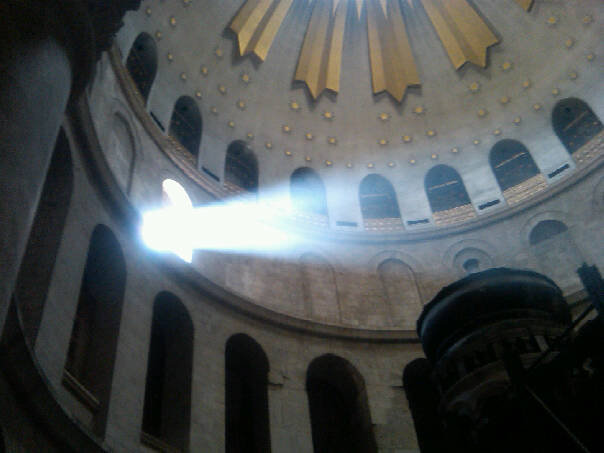
You could say the moment was holy polyphonic. We weren't arguing or trying to drown out theological competitors. There's more than enough of that in Jerusalem without our adding to the mayhem. Something similar happens every day during scheduled worship in the Church of the Holy Sepulcher, where we got a behind-the-scenes tour on Friday afternoon from Rev. Fergus Clarke, one of the Franciscan priests who work with five other denominations -- Greek, Armenian and Syriac Orthodox, Coptic, and Ethiopian -- to operate and care for Christianity's holiest place. Fergus reminded us that his is the only church in the world where denominations worship simultaneously in different languages -- for instance Coptics and Roman (or Latin) Catholics at opposite ends of Christ's tomb, within 20 feet of each other.

I've heard it, and it's beautiful. While agreeing by and large on just one thing -- that in the tomb they preserve and adore, our God in Christ destroyed death and saved the world -- these Christians all worship differently, and so have we on our 10-day pilgrimage.

The Rev. Canon Michael Bamberger (shown here with pilgrims Brenna and Steven Hayden) and I took turns celebrating Holy Eucharist -- Mike on Saturday morning in the ruins of a Crusader church at Emmaus Nicopolis, I a few days earlier on a stone altar overlooking the Sea of Galilee. But when it came to our non-Eucharistic services, we mixed it up considerably, taking turns organizing our pilgrim worship.

One evening Fr. Mike borrowed a moving Compline, or close-of-day, liturgy from our Diocese of Los Angeles colleague Canon Randy Kimler. The next night, pilgrim Christian Kassoff, co-leader of an emergent Christian community in Huntington Beach called Thom's, invited pilgrims to reflect about their first few days in Jerusalem. Christian and his son, Damian, took turns anointing them at the end of the service. I did the honors with the holy oil after the Rev. Lisa Rotchford, knee-deep in the Jordan River, presided at a reaffirmation of our baptismal vows (that's pilgrim Ed Alosio with Pastor Lisa).

It was back to the rooftop when we gathered in Nazareth one evening by the light shining from the cupola of the nearby Basilica of the Annunciation. Another Thom's minister -- Christian's wife and Damian's mother, Shannon -- led us in yoga and guided meditation. During one of my turns, I stretched liturgical propriety even further than yoga instructor Shannon stretched our pilgrim hamstrings when I offered some doggerel to be sung to the tune of "Pray For The Peace Of Jerusalem," which our Galilean friend the Rev. Fuad Dagher taught us at St. John's back in 2010. I hoped to illustrate the pilgrim virtues of patience, flexibility, tolerance, and unity:
When we set out for Tel Aviv
Our departure time was a slidin'
We pilgrims has to sit and wait
The runway was reserved for Joe Biden

Cucumbers and yogurt and olives with pits
Like no breakfast we've ever seen
We knew we weren't in Kansas no more
When we saw that the orange juice was green

Muslims and Jews, Christian orthodox
For all kinds, Jerusalem's the place
We walk the ancient streets of this town
Amazed by diversity of faith

In Bethlehem we reached and touched
The rough stone that sheltered the Christ
His love proclaims such unity
That mocks all our conflict and strife.
We pilgrims also shared perhaps 25 scriptural readings connected to the sites we visited and 50 prayers and blessings, almost all in the name of our Lord Jesus Christ. I remember just two exceptions. After we'd heard a talk by a religious Jew and peace activist who elected to stay for our closing prayer, Fr. Mike left out the reference to Christ. Saying grace over our Saturday lunch at a shawarma restaurant on Salah al-Din in east Jerusalem, where we were surrounded by pious Muslims, I prayed in the name of the Creator, not to deny Christ but avoid disappointing him by excluding any of God's beloved non-Christian creatures who may have been listening.

Thursday, June 21, 2012

Three From Day Two

Our first full day of pilgrimage in Jerusalem? Priceless. Summing it up at the end of the day in a blog post? Thanks to jet lag, impossible. I've posted a raft of photos over on Facebook. If we're not friends, friend me. The sky above the Western Wall below was the first of three favorite sights of the day (not including the curious, sometimes transfigured visages of my fellow pilgrims).

These crosses were made centuries ago in the soft Jerusalem limestone deep inside the Church of the Holy Sepulcher, carved by crusaders and other pilgrims. The arrangement of smaller crosses nestled in the quadrants of the larger, known as the Jerusalem cross, has been taken to stand for the four evangelists, four points of the compass, and four European nations that participated in the first Crusade in the 11th century. Our friend Canon Iyad Qumri, who's showing us around between now and July 1, offered the best explanation of all. The smaller crosses may stand for pilgrims' family members who couldn't make the expensive, arduous trip.

And these girls were heading for school this morning in east Jerusalem. If we can't make peace for ourselves, then for them.

Tuesday, June 19, 2012

Over And Up To God's Holy Mountain

A diverse group of lay and ordained ministers, including three school-age children (also ordained, though so far only by God Most High), we 20 St. John's pilgrims gathered this morning at LAX's Bradley International Terminal. This photo was taken just before the seasoned pilgrimage leader was gently reminded by security that photography isn't encouraged at the El Al check-in desk.

By the grace of God we'll take off at 1:15 this afternoon and arrive in Tel Aviv Wednesday afternoon, when we'll begin our drive up to Jerusalem by reciting one of humanity's most mysterious texts, Psalm 87 -- God's voice singing out of a primitive and warlike time into another (ours) that our differences with one another are imaginary, that we all come from and are bound for the place our creator loves most of all, a timeless city we are called to share:

On the holy mountain stands the city he has founded;
the LORD loves the gates of Zion
more than all the dwellings of Jacob.

Glorious things are spoken of you,
O city of our God.

I count Egypt and Babylon among those who know me;
behold Philistia, Tyre, and Ethiopia:
in Zion were they born.

Of Zion it shall be said, "Everyone was born in her,
and the Most High himself shall sustain her."

The LORD will record as he enrolls the peoples,
"These also were born there."

The singers and the dancers will say,
"All my fresh springs are in you."

Friday, April 27, 2012

Making Your Haj To Israel

The Palestinians are urging more Muslim pilgrims to come to Jerusalem and the Temple Mount, which Arabs have avoided since Israel won the territory in the 1967 war.

Tuesday, April 17, 2012

Arabs Aren't Springing

Hopes aren't high as the Israeli and Palestinian PMs prepare to meet in Jerusalem today, the first high-level contact in 20 months. Traveling in Asia, the Palestinian Authority's president, Mahmoud Abbas, refreshingly notes that his people's problems aren't all Israel's fault:

Abbas blamed the Arab countries for the severe financial crisis facing the PA. He noted that the Arabs have yet to fulfill their financial promises to support the Palestinians.

Thursday, February 23, 2012

Mounting Crisis

My post on Sunday's Jerusalem riot may have left the impression that a Muslim cleric had manufactured the idea that Jews were planning to occupy Muslim site on the Temple Mount. This detailed Richard Silverstein post shows otherwise, though the movement is so far confined to the far right of Israeli politics and religious life (no Rick Santorum jokes, please) :

It appears that a growing band of Israeli messianic settlers have banded together to orchestrate a crisis on the Temple Mount. Their ultimate goal seems to be taking Jewish control over the sacred ground, including two of the holiest sites in Islam, the Dome of the Rock and Al-Aqsa Mosque.

Sunday, February 19, 2012

Innocent Bystanders For Christ

Responding to false reports emanating from a man of God that Jews were planning to desecrate Muslim holy sites, 50 Muslims stoned Christians tourists who were visiting the Temple Mount in Jerusalem on the LORD's day. Covering the incident, Israel Today magazine reports:

Because of the constant threat of Muslim violence, and despite the fact that the Temple Mount is the most holy place on earth to Jews and many Christians, the Israeli police comply with Muslim demands for harsh restrictions on non-Muslim visitors to the site. For instance, Jews and Christians are forbidden to carry Bibles atop the Temple Mount or to utter even silent prayers within its walls. Jews and Christians are regularly detained for violating these conditions.

Competing holiness claims about the Temple Mount create an unholy mess, including during arguments over where a new nation of Palestine's capital should be. It's the holiest place for observant Jews because of the First and Second temples, though some Palestinians argue, against all evidence, that they never existed. It's usually described as the third holiest place for Muslims because Muhammad is said to have ascended to heaven from the foundation stone, though some insist that Muhammad never ascended to heaven. As for Christians, Israel Today has overreached a bit. We do consider the Temple Mount a vital part of our narrative. Jesus was presented at the temple as an infant, studied there as a boy, preached there during his public ministry, predicted its destruction, and performed some housecleaning that helped get him killed.

If there's one site in Jerusalem that Christians agree is the holiest, though, it's the Church of the Holy Sepulcher, whose original structure was built in the fourth century over the place Jesus was and is thought to have been crucified, buried, and resurrected, perhaps in a quarry located outside the walls that Herod the Great built when he expanded the Second Temple in the first century before Christ. Christians have battled one another over that church, and still do, but they wouldn't go to war over the Temple Mount -- making their getting stoned for Jesus this morning weirdly ironic.

Friday, February 10, 2012

What If The Children Led Them?

For a post about Alon Ben-Meir's Huffington Post series on the dearth of Israeli-Palestinian mutual understanding, I used photos I took several years ago of Arab Palestinian (shown here) and Jewish schoolchildren in Jerusalem. I was briefly tempted to append something about what might happen if we left peacemaking to the children but then decided not risk a callow-sounding and idealized P.S. to Ben-Meir's thoughtful words.

Then I listened to Dave Davies's "Fresh Air" interview with journalist Katherine Boo, who was talking about how the innate ethics of children in Mumbai's poorest neighborhoods are undermined by the harshness of daily living. Mumbai's struggles for survival are by and large more spirit-killing, I'm sure, than the struggle for political identity. Yet something of what Boo has observed probably applies to what kids in Jerusalem learn from political discussions around the dinner table:
[W]hat I see all the time in children in any country is an enormous ethical imagination. I really think that from a young age, people have a sense of justice in a society that is so corrupt that even to help a neighbor bleeding on the street is to risk your own livelihood and your own liberty because the police system is so corrupt.

I think that that innate capacity for moral action gets sabotaged, gets abraded, and I think that I see that constantly in my work. I see constantly, that in corrupt societies, in extremely viciously competitive societies, people's instinct to do the right thing gets turned upside down.

Tuesday, January 17, 2012

Jerusalem, Israel. Period.

Nathan Diament writes that it would be practically impossible to divide Jerusalem between an Israeli west and Palestinian east. His argument isn't easily summarized. Its nub is that the Muslim claim on the Old City (which would also be divided between east and west) is actually weak -- though one may quibble over his use of the phrase "national capital" instead of spiritual capital, since Jews lost all sovereignty over Jerusalem between A.D. 70 and 1948:
The search for a "split the difference" compromise...ignores the fact that the Old City of Jerusalem has been the national capital of the Jewish people for the past 3000 years and is Judaism's holiest site, while it is Mecca that plays that role for Muslims. The international community would never expect the Islamic world to cede sovereignty over Mecca; the Jewish people ought to be accorded no less respect with regard to the Old City of Jerusalem.

Tuesday, January 10, 2012

"Merry Christmas," Said The Jew And Muslim

Deb Neal, my Diocese of Los Angeles colleague, is serving as assistant to the Episcopal Bishop of Jerusalem at St. George's Cathedral in East Jerusalem. She's written a moving post about Christmas in the Holy Land, including the trip back to Jerusalem from Bethlehem's Church of the Nativity on Christmas Eve:
And because God is Good, and to remind me what it is really truly all about, and to make the evening truly blessed, as we passed through the horrid wall on our way home, the young Israeli guard wished me Merry Christmas. As you can imagine, I welled up and thought: This is where I see the hope. And oddly enough, the only other person to say Merry Christmas to me (other than in the church) was a Muslim shop keeper in Nablus. Aaah, Peace and Goodwill to all. I like it!

An 1896 View Of Ottoman Jerusalem


Hat tip to Andrew Sullivan for this gem (St. John's pilgrims will recognize some of the streetscapes from their visits over a century later) as well as for the commentary of a Palestinian high school student, Jalal Abukhater, who lives in Jerusalem:
It is becoming a trend among influential GOP candidates to call out the Palestinian people as “invented” or even “non-existent." First we had Republican candidate Newt Gingrich calling the Palestinians an “invented people." Another rising star, Republican candidate Rick Santorum, has also said “There is no Palestine." But I won’t really bother to give any of them dimwits any more attention than they deserve. Their case is a hopeless miserable case after all.

On this occasion I’d like to share with you this, video footage taken in Palestine back in the year 1896. We see Palestinians; we see Jews, Christians, and Muslims living in peace. We see a Jewish man praying at the Western Wall without having to show IDs to any authority, unlike what we see in Jerusalem today. We see neighbors, friends, families, and a society just like that in Cairo or Damascus, as the commentator says. If we look today, we don’t see much of the same thing. Not so much freedom of religion, not so much freedom of life.

Wednesday, March 23, 2011

The Puleeze Process

Sarah Palin came back from Jerusalem with the insight that West Bank settlement construction is a "zoning issue."

Jerusalem Weeps Again; And Still She Waits

Israeli-Palestinian talks are hanging fire over the broad cauldron of anti-authoritarian Arab unrest. Israel won't and probably can't make a move on a Palestinian state until Egypt's new regime is place, at the earliest. In the vacuum, the implacable enemies of peace are doing what they do best.

Wednesday, March 9, 2011

Ministry Interrupted

My bishop, Jon Bruno, outlines the consequences of Israel's refusal to approval the application of the Bishop of Jerusalem and his family for residency permits:
The seizure of Bishop [Suheil] Dawani’s travel documents means not only that he cannot visit the Christian communities of Lebanon, Jordan and Syria. It also means he cannot minister to the Christian communities located minutes from St. George’s Cathedral: the brewmasters of Taybeh, the schoolchildren of Bethlehem, the unemployed and elderly of Jericho. And it means he cannot bring essential medical supplies and alms — as well as hope — to the patients at Ah Ahli hospital in Gaza. That’s right: One of the few hospitals ministering to 1.5 million residents of the Gaza strip — one of the poorest and saddest parts of the Middle East — is owned and supported by Episcopalians around the world.

Friday, March 4, 2011

Up To Jerusalem, Mr. President

In another of his trenchant Friday columns on Israel and the Palestinians, Roger Cohen says that it's time for Barack Obama to set his face for Jerusalem:

Only an Obama gamble can break the logjam by September. He should go to Jerusalem in May and address the Knesset. He should spell out all the ways America will guarantee Israel’s security. He must coax Israel from the siege mentality that blinds it to the opportunities multiplying around it. He can spread the love.

A new Middle East deserves more than an old Israel.

Tuesday, February 8, 2011

The Place To Find God

I'm pleased to post the Holy Land reflections of the Hon. Andrew Guilford of St. John's Church. In January, Andy and Loreen completed their second St. John's pilgrimage:


By Andy Guilford

The Holy Land is a powerful place filled with confusion, but bringing clarity to pilgrims seeking to kno
w God. The confusion starts with what to call this land of milk and honey. Israel? Palestine? The West Bank? Samaria? Judea? But there is the clarity of all three Abrahamic religions agreeing that something's happening here. What it is ain't exactly clear, to some, and there's a man with a gun over there. Actually, there are many there with impressive automatic rifles, but they are just boys and girls, and we can call this place Israel only because of them.

As for wha
t's happening, for many this is where the physical meets the spiritual. Theophany is a powerful thing. Incarnation even more powerful. And it is in this physical place that these physical and spiritual things happened. That gives this place a Holiness like no other place.

There is no sign of a "post-Christian" world here, as diverse folks of many colors from around the world piously pilgrim to where the Holy One walked. Wavering Christians who seek holiness or truth or beauty or discipline elsewhere should first fully appreciate the Christianity that thrives around where He was born in Bethlehem, where He preached in Galilee, and where He was crucified and resurrected at a rock and slab honored under one roof at the Church of the Holy Sepulcher.

The calming Holiness of this place contrasts with the confusion of the conflict all around. The conf
lict may come from the desire of so many to control such special land. And perhaps it is fueled by the inability to forgive, and reconcile, and together move closer to the One God.

There is also the striking physical contrast between two cultures, with one producing the sparkling indicia of achievement, and the other stumbling thorough the rubbl
e of poverty, even a poverty that remains full of the spicy richness of life. How can this be side by side? Are we witnessing cultural bias, the oppressor and the oppressed, or those who are left free to achieve and those who are not?

Surrounded by all this, in the end, with the Creation thriving here in all its glory and pain, this is
indeed THE place to find God.

Photos: Pilgrim Andy at the Western Wall; Andy and Fr. John at a spot where the three Abrahamic faiths converge; Israeli soldiers drilling for a ceremony at the Western Wall plaza; Andy watches as pilgrim Loreen touches the stone of Mt. Calvary in the Church of the Holy Sepulcher; woman selling parsley in Jerusalem's Old City