Showing posts with label biblical criticism. Show all posts

Sunday, April 22, 2012

All About Sex After All

Ed Kilgore believes evangelical Christians prefer Mormon to mainline:
[A]ny evangelical distrust of Mormon theology pales beside the evangelical distrust of mainstream Protestantism—which happens to be the strand of Christianity that Barack Obama belongs to. This attitude can be seen in Rick Santorum’s dismissal of mainline U.S. Protestants as “gone from the world of Christianity”—a comment from 2008 that came to light during the heat of this year’s primary season. While Santorum’s statement was widely criticized, it’s a broadly held, even axiomatic, view for many conservative evangelicals and Catholics. Indeed, conservative minorities in the mainline denominations (most notably Episcopalians) have become accustomed to accusing mainline leaders of heresy and apostasy.

Sure, conservative Christians would have preferred a candidate with a less complicated and controversial belief system than Mitt Romney’s. But...their doubts about Romney probably owe more to the conservative anxiety about his slipperiness than to any particular concerns about the LDS. And in the end...the only religious test that matters is whether you support the “Biblical values” of hostility to feminists, gays, and liberal Protestants like the president.
Conservative Christians have frequently insisted that their primary worry is not the mainline church's policies toward women, gays, and lesbians but its undependable orthodoxy when it comes to such matters as the creeds, Biblical inerrancy, and the bodily resurrection of Christ. If you believe, as I do, that Jesus rose from dead without beaming down in north America (as the LDS teaches he did) and yet that the church needn't be confined by first-century social mores as expressed in the New Testament, the self-styled orthodox insist that I'm not one of them. But if you can support someone who thinks the Bible has been superseded by the Book of Mormon just because you think his views on women and gays coincide with yours, you are far more interested in public policy outcomes than Christian orthodoxy. For you, it really is all about sex.

Monday, March 19, 2012

Things That Were Said Back In Those Days

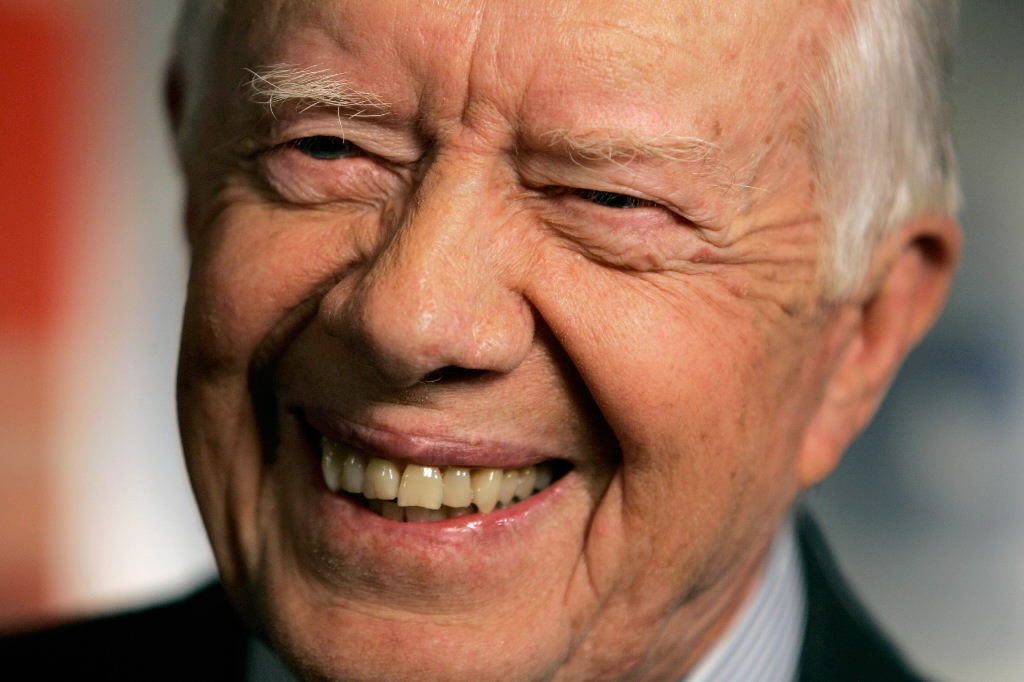
In response to questions from Paul Brandeis Raushenbush at the Huffington Post about the Bible's teachings on gender and sexual orientation, Sunday school teacher and former President Jimmy Carter gives us some of that old-time historical and cultural criticism:

I separated from the Southern Baptists when they adopted the discriminatory attitude towards women, because I believe what Paul taught in Galatians that there is no distinction in God’s eyes between men and women, slaves and masters, Jews and non-Jews -– everybody is created equally in the eyes of God.

There are some things that were said back in those days –- Paul also said that women should not be adorned, fix up their hair, put on cosmetics, and that every woman who goes in a place of worship should have her head covered. Paul also said that men should not cut their beards and advocated against people getting married, except if they couldn’t control their sexual urges. Those kinds of things applied to the customs of those days. Every worshipper has to decide if and when they want those particular passages to apply to them and their lives....

Homosexuality was well known in the ancient world, well before Christ was born and Jesus never said a word about homosexuality. In all of his teachings about multiple things -– he never said that gay people should be condemned. I personally think it is very fine for gay people to be married in civil ceremonies.

I draw the line, maybe arbitrarily, in requiring by law that churches must marry people. I’m a Baptist, and I believe that each congregation is autonomous and can govern its own affairs. So if a local Baptist church wants to accept gay members on an equal basis, which my church does by the way, then that is fine. If a church decides not to, then government laws shouldn’t require them to.

Thursday, March 17, 2011

The Bible And The Patience Of God

From Kristin M. Swenson, a great primer on modern scholarship's understanding of the Bible and its sources, ending with a reassurance about the sheer mystery of faith:
[T]his information about the Bible is compatible with belief in it. A person can simultaneously accept these truths about the Bible and the Bible as the Word of God. Doing so may require recalibrating assumptions, though, to allow for the possibility that God patiently works through people and time, enjoys a good debate and prefers inviting conversation over issuing absolutes.

Wednesday, February 9, 2011

The Ideology Of The Word Of God

If you want to learn more about Egypt's Muslim Brotherhood, read Jack Shenker and Brian Whitaker's Guardian article, where we also learn that Muslims as well as Christians grapple with the dictates of scripture in changing historical circumstances:

The Brotherhood continues to maintain that "Islam is the solution" while at the same time demonstrating a kind of pragmatism that suggests Islam may not be a complete solution after all.

One example is jizya, the poll tax on non-Muslims, which is clearly prescribed in the Qur'an. The original idea was that non-Muslims, since they did not serve in the military, should pay for their protection by Muslims.

Today, most Muslims regard jizya as obsolete. In order to follow Qur'anic principles strictly, though, it would have to be reinstated. In 1997, the Muslim Brotherhood's Supreme Guide at the time, Mustafa Mashhur, did suggest reintroducing it but, in a country with around 6 million Christians, this caused uproar and the movement later backtracked. For non-Islamist Muslims, jizya presents no great problem: they can justify its abolition on the basis of historicity – that the circumstances in which the tax was imposed no longer exist today. For Islamists, though, this is much more difficult because the words of the Qur'an and the practices of the earliest Muslims form the core of their ideology.

The late Nasr Abu Zayd, a liberal theologian who was hounded out of Egypt by Islamists in the 1990s, regarded historicity as the crux of the issue. "If they concede historicity, all the ideology will just fall down," he said, "… the entire ideology of the word of God."

Monday, February 7, 2011

Fixing First Texts

It's called textual criticism when Bible scholars examine how the earliest Christian texts -- St. Paul's authentic letters and the four gospels -- could have been altered by scribes, either because of copying errors or for substantive reasons. Experts think a ban on women speaking in church was added to the 14th chapter of 1 Corinthians after Paul wrote it, for instance.

Now Scientologists are saying much the same thing about their holy writ. A church spokesman blames unnamed persons for adding anti-gay references to L. Ron Hubbard's writings after his death (Hubbard is shown here). The LDS received new revelation in the late 1970s about the status of African-American people and, just last year, softened its teachings about homosexuality.

Cynics are are probably inclined to think that officials of both churches manufactured latter-day insights about first principles so that their doctrines would better conform to current social mores. So-called orthodox Christians accuse so-called progressives of the same thing when they accord full sacramental status to women and gay and lesbian people.

And yet modern biblical criticism does help expose the astonishing social egalitarianism in the Christ moment and early church, especially in the context of patriarchal Palestinian culture and the hyper-status conscious Greco-Roman world of the first century. Our scholarship aims to recover the true gospel and help us better appreciate Jesus Christ's teachings about how people should behave toward one another despite differences in condition and circumstance. Whether the same can be said about the founders of Mormonism and Scientology is for others to say -- though it's hard to criticize any institution that's bending in the direction of justice and righteousness.

Saturday, January 29, 2011

The Nephilim Explained?

You don't have to be a Neanderthal to find intriguing correlations between scripture and modern science -- once you're willing to accept that God's normal workday runs a bit longer than ours.

New archaeological finds suggest that human migration from Africa into Mesopotamia and beyond began as long as 127,000 years ago. From DNA evidence, scientists had previously concluded that the exodus started just 60,000 years ago.

Especially interesting is the speculation about where homo sapiens may have encountered and bred with Neanderthals. Nicholas Wade writes in the New York Times:
Jebel Faya is near the Persian Gulf, which is now a shallow sea. But before 8,000 years ago, when the sea level was about 330 feet lower than today, the gulf area was a low-lying plain, with the Euphrates running through it. The region would have been an oasis that served as a refuge during dry periods. Neanderthal sites are known from central Iraq, so perhaps Neanderthals came down the river to the gulf oasis before it was inundated, making it “an interesting candidate for the place of hybridization,” [University of Birmingham archaeologist Jeffrey] Rose said.
A refuge and an oasis fed by the Euphrates, huh? As for hybridization, there's always been that odd passage in Genesis 6:1-4, just before the Noah story:
The Nephilim were on the earth in those days—and also afterwards—when the sons of God went in to the daughters of humans, who bore children to them. These were the heroes that were of old, warriors of renown.
Wikipedia says Neanderthals were a little smaller but built more robustly than homo sapiens. What if thanks to the robustness of oral tradition, stories of their heroic exploits in northern European climes reached all the way to the compilers of Torah?

Saturday, September 4, 2010

Hawking, Dickens, And Spontaneous Combustion

Stephen Hawking now says that the laws of gravity were enough to bring the universe into being -- which would have been the first instance of spontaneous combustion. For us old-earth Bible-interpreters, this is big news. Since the publication of his A Brief History of Time, Christian adult education teachers who found no essential conflict between the big bang and Genesis have been able to say that the great British astrophysicist himself was willing to concede the possibility of Someone throwing the great switch.

That Hawking has changed his mind, as disconcerting as it may be at first to the Bible study teachers, just means that he has chosen to insist that "science is on his side in order to make his case for the imagination." Oops. Sorry, that's what Brooke D. Taylor says about Charles Dickens in the September 2010 issue of Dickens Quarterly.

See, the 19th century's greatest English writer believed in spontaneous combustion, too, and used it in his novel Bleak House to dispose of a character named Krook. Krook had been hoarding papers which held the key to a legal case that has been grinding along for decades. Two characters who come looking for him find -- well, you could say that they find evidence of a sacramental reenactment of the scientist's vision of the beginning of the universe, a mass for rationalists:
Here is a small burnt patch of flooring; here is the tinder from a little bundle of burnt paper, but not so light as usual, seeming to be steeped in something; and here is--is it the cinder of a small charred and broken log of wood sprinkled with white ashes, or is it coal? O Horror, he IS here!
That's Krook's burnt remains that are "here," not God. As Hawking now insists about the universe, no one had to light the fuse in Krook's grubby little room. It just happened. Really, it happens all the time. As he assured his readers in the preface of Bleak House, Dickens had studied the literature.

All these years everyone has thought him a bit daft on this narrow point. Seeking to rescue him, Brooke Taylor concludes:
In the end, most of us agree that, for literary purposes, the scientific accuracy of Spontaneous Combustion doesn't matter. But Dickens argues for the scientific authenticity of this manner of death because a world in which fact and feeling are irreparably divided is a tragic and frightening place.
Maybe that kind of fear helps us understand why the mystery of God can be such a challenge or an affront to the rational mind. For Hawking and those who are most pleased by his latest assertion, it actually seems less preposterous, or perhaps less frightening, to say that they know what occurred 14 billion years ago at a point in-- well, somewhere, than to accept the possibility that a living but persistently invisible source of ultimate meaning and benevolence is present right now, right here. The very idea of a power they can't fully explain must make them want to explode.

Thursday, August 19, 2010

No, Of Course Not

From the mainline schism desk, another group of Christians forming an ity bitty denomination who insist that it's not about the gay thing:
Lutherans throughout the United States have been reacting to actions by the Evangelical Lutheran Church in America reversing ELCA policy to allow pastors to be in same-sex relationships and to officiate at same-sex union ceremonies.

Lutheran CORE leaders note that the problems in the ELCA are really not about sexual behavior but rather about an ongoing movement away from the authority and teaching of the Bible throughout the ELCA.
My brothers and sisters, let us at least be direct with one another. It's definitely about "sexual behavior." It's not so much about the authority of scripture as about how discerning, faithful people read and, yes, are instructed and commanded by the Bible. Perhaps most of all, deep down, it's about gender. How about we honor the body of Christ by staying together and talking, reasoning, praying, and conquering our divisions for the sake of the glory of God?

Monday, November 23, 2009

"The Economist" For Christmas, Todd, Please!

Franklin Graham on Sarah Palin's conversation with his father, Billy, yesterday at the great evangelist's home:
She...wanted his take on what the Bible says about Israel, Iran and Iraq, Franklin Graham reported.
That's pretty weird, since the Bible doesn't say anything about Israel after about 90 A.D., Iran (unless she means Cyrus the Great's Persia in the sixth century before Christ), or the war in Iraq (though Gen. 3 does suggest that the Garden of Eden was near Baghdad). Wrong briefing book, governor!

Sunday, November 22, 2009

Blunting The Islamification Of Christianity

The New York Times on Saturday's Vatican meeting between Benedict XVI and the Archbishop of Canterbury, Rowan Williams:
[Williams]...questioned why the longstanding dialogue between the religions had foundered over the question of female clergy.
Here's why, your Grace. The pope's brazen move to convert British Anglican priests who oppose female bishops is an obvious sign that he considers the Roman Catholic Church's misogynist ecclesiology to be its leading missionary edge. Because it marginalizes women to say they shouldn't be bishops or priests (or pastors, as most U.S. evangelical Protestants still do). It devalues women to say that they aren't pure enough to do sacramental work. It insults women to claim that they are a lessor order of humanity, as Gen. 2 seems to teach, though Gen. 1:27 does not (which notion of creation have you been taught and do you prefer -- woman made as an afterthought from man's rib or male and female created simultaneously in God's image?). It cuts women off from the grace of God itself to say that God and our LORD Jesus Christ view them as less worthy to preach and teach and bless and absolve in their holy names.

Treating women that way in the church either makes sense to one, or it doesn't. It evidently still makes sense to Benedict, but my guess is that, deep down, it doesn't make complete sense even to young American Roman Catholics, both male and female. And it no longer makes sense to most in the Episcopal Church, which has had female priests since the 1970s and now has a female presiding bishop, nor to ++Rowan, who favors the British Anglican church eventually ordaining women as bishops.

So how long are we reportedly besieged, marginal, so-called progressive Christians -- especially those who believe that Jesus Christ's radical and reckless love extends to male and female followers, apostles, and priests in precisely equal, which is to say infinite, measure -- going to continue acting so defensive? How long are we going to let Christians whose view of women tends to mirror Islam's have the upper hand in the church and especially in the news media, which largely dictate how secular society views people of faith?

Precisely as long as we continue to let our critics get away with pretending the great debate is about something else entirely. So-called orthodox conservatives like to say the church is mainly having an argument about the authority of scripture and the role of gay and lesbian people. It behooves them to do so to distract the attention of the half of the human race about whom Christendom is truly convulsed. Will or will not the relatively small minority of Christians who are absolutely right on this issue finally be able to stand up for women and blunt the Islamification of Christianity?

Saturday, October 24, 2009

Reading And Believing In The Light Of History

When faithful people read the Bible, are they allowed to take into account the social and historical circumstances of the time (or times) it was written or edited when deciding which teachings still apply in our own time? The question of how literally we take the Bible has vast implications for the way people lead their lives and run their churches. For Christians, the roles and rights of women and gay and lesbian people are the two most pressing examples.

Theologians, Bible scholars, preachers, and even Presidents have been performing historical criticism since the 19th century, though it's still alien territory for many Christians and Jews. As is so often the case, younger people may be forcing the issue, according to a survey conducted by the Barna Group:
David Kinnaman, the Barna Group president who oversaw the research over multiple surveys between 2006 and 2009, said that Mosaics’ [readers aged 18-25] reliance on social networking and interpersonal relationships is an indication future generations will distance themselves further from the Bible if their societal interpretations are discounted.

“The central theme of young people’s approach to the Bible is skepticism,” Kinnaman said. “They question the Bible’s history as well as its relevance to their lives, leading many young people to reject the Bible as containing everything one needs to live a meaningful life. This mindset certainly has its challenges, but it also raises the possibility of using their skepticism as an entry point to teaching and exploring the content of the Bible in new ways.”

Sunday, March 29, 2009

The Bible: Story Of God, Story Of God's People

My mentor and friend, the Rev. Cn. Mark Shier, five months from retirement after an extraordinary third of a century's rectorship at the Episcopal Church of St. Andrew in Fullerton, California, on reading the Bible:
Only the simple or the lazy would look at the events and attitudes of the Bible without realizing that they are colored by the lens through which they are reported. The text of the Bible did not descend miraculously out of the clouds of heaven and the mind of God. The Bible as we have it is the result of a long and complex development, guided indeed by the Spirit of God but nonetheless the work of different men and women with different personalities (different neuroses!), folk observing and interpreting events out of different societies and cultures, most of them far more harsh and primitive than our own. If we don’t do the work of compensating for the shortcomings of the reporter, we will get a skewed idea of what is reported. If we read a book about Sherman’s march through Georgia to the sea in our Civil War, we will want to know whether the author is a Southerner or a Northerner or a third party presumably free from bias. If we want to know of the contributions of Jewish culture to Europe, we will want to know if our author is a Nazi or an Israeli. It will make a difference.

So it is with the Bible. We will want to know what period of history the book comes out of, who were the friends and who the enemies, what experiences of conquest and injustice might have colored the narration in front of us, how was God conceived, what was the idea of mercy (it is not always our idea of mercy – for example, “an eye for an eye and a tooth for a tooth” was not a harsh prescription of punishment but a merciful way of limiting retaliation for wrong (Exodus 21.23, Leviticus 24.19, Deuteronomy 19.21), and so on. The Bible is the story of God’s people every bit as much as it is the story of God. If we are wise, we will make and know the distinction.

Monday, February 16, 2009

Yoga And The Islamic Reformation

In Malaysia, where religious authorities recently issued a fatwa against yoga, Muslim women from 47 countries gather to grapple with the Islamic dimension of timeless theological questions about how to live modern lives in the light of scripture. While Muslim reformers have some catching up to do, similar questions among Christians are hardly settled:
The repression comes not from the Koran, the women argue, but from the human interpretation of it, in the form of Islamic law, which has ossified over the centuries while their globalized lives have galloped ahead. So they are going back to the original text, arguing that its emphasis on justice makes the case for equality.

“Feminist Islamic scholarship is trying to unearth the facts that were there,” Ms. Mir-Hosseini told a room of eager activists Sunday. “We can’t be afraid to look at legal tradition critically.”

She referred to the work of Muslim intellectuals, like Nasr Abu Zayd of Egypt and Abdolkarim Soroush of Iran, reformers who argue that the Koran must be read in a historical context, and that laws derived from it can change with the times. Their ideas are controversial, and both are in exile in the West.

Monday, February 2, 2009

As Women Reclaim The Bible

Adam Kirsch:
When Harold Bloom suggested, in The Book of J, that the oldest component of the Hebrew Bible was written by a woman--an aristocratic woman at King David's court, possibly even Bathsheba herself--he might not have been offering a testable scholarly hypothesis. But he was correctly drawing attention to the extraordinarily prominent and positive role of women in the Jewish scriptures. God may have made his promises to the patriarchs, but very often it is the matriarchs who carry out his plans. Think of Rebecca securing Isaac's blessing for Jacob; or Tamar disguising herself to earn her due from Judah; or Deborah leading the Israelites into battle against Sisera; or Judith cutting off the head of Holofernes.

It is a paradox of Judaism, then, that a religion that honors such independent and active women should have evolved a code of law that sharply restricts women's independence and activity.
Christianity, too, keeps women down. It's our greatest scandal.

Thursday, December 11, 2008

George W. Bush And The Germans

Although not known as a raving theological liberal, the President shows that his years of Bible study have given him some modern insights:
Asked whether the Bible was literally true, Mr Bush replied: "Probably not. No, I'm not a literalist, but I think you can learn a lot from it."

"The important lesson is 'God sent a son,'" he said.
And that God destroyed death by raising him at the first Easter, he might have added. But that "probably not" offers a gateway to many liberating, saving insights about scripture and the reign of God. Way to go, Mr. President.

Thursday, November 27, 2008

Did Mohammad Exist?

From a beautifully written blog by a neighbor over in Riverside, California -- a lover of the Mission Inn, where Richard and Pat were married in 1940 and Episcopalians of the Diocese of Los Angeles will gather next weekend for their annual convention:
German scholarship helped create Biblical criticism in the nineteenth century. Criticism placed the Gospels, particularly, in historical context. It tries to determine what portions of the Gospels were close to the events and likely accurate, and which were later interpolations and more likely expressed the hopes of their eras. Now a German scholar, a convert to Islam, has turned historical criticism on to the Muslim texts. The uproar has barely begun; but without such criticism, the modernization and moderation of Islam cannot get underway.

Wednesday, November 26, 2008

Two Flashes Of Light

The Church of the Holy Sepulchre in Jerusalem

Cathy Lynn Grossman:
Barry Kosmin, one of the nation's top researchers on the demographics of faith, argues in a book he co-authored, Religion in a Free Market, that competition among religion groups keeps interest in God high in the USA, even as denominational identity is fading.
Now, you can see that "market" in action: The final formal break-off of a small but significant group of U.S. and Canadian parishes and dioceses from their national denominations and, quite possibly, from the Anglican Communion, the world's third largest Christian denomination, as well.
The Episcopal Church, the U.S. branch of the worldwide Anglican Communion, has been riven by dissent for years over how to read the Bible and whether homosexuals can serve as bishops.
Not to judge Kosmin's book by its title, but Jesus demonstrated that the marketplace and gospel don't mix by cleansing one in the name of the other, his only reported direct use of violence. Post-1960s American Christians do tend to be church-shoppers, tempting pastors and congregations to focus on customer service and nose-counting. We keep God popular by making him seem palatable and relatively undemanding. But the gospel is about giving, not consuming. Christians are supposed to be more interested in the fast than what tastes good. We can't follow the money or the attendance tallies to truth and salvation. As Jesus also showed, it's possible for the ten thousand to be wrong and the one right.

As for Grossman's summary of the Episcopal Church's problems -- the ordination of a partnered gay bishop and differences of opinion about how to read the Bible -- that's about right. In the end, the second problem may be far worse than the first.

By the time we're through, five or ten percent of Episcopalians will probably have left because of the church's purported permissiveness. Which of the remnants, the larger or the smaller, is righteous? The question is complex and emotional. It's about individual dignity as well as the best way to raise children. But the church is learning along with civil society about the permanence of sexual orientation. In 50 years, it could be as unthinkable to deny ordination or a blessing on the basis of homosexuality as ethnicity or eye color.

While progressives may be on the right side of the arc of history when it comes to gays and lesbians, they are whistling past the empty tomb when it comes to Grossman's second issue -- how Christians read the Bible. Tens of millions claim to do so literally, especially many U.S. evangelicals and virtually all those who are threatening to rip the Anglican Communion apart. In a way, it's hard to blame them. As Episcopal theologian Phyllis Tickle has pointed out, Anglican missionaries lugged crates of Bibles to Africa in the 19th century and proclaimed that its every dit and twiddle was the basis of salvation, including passages such as Romans 1:27 which prohibit homosexual relations. It seems almost churlish to complain when some of their bishops take umbrage now that there their newly enlightened U.S. and Canadian colleagues insist it's not a sin after all, in spite of God's authoritative word.

When it comes to Bible rules, some of which are more practical in modern life than others, it's all about authority. Roman Catholics believe God empowered the pope to explain and elaborate Bible rules, making church tradition tantamount to God's own proclamations. Since the Reformation, Protestants have been struggling to find an alternative. What many have fixed on is the unquestioned authority of the written word itself, the doctrine of sola scriptura.

The chasm between these Christians and those who read the Bible using various modern tools such as historical, textual, and canonical criticism is at least as wide as the divide over sexual orientation. Take this passage from St. Paul's First Letter to the Corinthians (14: 34-35, NRSV), for instance:
Women should be silent in the churches. For they are not permitted to speak, but should be subordinate, as the law also says. If there is anything they desire to know, let them ask their husbands at home.
While some churches may follow this proscription, no women I know attend them. Our critical tools give us permission to ask these questions: How did the role of women in the first century Roman world affect Paul's thinking? Could he have been worried that noisy women would put both them and the young Christian movement in danger? Did Paul even write the passage, or did a scribe or follower add it later to reinforce male authority in the church in spite of Jesus's egalitarianism?

Many worshiping in mainline denominations have no trouble asking these questions and yet still honoring the sacredness of the Bible. Conservative evangelicals also make some allowances as well, permitting women to pipe up occasionally but tending not to call them as preachers or pastors -- and whatever they might decide about women, ix-nay on the a-gays.

Authority in the Episcopal Church is rooted in 18th century representative democracy, right down to the bicameral legislature (with houses of bishops and deputies). Believing that the Holy Spirit is present when faithful people gather in community, TEC votes on how to interpret the Bible, when to ordain women and gays, and whether to have fish or steak for dinner. Though Anglicans have a formula for weighing three factors -- scripture, tradition, and reason -- our polity tends to give more weight to reason than the originator of the famous three-legged stool, Richard Hooker, may have intended. After all, smart, well-intentioned people can talk themselves into anything. As for tradition, even that changes as faith communities and denominations change with the times. For some, only Scripture is immutable.

The irony is that many biblical literalists don't realize that in their church practice they're participating in modern scriptural interpretation. Every woman at Saddleback who speaks her mind in Bible study instead of asking her husband to teach her at home is violating St. Paul's literal rule, because some authority in her church has correctly decided that Christ's church can't discriminate so harshly against women in our egalitarian times. But if they set aside Corinthians for the sake of women but not Romans for the sake of gay and lesbian people, then they are being selectively modern. They are choosing when to stick to a literal reading depending on a human predisposition about the sinfulness of homosexual behavior, rooted either in the traditions of the human church or their own intestines.

To a greater or lesser extent, almost every Christian observes some Bible rules and exempts himself from others. Without some central authority to set and enforce rules for Bible living, individual Christians are free to provide their own. The danger is that we will arrive at self-justifying, self-idolatrous interpretations, contrary to the thrust of Christ's radically other-focused gospel. At the root of the TEC schism is the individualistic American tendency for any community to shrink until only the like-minded remain, with the church of one (probably not including Jesus) being the ultimate solution.

For their part, some schismatics rightly fear that progressives are also carving up the Bible, keeping Jesus's humane teachings and the best stuff in the prophets about peace and justice while excluding the bits about righteous living as well as anything smacking of the magical such as miracles and healings. Also up for grabs -- focal point, perhaps, for the coming schism of schisms -- is what the Bible discloses about Christ's bodily resurrection. Whether or not they disclose it at Easter services, many modern churchpeople are squishy about whether Christ's body was literally reanimated. For decades there has been a lot of talk about how he just seemed to be alive again because his memory and teachings were so powerful.

I can't help but think that this is the real deal breaker for the Church, with debates about women, which prayers to use, and the rights of gay and lesbian people being the sideshows. The risen Lord is the hope of the world, not the imperfectly transcribed accounts of his teachings or the wisdom and piety of the human beings in his church. Perhaps Christians need a new fundamentalism with just two pillars: Insistence on the absolute dignity and equality before God of all whom he has made as he made them, and faith that he created the world with a flash of light and saved it with another.