Regarding the Israeli-Palestinian peace process, 71 percent of Israelis and 68% of Palestinians surveyed viewed the chances for establishing an independent Palestinian state within the next five years to be minimal.
Nonetheless, 60% of the Israelis and 65% of the Palestinians opposed a one-state solution with equal rights between Arabs and Jews, according to the poll. Only 36% of Israelis and 31% of Palestinians supported such a solution.
Tuesday, July 3, 2012
A State Of Suspension
A new poll shows that Israelis and Palestinians agree on at least one thing -- that the status quo will persist:


Monday, July 2, 2012
Cross Beam
 On Saturday morning, the rising sun pierces the cross Canon Iyad Qumri is carrying as he leads St. John's pilgrims toward the Herod Gate of Jerusalem's old city, where we'll walk the stations of the Cross.
When Fergus Encounters Richard Again
 Rev. Fergus Clarke, an Ireland-born Franciscan priest, was pastor at St. Joseph's Catholic Church in Placentia, California, where he became fast friends with Charlie Frazee, my seminary church history professor and a longtime St. Joseph's lector and teacher. Around that time, Fergus felt called to the Franciscans' traditional ministry of caring for Christian sites in Israel and the West Bank. These days he's the ranking Roman Catholic at the Church of the Holy Sepulcher in Jerusalem, where million
 s line up every year to kneel in the tiny chapel built several meters above what remains of Jesus's tomb. Thanks to Charlie's good offices, when St. John's folk are in the Holy Land they get Fr. Fergus's generous behind-the-scenes tour of the world's holiest church.
Last Friday, as we stood in the friars' spare kitchen and dining room at the beginning of an astonishing two hours, Fergus pointed at a doorway behind a refrigerator. "I'm bringing you here not because our refectory and kitchen are much to look at but because they are built in the same area where, in the middle of the fourth century, Helena had her quarters," he said. Queen Helena was
 Constantine the Great's mother. She came to Jerusalem, found what was thought to be Jesus Christ's cross, and resolved to build one of her three churches over Golgotha and Christ's tomb (which most authorities now agree were indeed within sight of each other). "That door was once the window through which Helena would look down on Cyril of Jerusalem as he gave his sermons," Fergus said. Cyril was a great bishop, catechist, and defender of Christian orthodoxy -- heady company when you're having your morning oatmeal.
Fergus's equally riveting accounts of the politics, diplomacy, and intrigue that ensue when Catholics, Copts, Ethiopians, and Greek, Armenian, and Syriac Orthodox make decisions about everything from plumbing to liturgy -- alas, all off the record. I'll risk this much: He said that Catholics have to keep chanting and celebrating in Latin during their beautiful services in the Holy Sepulcher since, if they switch to the vernacular, the other denominations might well claim that the friars no longer represent t
 he Latin church referred to in 19th century and subsequent agreements and try to revoke the Catholics' rights and privileges. Among these is that Fergus and his colleagues (the only clerics who live in the Holy Sepulcher) are locked in every night by the church's Muslim doorkeeper. If that sounds weird, welcome to Jerusalem and a church that brims with mystery, ritual, and periodic controversy.
Fergus insists that the latter's been overblown and overstressed by the media. He says that every family living in close quarters has its bad days and stresses all the things that go smoothly in spite of the six denominations' vast doctrinal differences and centuries of hurt feelings. For instance, Raymond Cohen's Saving the Holy Sepulcher: How Rival Christians Came Together to Rescue Their Holiest Shrine details a half-century-long cooperative effort to restore and rehabilitate the church that kept it from crumbling to dust. What made that work possible, Fergus told us, is the denominations' shared belief in an indispensable first principle. "Bill Clinton was famous for saying 'It's the economy, stupid' in one of his campaigns," Fergus said. "For all of us here, it's the Resurrection, stupid."
Fergus's vocation and infectious passion are themselves signs of Easter power. He's a charming, hospitable, fun-loving man who's willing to get up at two in the morning for the first service of his day, negotiate endlessly with Copts over restroom rights, and submit to being padlocked nightly inside his place of business only because he believes with all his heart in the scandalous reality that Jesus Christ spurned his tomb, walked fully alive into the Jerusalem sunshine, and in doing so destroyed the power of death, sickness, injustice, oppression, and everything else that fiendishly masks the abundant potentiality of our God-drenched lives.
Clinton was Fergus's second presidential reference, by the way. The first was to none other than Richard Nixon. He recalled his visit to Nixon's Yorba Linda gravesite in the 1990s and also 37's comment in July 1969 that two Apollo 11 astronauts' moon walk was the greatest event in the history of humankind. Our host begged to differ, since that event
 would, of course, have been the Resurrection. I reminded him that pilgrim Kathy (shown here stooping to touch Golgotha) and I had both worked for 37. He actually said the Apollo mission had occurred during "the greatest week in the history of the world since the Creation." That's an even more reckless statement, unless you submit to the logic of Nixon's comparison. When the comment became controversial at the time, he said that he'd been naturally drawn to the seven-day (actually six) Creation since Apollo 11 also lasted about a week (actually eight days).
There's also the matter of the Yorba Linda Quaker's lifelong skepticism about the bodily Resurrection of Christ -- about which, I'm sure, Fergus will bring him around in good time, if circumstances and conditions have not done so already.
 Last Friday afternoon at the Church of the Holy Sepulcher, from left to right: St. John's pilgrims Ed, Kathy, Christian, Shannon, Debbie, Remy, Alexandra, Fr. Michael, and Brenna; Fr. Fergus; pilgrims Allana, Steven, Pastor Lisa, Kathe, Cathy, Jerry, and Bob. Missing: Pilgrims Cindy D., Cindy K., Damian, and John (the photographer)
This version of my post, updated on July 4, includes two corrections graciously provided by Fr. Fergus.
Sunday, July 1, 2012
More Rungs On Jacob's Ladder
 Even in the digital age, a group of pilgrims in Israel and the West Bank is likely to end up feeling set apart from the world – hermeneutically sealed, you might say. Are those Crusader or Byzantine ruins atop Mt. Tabor in Galilee, or a combination of both (which is usually the right answer)? The cassocked monk who just brushed by us in Jerusalem's old city -- Armenian or Greek Orthodox? Does any of Queen Helena's 4th century building remain in the Church of the Holy Sepulcher (yes, or so we were told; the center arch in the photo above)?
It's not that we didn't go on-line. But when we visited Wikipedia, it was to learn more about the history of the Freres Blanc, custodians of St. Anne’s Church and the pools of Bethesda, and to try to figure out which of the eight purported sites of the biblical Emmaus we had actually visited on Saturday morning.
We weren’t totally hermetic in our coenobiticality. News of pastoral crises quickly reached us – two friends’ unplanned hospital visits, another’s home being threatened by fire in Colorado Springs. We also heard in real time about the political firestorm sparked by
 the Supreme Court's health care opinion. But what I didn't learn until we were en route to LAX (and I opened the new issue of the Economist that had materialized on my Kindle) was that the walls bordering one of the sites we visited last week in Nablus on the West Bank, Jacob’s Well, had recently been shot up, the result of internecine Palestinian tensions.
The incident notwithstanding, I'm glad we didn't skip our Jacob's Well stop, which proved to be a favorite for several of our St. John's pilgrims. Because of Palestinian Authority reforms and improving economic conditions, the West Bank has been peaceful for the last few years. When there is talk these days of a third intifada, or popular uprising, it's about the chances of an armed struggle within the Palestinian movement between Fatah, which is working constructively with Israel, and Hamas, still officially dedicated to Israel's demise:
“There is no political horizon,” say disgruntled Palestinians. They increasingly question the point of the PA. It has failed to usher in a Palestinian state, and appears powerless to prevent Israeli military incursions or the relentless expansion of Jewish settlements on the West Bank. “All the windows are closed, and the political elite has no keys to open them,” says Raid Nairat, an academic. The West Bank’s 30,000 security forces seem unkeen on a recent quest for reconciliation between Fatah and Hamas that would force them to share power. Their recent round-up of 150 Hamas men helped dampen hopes of a deal.So there are some more roadblocks on the peace highway, more rungs on Jacob's ladder. It's hard to imagine Fatah and Hamas sharing power (until their goals converge), Israel making a deal with ju
 st Fatah (since it would reasonably assume that Hamas would undermine it), and Israel making a deal with a united Fatah and Hamas (unless Hamas permanently renounces jihad against Israel). A Palestinian civil war might actually be welcomed by those who think it would take the pressure off Israel to make peace. Better to hope that Hamas will be pulled to the center by its ongoing nation-building work in Gaza and the election of a Muslim Brotherhood president in Egypt who is fully committed to the peace process.
Saturday, June 30, 2012
Divine Polyphony
 On Thursday, as the sun set over Jerusalem, we pilgrims gathered on the roof of the Holy Land Hotel for an abbreviated service of evening prayer. "O gracious light," we said, "pure brightness of the everliving Father in heaven...Now as we come to the setting of the sun, and our eyes behold the vesper light, we sing your praises..."
But this was Jerusalem, so we weren't praying alone. No one ever is. When the time came for the Lord's Prayer, our voices were blending with t
 hose of muezzin calling Muslims to their sunset prayer (7:55 p.m. in Jerusalem, or about ten minutes after our service had begun). I could distinguish at least two chants, and there may have been three. Our hotel in east Jerusalem had three minarets within sight. So we joined hands and joined our voices to those of the muezzin and chanted the Our Father using one of the settings from the Episcopal hymnal.
You could say the moment was holy polyphonic. We weren't arguing or trying to drown out theological competitors. There's more than enough of that in Jerusalem without our adding to the mayhem. Something similar happens every day during scheduled worship in the Church of the Holy Sepulcher, where we got a behind-the-scenes tour on Friday afternoon from Rev. Fergus Clarke, one of the Franciscan priests who work with five other denominations -- Greek, Armenian and Syriac Orthodox, Coptic, and Ethi
 opian -- to operate and care for Christianity's holiest place. Fergus reminded us that his is the only church in the world where denominations worship simultaneously in different languages -- for instance Coptics and Roman (or Latin) Catholics at opposite ends of Christ's tomb, within 20 feet of each other.
I've heard it, and it's beautiful. While agreeing by and large on just one thing -- that in the tomb they preserve and adore, our God in Christ destroyed death and saved the world -- these Christians all worship differently, and so have we on our 10-day pilgrimage.
The Rev. Canon Michael Bamberger (shown here with pilgrims Brenna and Steven Hayden) and I took turns celebrating Holy Eucharist -- Mike on Saturday morning in the ruins of a Crusader church at Emmaus Nicopolis, I a few days earlier on a stone altar overlooking the Sea of Galilee. But when it came to our non-Euc
 haristic services, we mixed it up considerably, taking turns organizing our pilgrim worship.
One evening Fr. Mike borrowed a moving Compline, or close-of-day, liturgy from our Diocese of Los Angeles colleague Canon Randy Kimler. The next night, pilgrim Christian Kassoff, co-leader of an emergent Christian community in Huntington Beach called Thom's, invited pilgrims to reflect about their first few days in Jerusalem. Christian and his son, Damian, took turns anointing them at the end of the service. I did the honors with the holy oil after the Rev. Lisa Rotchford, knee-deep in the Jordan River, presided at a reaffirmation of our baptismal vows (that's pilgrim E
 d Alosio with Pastor Lisa).
It was back to the rooftop when we gathered in Nazareth one evening by the light shining from the cupola of the nearby Basilica of the Annunciation. Another Thom's minister -- Christian's wife and Damian's mother, Shannon -- led us in yoga and guided meditation. During one of my turns, I stretched liturgical propriety even further than yoga instructor Shannon stretched our pilgrim hamstrings when I offered some doggerel to be sung to the tune of "Pray For The Peace Of Jerusalem," which our Galilean friend the Rev. Fuad Dagher taught us at St. John's back in 2010. I hoped to illustrate the pilgrim virtues of patience, flexibility, tolerance, and unity:
When we set out for Tel AvivWe pilgrims also shared perhaps 25 scriptural readings connected to the sites we visited and 50 prayers and blessings, almost all in the name of our Lord Jesus Christ. I remember just two exceptions. After we'd heard a talk by a religious Jew and peace activist who elected to stay for our closing prayer, Fr.
Our departure time was a slidin'
We pilgrims has to sit and wait
The runway was reserved for Joe Biden
Cucumbers and yogurt and olives with pits
Like no breakfast we've ever seen
We knew we weren't in Kansas no more
When we saw that the orange juice was green
Muslims and Jews, Christian orthodox
For all kinds, Jerusalem's the place
We walk the ancient streets of this town
Amazed by diversity of faith
In Bethlehem we reached and touched
The rough stone that sheltered the Christ
His love proclaims such unity
That mocks all our conflict and strife.

 Mike left out the reference to Christ. Saying grace over our Saturday lunch at a shawarma restaurant on Salah al-Din in east Jerusalem, where we were surrounded by pious Muslims, I prayed in the name of the Creator, not to deny Christ but avoid disappointing him by excluding any of God's beloved non-Christian creatures who may have been listening.
Thursday, June 28, 2012
Roberts Rules
 My Nixon brother Hugh Hewitt doesn't like the Supreme Court's health care ruling. But he knows the chief justice, John Roberts, with whom he shared an office in the Reagan White House, and believes that he ruled as his conscience dictated:
The Chief Justice's decision is the consequence of his personal integrity as it would have been much, much easier for him to rule the other way. Critics of him will have to consider what they would have done if they believed the mandate to have been justified by the taxing power.
Wednesday, June 27, 2012
Missing Footnotes To History
 In a History News Network post, historian and blogger Maarja Krusten accuses historians of complacency because of their inattentiveness to the slings and arrows hurled at former Nixon library director Tim Naftali by Bob Haldeman's operatives.
Tuesday, June 26, 2012
Did Jesus Live Here?
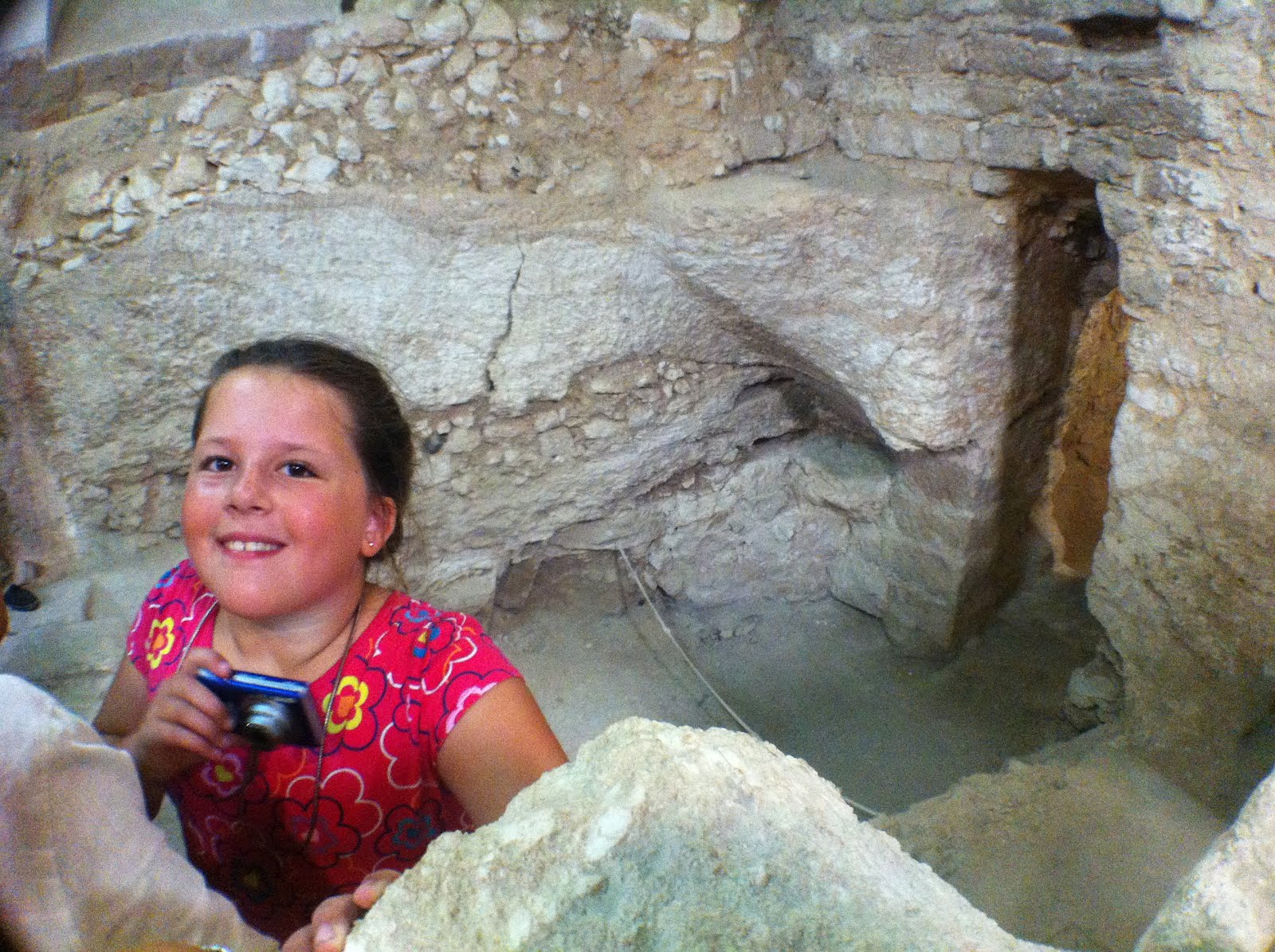 Visited mostly by pilgrims and other guests of the retreat house of the Religious Sisters of Nazareth, which shelters them, these ruins are known to include a Herodian grave complete with rolling stone (not Jesus's, of course; that was in Jerusalem), first-century as well as Byzantine and Crusader-era streets and floors, and remains of a first-century hillside residence (that's a cave to you and me, kids).
In Jesus's time, perhaps 200 people lived in Nazareth. So Jesus, Mary and Joseph and other members of their family probably at least walked through the portal into the front room behind pilgrim Brenna. Did they live here? There's not much on the web or even in guide books about this place. But there's evidence that people considered it holy for centuries.
More later. To follow our pilgrims' progress in the meantime, friend me on Facebook and check out the photos here.
Sunday, June 24, 2012
Five For The Road
 The St. John's Spirit of Jerusalem pilgrimage will begin its day (that's Monday to us) in the Judean desert and finish in Nazareth, land of occasionally sketchy wireless. To tide you over if necessary, some miscellaneous images, including our traveling Deb Neal fan club (that's Deb third from the right; out former Diocese of Los Angeles colleague, she's now the Bishop of Jerusalem's secretary).
 You want to have a truly blessed time in the Holy Land? Then travel with pilgrims Brenna (8), Steven (13), and Damian (12).
 Pilgrim Kathy gives pilgrim Cindy a back rub.
 In Episcopal churches everywhere, including St. Matthew's in Zababdeh, children proudly bring their Sunday school handwork into the great congregation when that long episode called the sermon is finally over.
 Singing one of my favorite hymns, "All Hail The Power Of Jesus' Name," with three of my favorite people, pilgrims Mike, Debbie, and Cindy? Words fail.
 Holy Land graffiti is always worth reading, noting, and inwardly digesting.
The Greatest Man I Ever Met
 In 1979, ultra-orthodox Jewish settlers (traitors to their faith no less notorious than Sept. 11 attacker Mohamed Atta was to his) raided a Greek Orthodox monastery in the West Bank town of Nablus and used an axe to murder the abbot, Archimandrite Philoumeno, who was especially beloved of the local Arab community.
The abbot, beatified in 2009, died while saying vespers. Another brother standing and praying nearby, Fr. Justinus, subdued St. Philoumeno's killer by smashing him with a chandelier and breaking both his legs, an especially remarkable accomplishment since Justinus is five feet tall and had been stabbed 16 times in the attack. The murderer and his accomplices were put on trial but acquitted by reason of insanity.
As outrageous as the verdict sounds, maybe the court got it right. Faithful people would have to be nuts to commit such an abomination at the site of Jacob's well, which, as disclosed by John's gospel, was where Jesus Christ asked a woman of Samaria (whom he should have judged unclean and unapproachable, according to th
 e religious authorities of the day) to pour him a drink of water.
Yet creating new martyrs in a place remembered for the great patriarch as well as a supreme act of reconciliation is not as ironic as it might seem, according to Fr. Justinus. When we St. John's pilgrims visited him this afternoon, he told us that the attackers were motivated not by a reverence and preference for the site's Hebrew Testament antecedents but by their plan to twin it with nearby Joseph's Tomb as a money-making G ticket for Jewish and presumably Christian visitors and pilgrims.
Instead, Justinus picked up Philoumeno's mantle and spearheaded the construction of a magnificent Crusader-style church over the many-storied well, one of an elite category of Holy Land sites which are precisely what tradition purports. St. Photina's opened about 20 years after the settler attacks. Besides sheltering St. Philoumeno's remains, it's filled w
 ith Justinus's own exquisite paintings, murals, and icons, including one showing his colleague and friend's murder (above) and another depicting Jesus's encounter with the woman at at the well.
I've met presidents and their ministers and factotums but no one greater than Fr. Justinus -- near-martyr, brave wielder of the mighty sword of justice, church-builder, artist, and gentle and gracious pastor. He greeted us near the front door of his church with a friendliness and generosity of spirit you won't find in many rich, powerful people who can boast of nothing like his courage and character. He took time to pose with pilgrims Steven, who is 13 and about his height, and Brenna Hayden and stooped (though not very far) to kiss Brenna on the top of her head.
And yet after pilgrims Steven, Brenna, and Damian had lowered a bucket into the well, and we'd all drunk from the same ancient spring as Jesus, I was surprised to see Justinus step behind the gift counter and add master salesman to his repertoire. In three minutes he had deftly maneuvered me toward purchasing a hand-painted copy of his depiction of Jesus and the Samaritan woman.

Would you say no to Gandhi? Dr. King? He signed and anointed my purchase (a deep cruciform soaking that will mark this treasure forever) and the hands of everyone standing nearby, including the Rev. Lisa Rotchford, who's afraid she persuaded me to buy the icon. Not a chance. He had me at hello.
Fr. Justinus said he and the brothers had been praying for our bishop, Jon Bruno, and were delighted to learn that that his leukemia was in remission. "He is a big man, with a big heart," said the little priest. Takes one to know one.
Subscribe to:
Posts (Atom)