Showing posts with label Charles Frazee. Show all posts

Wednesday, July 25, 2012

Massive Question

Those who think that anything goes in The Episcopal Church should read Mary Frances Schjonberg's coverage (supported by my Diocese of Los Angeles colleague, Pulitzer Prize-winning journalist the Rev. Pat McCaughan) of the painstaking debate about open communion that took place at our recently concluded General Convention in Indianapolis.

According to our national church's canons [I. 17. 7], only baptized persons are eligible to receive the consecrated body and blood of Christ. Feeling that the canonical requirement might impede the movement of the Holy Spirit in a spiritual searcher's life, some priests and parishes invite everyone to come to the table, baptized or not.

No one checks congregants' baptism IDs at the altar rail. The question is whether priests
err by failing to articulate the rule or by flying in the face of it.

In Indianapolis, the Rev. Anna Carmichael, rector of St. Mark's in Hood River, Oregon, was part of an unsuccessful effort to persuade General Convention to abandon the requirement altogether. Her reasoning, as Schjonberg and her colleagues reported:
“While I understand that as a priest I have taken a vow to uphold the rubrics of the prayer book, I feel that sometimes pastoral care and pastoral sensitivity are equally as important as our theology behind what we do,” she said, adding that the Episcopal Church is always striving to extend its welcome to all people “and I hope that at some point our welcome will include unbaptized at the communion rail.”
In the end, the convention preserved the requirement. It even turned aside a resolution containing this sentence: “We also acknowledge that in various local contexts there is the exercise of pastoral sensitivity with those who are not yet baptized.” Opponents of the wording argued that while priests always reserve the right to make pastoral judgment calls, being that explicit would have amounted to a proclamation of open communion. At the core of the debate is TEC's passion for baptism as the first and greatest sacrament, the irreducible outward sign of membership in Christ. Some fear diluting its power by eliminating it as a condition for participating in Holy Eucharist.

Yet I'm sure most priests have a story about someone who probably wouldn't have decided to be baptized without first being welcomed to the table. At St. John's, the wording in our Sunday bulletin (inspired by another LA Diocese colleague, the Very Rev. Canon Michael Bamberger; that's he above, celebrating mass for us pilgrims last month at Emmaus-Nicopolis in Israel) probably wouldn't pass muster with the canonical cops:
Episcopalians consider all baptized persons to be members of Christ's Church. Wherever you are on your journey of faith, you are invited to come to the Lord's table and receive the Lord Jesus Christ in the consecrated Bread (or Host) and Wine.
The first sentence is designed to do two things. Roman Catholics and members of other denominations often come to an Episcopal parish wondering if they're allowed to receive. We want to be sure to tell them yes. It also implies that membership has its altar privileges, while the second sentence creates ambiguity by implying that membership doesn't matter when it comes to Holy Communion. Folks have asked me about the ambiguity and ended up baptized, marked as Christ's own forever, as a result. The more traditional approach, of course, is to honor baptism by refusing Holy Eucharist to the unbaptized. That's the way my Roman Catholic wife and fellow St. John's minister, Kathy O'Connor, grew up.

Even though TEC doesn't require it, some families prefer to wait until their baptized children are old enough to understand the significance of Holy Eucharist. For such families at St. John's, Randall and Kristen Lanham offer wonderful early communion classes each spring, the Episcopal equivalent of the first communion process in Roman Catholic parishes.

If parents are willing, I and most priests will give communion to anyone old enough to exhibit the curiosity and a tooth or two. We figure that people are more likely to make a habit of church attendance if they can't remember a time when they weren't welcome at the Lord's table. And welcome is the operative word. In an era of mounting skepticism about the institutional church, it's unwise for any denomination or parish to fail to make hospitality a core value.

Besides, if we should stick slavishly to I. 17. 7 and try to keep the unbaptized from the communion rail, our Roman Catholic brothers and sisters may have done us one better. Many have had the experience of being told one has to be a baptized Roman Catholic to receive communion. God bless those priests, especially at funerals, who make a point of saying that all are welcome, even though by doing so they're violating Vatican rules. That's why I never ask for the sacrament in a Catholic church when there's a chance that the priest knows I'm not one of his own. Why force my brother either to deny me the body of Christ or violate canon law?

For whatever reason, in late June we St. John's pilgrims didn't have to display that kind of sensitivity during an early-morning mass in the grotto at the Church of the Nativity in Bethlehem. We stood a few steps from the traditional place of Jesus's birth as a Franciscan priest from Italy served us each Holy Communion. The photo at right above shows pilgrim Christian Kassoff being communicated.

The priest may have thought we were Roman. He may not have cared. But when I blogged about the experience, my friend Charles Frazee, a specialist in church history and his Roman Catholic church, wanted to be sure I understood that no Catholic priest is permitted to deny the sacrament to someone who seeks it, baptized Catholic or not, unless the person is known to be guilty of a grave sin (being Episcopalian isn't included). TEC doesn't have that kind of universal access stipulation in our canons. So, um, are we really stricter than the pope?

Saturday, July 7, 2012

My Episcopal Trifecta For The Day

Episcopal as in pertaining or relating to bishops and the historic episcopacy, that is.

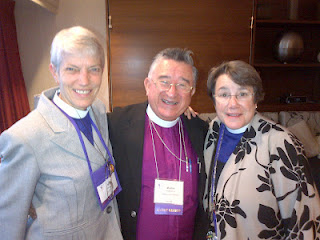
Deacons and priests tend to tell their ecclesiastical life stories with reference to bishops. For instance, take this photo, which appeared today on Bishop Suffragan Diane Jardine Bruce's blog showing her with her sister suffragan, Mary Douglas Glasspool (left) and Bishop Martin Barahona of the Episcopal Diocese of El Salvador at an event in his honor during our triennial General Convention in Indianapolis.

I was Bishop Mary's chaplain when she and Diane were participating in the process that led to their historic election as our diocese's first women bishops in 2009. Bishop Diane was a gracious and indispensable mentor in the late 1990s during my ministry study year at Church of the Messiah in Santa Ana, California, where she was associate rector. As a fellow Bloy House seminarian, she also gave me photocopies of her famous Charles Frazee church history index cards. For five points, what's the Shepherd of Hermas? And I had the blessing of serving as Bishop Barahona's chaplain when he paid a visit to St. Paul's Episcopal Church in Tustin, California one Sunday in 2002, where I was doing a field study internship.

We just love our bishops!

Monday, July 2, 2012

When Fergus Encounters Richard Again

Rev. Fergus Clarke, an Ireland-born Franciscan priest, was pastor at St. Joseph's Catholic Church in Placentia, California, where he became fast friends with Charlie Frazee, my seminary church history professor and a longtime St. Joseph's lector and teacher. Around that time, Fergus felt called to the Franciscans' traditional ministry of caring for Christian sites in Israel and the West Bank. These days he's the ranking Roman Catholic at the Church of the Holy Sepulcher in Jerusalem, where millions line up every year to kneel in the tiny chapel built several meters above what remains of Jesus's tomb. Thanks to Charlie's good offices, when St. John's folk are in the Holy Land they get Fr. Fergus's generous behind-the-scenes tour of the world's holiest church.

Last Friday, as we stood in the friars' spare kitchen and dining room at the beginning of an astonishing two hours, Fergus pointed at a doorway behind a refrigerator. "I'm bringing you here not because our refectory and kitchen are much to look at but because they are built in the same area where, in the middle of the fourth century, Helena had her quarters," he said. Queen Helena was Constantine the Great's mother. She came to Jerusalem, found what was thought to be Jesus Christ's cross, and resolved to build one of her three churches over Golgotha and Christ's tomb (which most authorities now agree were indeed within sight of each other). "That door was once the window through which Helena would look down on Cyril of Jerusalem as he gave his sermons," Fergus said. Cyril was a great bishop, catechist, and defender of Christian orthodoxy -- heady company when you're having your morning oatmeal.

Fergus's equally riveting accounts of the politics, diplomacy, and intrigue that ensue when Catholics, Copts, Ethiopians, and Greek, Armenian, and Syriac Orthodox make decisions about everything from plumbing to liturgy -- alas, all off the record. I'll risk this much: He said that Catholics have to keep chanting and celebrating in Latin during their beautiful services in the Holy Sepulcher since, if they switch to the vernacular, the other denominations might well claim that the friars no longer represent the Latin church referred to in 19th century and subsequent agreements and try to revoke the Catholics' rights and privileges. Among these is that Fergus and his colleagues (the only clerics who live in the Holy Sepulcher) are locked in every night by the church's Muslim doorkeeper. If that sounds weird, welcome to Jerusalem and a church that brims with mystery, ritual, and periodic controversy.

Fergus insists that the latter's been overblown and overstressed by the media. He says that every family living in close quarters has its bad days and stresses all the things that go smoothly in spite of the six denominations' vast doctrinal differences and centuries of hurt feelings. For instance, Raymond Cohen's Saving the Holy Sepulcher: How Rival Christians Came Together to Rescue Their Holiest Shrine details a half-century-long cooperative effort to restore and rehabilitate the church that kept it from crumbling to dust. What made that work possible, Fergus told us, is the denominations' shared belief in an indispensable first principle. "Bill Clinton was famous for saying 'It's the economy, stupid' in one of his campaigns," Fergus said. "For all of us here, it's the Resurrection, stupid."

Fergus's vocation and infectious passion are themselves signs of Easter power. He's a charming, hospitable, fun-loving man who's willing to get up at two in the morning for the first service of his day, negotiate endlessly with Copts over restroom rights, and submit to being padlocked nightly inside his place of business only because he believes with all his heart in the scandalous reality that Jesus Christ spurned his tomb, walked fully alive into the Jerusalem sunshine, and in doing so destroyed the power of death, sickness, injustice, oppression, and everything else that fiendishly masks the abundant potentiality of our God-drenched lives.

Clinton was Fergus's second presidential reference, by the way. The first was to none other than Richard Nixon. He recalled his visit to Nixon's Yorba Linda gravesite in the 1990s and also 37's comment in July 1969 that two Apollo 11 astronauts' moon walk was the greatest event in the history of humankind. Our host begged to differ, since that event would, of course, have been the Resurrection. I reminded him that pilgrim Kathy (shown here stooping to touch Golgotha) and I had both worked for 37. He actually said the Apollo mission had occurred during "the greatest week in the history of the world since the Creation." That's an even more reckless statement, unless you submit to the logic of Nixon's comparison. When the comment became controversial at the time, he said that he'd been naturally drawn to the seven-day (actually six) Creation since Apollo 11 also lasted about a week (actually eight days).

There's also the matter of the Yorba Linda Quaker's lifelong skepticism about the bodily Resurrection of Christ -- about which, I'm sure, Fergus will bring him around in good time, if circumstances and conditions have not done so already.

Last Friday afternoon at the Church of the Holy Sepulcher, from left to right: St. John's pilgrims Ed, Kathy, Christian, Shannon, Debbie, Remy, Alexandra, Fr. Michael, and Brenna; Fr. Fergus; pilgrims Allana, Steven, Pastor Lisa, Kathe, Cathy, Jerry, and Bob. Missing: Pilgrims Cindy D., Cindy K., Damian, and John (the photographer)

This version of my post, updated on July 4, includes two corrections graciously provided by Fr. Fergus.

Thursday, February 24, 2011

Golden-Throated Gary

From medieval icons to Chagall's "White Crucifixion," from Bernini to Dali, our friend Gary Toops took 25 St. John's art lovers on a 1600-year sacred art walk these Thursday evenings in February. The brain child of Gary and our former associate vicar, the Rev. Karen Ann Wojahn, the class took two years to schedule in part because of Gary's busy schedule as teacher, organist, and community choir director. His and Marjorie Toops' Festival Singers rehearse each Tuesday evening at St. John's (a wonderful soundtrack for our weekly Bible study, which meets a few steps away). Over Memorial Day weekend last year, the Festival Singers and the St. John's Middle School choir, under the direction of my colleague Lori Speciale, appeared at Carnegie Hall, members of a 200-voice choir performing John Rutter's "Mass of the Children."

We'll actually have one more meeting of "Exploring Sacred Art," this Saturday at the Getty Center in Los Angeles. Our classroom work ended tonight with Gary's analysis of a work by a local artist, Charles Frazee, professor emeritus of religion and church history at Cal State Fullerton and the Episcopal Theological School at Claremont. In 2009, I acquired this icon which Charlie painted of our church's patron, John Chrysostom, the fifth century archbishop, preacher (hence his Greek sobriquet meaning "golden throat"), and courageous reformer.

The late Walter Annenberg (with whom I actually spoke the very week he bid successfully for "At the Lapin Agile") and the Getty had to reveal what they paid at auction for their Renoirs and van Goghs, but I shan't. That's between Charlie and me, as is the five-point ID question I missed on his final when I was in seminary 13 years ago. I barely remember. Okay, it was the Shepherd of Hermas. The Annenberg name-drop was a compensatory defensive gesture.

Wednesday, January 19, 2011

Pilgrims' Progress In The Church Of All Churches

You come to Jerusalem a few times, and you actually have people to look up. On Tuesday afternoon Kathy and I went first to the Armenian Quarter and Sami Barsom's tailor shop. He was making tea for a visitor, the Rev. Shemun Can, assistant to the Syriac Orthodox archbishop in Jerusalem, and he invited us to join them.

I'd met Sami twice before. He was gracious enough to say he remembered, if not my name, the shape of my face. While we sat and talked, he waved at two Orthodox Jews who walked past his shop and warmly greeted an Arab who came in to introduce his fiancee. When they left, Sami smiled and said, "He said he met me 10 years ago and asked if I remembered him."

The muchtar, or top lay leader, of Jerusalem's Syriac Orthodox, Sami prides himself on talking to everyone. A recently published collection of his articles for the Jerusalem diocese's magazine contains pictures showing him practicing his faithful personal diplomacy with prominent Israelis and Palestinians alike. "We follow Jesus Christ," Sami says, "and he calls us to be in peace with one another. So what else can I do?"

It isn't that he hasn't experienced the alternative. Both his and Fr. Shemun's families fled Turkish persecution in 1915, when, as Sami told us, Assyrians and other ethnic groups were engulfed in the Armenian Genocide. "The Turks said, 'They're all like the Armenians, they're all the same'," Sami said with a dismissive wave. His family settled in west Jerusalem and moved to the Jordan-controlled Old City, he said, in the aftermath of Israel's 1948 war of independence.

Fifty-one years ago, he opened his tailor shop right around the corner from St. Mark's Church, seat of Jerusalem's Syriac Orthodox archbishop and one of the places touted (as reliably as by anyone else) as the site of the Last Supper. Most of his customers, he said, are Anglicans and Episcopalians. Among the consequences of his abundant hospitality is that most of them probably abandon any thought they may have had about negotiating a price. We left with a handmade green stole (good for the whole season between Pentecost and Advent) and some extra gifts from Sami, including something for the St. John's Altar Guild as well as a postcard containing the Lord's Prayer as set down in Fr. Shemun's exquisite Syriac Aramaic calligraphy.

Our inevitable next stop was the irresistible Church of the Holy Sepulcher, where we watched an elaborate Epiphany mass at Christ's tomb that looked as though it was being overseen by none other than His Holiness Karekin II, supreme patriarch and catholicos of the Armenian Orthodox Church (that's he in the background in the above right photo, with the black hood and crosier).

After Kathy got another chance to say a prayer inside the Edicule, we ran across a procession of friars that was moving from chapel to chapel around this most mysterious and chaotic of churches. Among them was a distinguished-looking priest who put us in the mind of our two-year-old promise to try to say hello to the Rev. Fergus Clarke, Jerusalem-based buddy of my friend and church history professor Charlie Frazee. Making our way to the Franciscans' corner of the church, we asked about Fr. Fergus and learned that, sure enough, that was he in the holy procession. So we waited, listening as the Latin chant echoed through the church, coming closer minute by minute. Just as they swung toward the entrance of Christ's tomb carrying their candles and amid swirling incense, an organ began to play in support of their plainchant, as glorious a moment of liturgy as I've ever experienced.

The monks offered two more rounds of prayer, including a highly ritualized censing of the Mary Magdalene chapel and the veneration of the consecrated elements in the Chapel of the Sacrament next door. Fr. Fergus (at left in the above right photo) welcomed us graciously in the sacristy and cheerfully admitted he knew Charlie from his days as a parish priest at St. Joseph's in Placentia, California. Indeed he said he'd mailed him a letter that very morning. He said a blessing over us and my new stole and invited us back to see him, and we marveled again at how we felt so at home in this faraway place where God seems so close.

Tuesday, August 4, 2009

The Perfect Chaos Of Christ

Shadow of a priest walking near the Church of the Holy Sepulcher

A magical day in the Holy Land, among my 18 (19 when Mike join us tomorrow) fellow pilgrims from St. John's, began, I'm ashamed to say, with a passing derisive thought. My friend and seminary professor Charlie Frazee left a Facebook message suggesting that I look up his longtime friend, Fr. Fergus Clarke, when we visited the Church of the Holy Sepulcher in Jerusalem. Fr. Fergus is one of the Franciscan monks who help oversee that famed and complicated church, where six once-fractious denominations share authority under a 19th century edict called the Status Quo.

Reading Charlie's post, I said to myself, "Fat chance." The millions who visit the place of Jesus Christ's death and rising each year are plunged into a marketing consultant's worst nightmare. You find it with a map or by asking a vendor in Jerusalem's Old City. Nobody collects admission or hands you an Accustiguide. The building, built, rebuilt, burned, and reconfigured scores of times since a church was first built on the site in the 4th century, makes no sense whatsoever. There is no gift shop, and no one ever asks you for money.

Our guide, Canon Iyad Qumri, always takes his groups to the Ethiopian chapel, where he asks a priest to read the passage from Acts about the official of the Candace of Ethiopia being converted and baptized by Philip. Iyad does this, he says, because the Ethiopians are the poorest of the Church's six sects, and he hopes we'll leave a donation. There doesn't seem to be anyone else in charge except for the Greek Orthodox priest who barks orders (in Greek) at pilgrims if they dawdle at the the chapel built atop the rock of Golgotha -- hence my brief amusement at the thought of presenting myself at the front desk and asking for Fr. Fergus and imagining that anyone would know what I was taking about. As you've probably deduced, there's no front desk at the Church of the Holy Sepulcher.

I'd actually put Charlie's request out of my mind by the time we made our first stop of the morning at Ein Kerem, a beautiful hillside town north of Jerusalem. The Franciscans have a 17th century church there, successor of Crusader and Byzantine churches, built over the grotto purported to be the birthplace of John the Baptist. A monk tending the flowers in front of the church asked me where our group was from. I said, "Orange County," and he said, "Oh, then you must know Fergus Clarke," of whose whereabouts (on a 45-day leave in the U.S.) he was fully aware. The monk, Fr. Anthony Sedja from New Jersey (shown chatting with pilgrims Ron and Monte), listened politely as I said my penance. Bless me, Father, for I again forgot that God breathes an intelligence into this sacred space that exceeds anything I could manage or even imagine.

As if one minor miracle weren't enough for the day, I can also report that God heard my prayer for gellato. Among our pilgrims are four members of the St. John's Altar Guild, who looked like a million bucks despite a daunting flight of stairs up to Ein Kerem's Church of the Visitation (built to commemorate Mary's visit to Elizabeth, as recounted in Luke's gospel). Not far away, pilgrims Kathy and Loreen sat resting, hoping, Kathy said, that someone would serve them tea. No one did. One of the guilders, though troubled by pain in a knee, had climbed every step, trod every cobbled street, and never stopped smiling. She had, however, been persistently mentioning gellato -- and imagine what we found in a shop right along our path at the end of a particularly arduous walk. It was a little miracle for me to see that a breathtaking wall, containing Mary's impossibly prophetic "Magnificat" rendered in all the world's major languages, had been dedicated in the year of my birth.

Although everything has gone perfectly on our pilgrimage so far, whenever Canon Iyad is asked about a paradox, or something that's done here differently from the way we'd do it, he smiles and says, "It's Jerusalem" or "It's the Holy Land." While experts have a pretty good idea about where Jesus was crucified and buried (in a quarry just outside the City's ancient walls, with his tomb probably located within site of the Cross), for the specific geography of much of the rest of the story, the Church relies on formulations including the words "purportedly," "according to tradition," or "many believe." For me, the truth may end up being in the very chaos. What would humans do if they were truly in charge of Christianity's holiest place? Rope lines and revenue, collateral and commerce, turnstiles and taxes, membership discounts in the Shop of the Sepulcher. But they're not in charge. If you want to know who is, just pay attention to the light in the rotunda that arches over the tiny shrine housing what many believe, according to tradition, is the place where Jesus Christ's body lay for three days. Watch how the sunlight and candlelight transfigure faces, how beams of light stretch toward the tomb like a mother grasping for her child.

Friday, May 1, 2009

The Shepherd Of Episcopalians

Before leaving this morning for one of my periodic lunches with church historian Charles Frazee, I jokingly wrote on Facebook that I expected a conversation about the Coptic church. While we went much further afield, as any conversation with Dr. Frazee must because of the astonishing extent of his interests and gifts, I did come away with a copy of his latest manuscript, An Historical Introduction to the Eastern Christian Churches, Copts, of course, included, exam, I pray, not.

My Facebook post prompted a half-dozen comments from fellow Episcopal priests who, like me, learned their church history from Charlie. "Yea, Dr. Frazee," said the Rev. Kay Sylvester. "He rocks." Wrote the Rev. Cn. Diane Jardine Bruce, "Give him my best...and tell him someone (not me!) lost all my 3x5 cards that I made from his classes!" When I passed these greetings along, Charlie's always cheerful face brightened a little more at the mention of each name. He even remembered Diane's copious index cards, photocopied and studied, thanks to her devout Christian pity, by a whole generation of M.Div. students at the Episcopal Theological School at Claremont, California.

Dr. Frazee, you see, didn't use a textbook. At the beginning of his two-semester course in late August, he's say, "The church of Christ was born the moment Mary Magdalene received the news of Jesus's Resurrection..." At the end of the last class in May, he'd say, "...and though Warren's church is Southern Baptist to the core, it takes pains to present a non-threatening, post-denominational face." In between we would have experienced 20 centuries of Christian history and practice -- the Gnostics, ecumenical councils, Crusades, Liturgy of St. John Chrysostom, and perhaps 500 other topics. He would never have looked at a note, missed a name or date, grasped hesitantly for a word, or failed to utter a graceful, perfectly formed sentence.

If you had his class after lunch on Saturday, which I always did, students' energies might flag, but his never did. Each semester, he assigned four or five books and book reports -- The Rule of St. Benedict, The Imitation of Christ, that kind of thing. As for the core material, while he was always pleased to hear his often middle-aged students talk about the Holy Spirit or challenge him with their views on post-structural gender semiotics as applied to the gospel narratives, he said his job was making sure we future ministers knew when the First Letter of Clement had been written what Martin Luther's dates were. I lost five points on the fall 1998 final because I didn't remember the Shepherd of Hermas. Not that I'm licking old wounds.

Speaking of Br. Martin, I wouldn't say that Charlie spent a lot of time on the Reformation. He figured we'd get plenty in our Anglican history and theology classes. He also believes that the mother church would probably have managed to reform without the Protestant reformers. An inactive Catholic priest with a brilliant wife and two brilliant daughters, Charlie served in the Archdiocese of Indianapolis during the 1960s and early 1970s, earning the scorn of his bishop for helping lead protests against the Vietnam War. After he, Kathy, Sara, and Jill came to California, he taught at California State University, Fullerton and, of course, ETSC.

Though retired from both posts, he teaches and lectures frequently and writes incessantly. Some of his prior books are listed here. In September, he's leading a pilgrimage to Catholic Greece. Did you know there were 50,000 Roman Catholics in Greece? You do now, and watch out: It'll be on the test.

Monday, November 24, 2008

Golden Throat, Harsh Tongue

This icon of St. John Chrysostom (c. 347-407), namesake of the church I serve, was painted and given to me by church historian Charles Frazee. As archbishop of Constantinople, John defied corrupt rulers and uplifted his people with magnificent preaching. He's also remembered for bloodcurdling denunciations of Jews. More ambiguity!