[A]t no point during his visit did Romney promise that if elected, he would attack Iran's nuclear facilities. The most he would say about military action against Iran recalled Obama's position: "In the final analysis, of course, no option should be excluded. We recognize Israel's right to defend itself, and that it is right for America to stand with you."
Showing posts with label pilgrimage 2012. Show all posts
Showing posts with label pilgrimage 2012. Show all posts
Sunday, July 29, 2012
Romney's Iran Atmospherics
Barak Ravid writes that Mitt Romney flew 5,000 miles to make clear that there aren't three inches of difference between his and Barack Obama's policies on the Israel-Iran crisis:


Saturday, July 28, 2012
Peace Through Partnership
 Alexander D. Baumgarten, who represents The Episcopal Church in Washington, D.C., takes justifiable pride in the even-handed, classically Anglican position our church staked out on Israel and Palestine:
As one bishop pointed out to me after final passage of...resolution [B019], we just witnessed something nearly unprecedented in the past three decades since the General Convention began addressing this subject: bishops and deputies from a variety of viewpoints on the Israeli-Palestinian conflict coming together enthusiastically and vocally in favor of a single resolution that calls for all Episcopalians to join the conversation. Equally importantly, the resolution calls for us to invite others into the conversation: Palestinians, Israelis, Jews, Muslims, and other Christians. There are to be no outcasts in the conversation,and all voices are welcome on equal terms. I can attest firsthand how rare this kind of genuine dialogue and listening is in practice, and also how fruitful it is when it does take place.

One other very important theme comes out of this very important resolution: investment of our own treasure in the Palestinian economy, and commitment to visiting, and being in partnership with, the Anglican Church in Israel and the Palestinian territories. The Anglican Bishop in Jerusalem, Suheil Dawani, a Palestinian from the West Bank, along with the Palestinian government, have repeatedly stressed the need for outside investment and the creation of economic infrastructure in the occupied territories in order to allow Palestinians to prepare for the creation of a future state. The Episcopal Church has recognized this before, but Resolution B019 gives new and important flesh to the concept.
Finally, it’s important to note what the General Convention declined to do. The House of Deputies overwhelming rejected a move to endorse boycott and divestment of Israel and the study of two documents that have been criticized by some – including the Episcopal Church’s chief operating officer, Bishop Stacy Sauls – as theologically problematic in their portrayal of Judaism. One deputy noted that these steps would have been “conversation stoppers” and that we can’t create a broader base of understanding and support for a just peace if we can’t successfully bring people to the table. Another deputy noted that economic punishment of Israel, which Bishop Dawani and the Palestinian government both have criticized, could end up hurting the Palestinian economy, as it is fundamentally intertwined with Israel’s.
Photos: Arab and Jewish schoolchildren in Jerusalem, June 2012
Hat tip to Norris Battin
Wednesday, July 18, 2012
With The Sisters And Savior In Nazareth
 All Holy Land pilgrims enjoy imagining that they're walking in the footsteps of Jesus Christ. A privileged few, including our recently returned St. John's cohort, can also say that they just may have stood in his living room.
On four trips since 2007, I and my fellow pilgrims have stayed at the guest house of the Religious Sisters of Nazareth, French nuns who began their ministry in Mary, Joseph, and Jesus's home town in 1855. As they began to build their convent, they discovered remnants of an Crusader-era church or monastery as well as a tomb with a rolled stone (like the one that would have been used for Jesus's burial in Jerusalem) that dates from the sixth century before Christ or even earlier. It's shown below with some of our pilgrims. Periodic excavations in the years since have uncovered cisterns, mosaics, and other features, including some from Byzantine times, which is to say from as early as the fourth and fifth centuries.
But the most intriguing finds are now thought to be from the first century, during Roman times -- street surfaces and a portion of a doorway that may have been a
 n entrance to the kind of cave dwelling that would have been common in Jesus's day, when as few as 200 people lived in Nazareth.
That's pilgrim Brenna Hayden above, with the doorway over her shoulder. She's standing in a first-century dwelling in the holy family's tiny home town. You begin to get the picture. Did Jesus visit or perhaps even live in this space?
Let's start with Mary and Joseph. Luke's gospel says they hailed from Nazareth and returned home soon after Jesus's birth. Matthew implies that they were from Bethlehem and says that they took the holy child to Egypt to escape Herod the Great's killers. Returning to Israel after Herod's death, Joseph was warned in a dream to take his family to Galilee (Matt. 2:22), where the Holy Spirit seems to have thoughtfully lined up work. In his archaeological history The Holy Land, Jerome Murphy-O'Connor writes that Joseph's arrival in Nazareth precisely coincided with Galilean tetrarch Herod Antipas's recruiting drive for artisans for a new capital he was building about three miles away, to be called Sephoris.
That would have given Joseph and eventually his young apprentice a way to afford a tidy little cave dwelling for themselves and Mary. But is it the spot under the Sisters? Perhaps not, or so we might conclude just from consulting Murphy-O'Connor. In his entry on the convent, he mentions the Second Temple-era tomb and Crusader ruins (circa 11th century) and also writes that the site was used by Muslims for worship after the Crusaders were driven out. But he doesn't mention any first-century ruins.
But all is not lost. During our visit in June, our guide, Canon Iyad Qumri, tantalized us by reading an excerpt from a seventh-century text describing the experiences of a pilgrim much like us that the Sisters take as evidence of the site's provenance:
The city of Nazareth, as Arculf who stayed in it relates, is situated on a mountain. It is, like Capharnaum, unwalled, yet it has large houses built of stone, and also two very large churches. One of these, in the middle of the city, is built upon two vaults, on the spot where there once stood the house in which our Lord the Saviour was brought up.The convent and guest house's central location (next door to the Roman Catholic Basilica of the Annunciation) and the description of the vaulting character of the site have inclined experts to believe that Arculf could have been talking about t
 he Sisters' spot, whose excavations are over two stories high. The reference to a church could account for the Byzantine ruins modern archaeologists have identified.
Who told Arculf that it had been Jesus's house? No one knows. Here's what we do know. We pilgrims were seeing, in one place, first century, Byzantine, and Crusader ruins. Add the mosque for good measure (remember that Muslims honor Jesus and his mother), and you have overwhelming evidence that the spot has been considered holy for 1500 years or more.
I asked the mother superior, Sister Stephania (shown here with pilgrim Debbie Bamberger), if she had more information about Arculf. She graciously provided a link to the full account of his visit to the Holy Land, which is thought to have taken place around 670.
My next stop was a volume I've rarely cracked since seminary. It turns out almost everything we know about Arculf comes from the Venerable Bede's Ecclesiastical History of the English People, which he completed in 731. Bede writes that Arculf was a French bishop who dictated the account of his travels in the Holy Land and around the Mediterranean to Adamnan, abbot of the famous monastery at Iona. Though he doesn't mention Nazareth, the meticulous Bede devotes three chapters to a summary of Arculf's pilgrimage, obviously considering it a document of considerable value.
So one of the church's greatest scholars put his blessing on a report that his era's Nazarenes were safeguarding the place Jesus grew up. It's a small-to-midsized leap of faith to believe that we were standing there, too. You know what? The place simply feels holy. In the end, if it's good enough Bede and the Sisters, it was good enough for Brenna and the pilgrims.
A House Divided (And Not Beelzebub's)
 Covering this week's Christians United for Israel rally in Washington, D.C., Natasha Mozgovaya gets to the nub of the matter thanks to one of the speakers, Rabbi Shmuley Boteach, who's running for Congress in New Jersey:
Boteach [discussed] the notion that such Christians are interested in Israel only to bring about the second coming of the messiah. "Judaism is clear that action is more important than intention, it's not motivation that matters. I also don't buy it that Christians love for Israel is a pre-condition for the return of Christ. I do believe it's sincere. I think it's based on a true desire to connect to the origins of Christianity,” said Boteach.While their love is undoubtedly sincere, I don't think there's any question that the main source of conservative evangelicals' relatively new-found passion for Israel's security is what they think the Book of Revelation foretells about Jesus Christ's return at the end of days. In pursuit of their vision, some have made common cause with ultra-Orthodox Jews in Israel who are planning to rebuild the Jewish temple -- on the Temple Mount, that is. You can make a contribution to the non-profit organization in Jerusalem that is already manufacturing the furnishing and fixtures. Of course there's the small complication that bu
 ilding the Third Temple would require the destruction of two medieval installations to which the world's Muslims are considerably attached, the al-Aqsa mosque and Dome of the Rock, as well as the recommencement of ritual animal sacrifices by temple priests. These Jews are trying to set the stage for the return of the Messiah, too, though they don't think he'll look like Jesus, much as the Rev. John Hagee (who also spoke at the conference this week) may hope and pray otherwise.
The motive behind these Christians' devotion to Israel makes no sense to me, because I don't read the Revelation to John the way they do. Its author was an authority on the tyranny of late first-century Rome, not the geopolitics of the 21st century Middle East. Besides,
 it strikes me as the height of pride for a pastor, rabbi, or theologian to think that the LORD is going to bring all things to completion in our particular lifetime. It reminds me of believers in reincarnation who naturally prefer the idea that they were someone such as Cleopatra rather than a slave who died one afternoon while chiseling a stone for the pyramids. Nothing like putting yourself and your generation at the climax of the whole story of the universe.
While these Christians are entitled to their interpretation of Holy Scripture, which places Israel at center stage for the end of days, I wonder how much Christian compassion they have for Palestinians who have been living under military occupation on the West Bank since 1967. This population includes Christians whose perspective on Israel differs dramatically from Pastor Hagee's. Those we St. John's pilgrims met on our recent visit to Israel and the West Bank reminded us that Palestinians have been worshiping Christ longer than than anyone -- since the first Pentecost, they like to say, when the Holy Spirit anointed the faithful from all over the region as they gathered in Jerusalem. Scriptural int
 erpretation aside, their two-millennial perspective helps them resist the idea that all things are coming to a head next year or next Tuesday.
Unfortunately, as theological lines are being drawn, so too are political ones. In the mainline denominations, a reflexive tendency to blame Israel is taking hold, in part the result of go-slow policies of the Netanyahu government when it comes to the peace process. Our conservative brothers and sisters seem to be reflexively opposed to the Palestinian perspective. That's not good for anyone. As in all situations where people of faith have the opportunity and indeed are commanded to make the world better, guess who wins when the body of Christ is working against itself to the almost comical extent on display in the Middle East. For extra credit, where did Abraham Lincoln get the idea for his "house divided" speech?
Thursday, July 5, 2012
Out On the Palestinian Streets
 St. John's pilgrims Ed and Cathy Alosio are pictured on the streets of east Jerusalem near the Holy Land Hotel, headquarters for a week during our recent pilgrimage to Israel and the West Bank.
It was a considerable change of pace compared to my three prior trips, when our groups stayed at the pilgrim guest house of St. George's Episcopal Cathedral. This time we stepped easily into the bustling life of what Palestinians
 hope will be their capital someday. The main drag, Salah al-Din, was around the corner, which meant we were a few steps from newspapers, the post office, a cafe with cappuccino and croissant, a florist (where pilgrim Kathe Hayden made friends with the proprietor by showing him some arrangement tricks), soccer courts (where Bob and Steven made friends playing baseball), shops selling pistachios and za'atar (a tasty blend of herbs, sesame, and salt; try it on fresh warm bread in the morning), and delicious shawarma (think Arab gyro).
St. George's, which is finishing up with some renovations, has considerable charms. Our friend Canon Iyad Qumri took us by one morning for a visit with the new cathedral dean, the Very Rev. Canon Hosam Naoum, and our LA diocese friend, Deb Neal (pictured with the Rev. Lisa Rotchford, at left), now serving as secretary to the bishop of the Diocese of Jerusalem. The beautiful cathedral close, on a quiet stretch of Nablus Rd., was a longer walk than our hotel from the Damascus and Herod gates, which we pilgrims used for our daily and nightly excursions to the Muslim, Christian, Armenian, and Jewish quarters.
At the comfortable Holy Land, presided over by its courtly Muslim owner, Zuhair Al-Amad, and his good-humored and patient reception director, Fawaz Takrouri (whose young assistant tore himself away from watching the Euro 2012 tournament in the hotel bar long enough to sho
 w me some card tricks), we couldn't help feel more connected to the city and encouraged to explore and rub shoulders, observe the pace and style of commerce, and indulge our curiosity about varying styles of women's dress according to Muslim tradition (a preoccupation of all western pilgrims) as people walked to and from jobs and shopping.
One night Kathy and I and pilgrims Christian, Shannon, and Damian Kassoff were exploring when, shades of Greenwich Village, we encountered an art
 happening -- a group of young people wheeling a projection system along the sidewalk looking for blank walls for their screen. We also organized a pilgrimage to the historic American Colony Hotel, where $130 bought a round of drinks and the privilege of imagining we had spotted the ghosts of Edward Said and Christopher Hitchens drinking and laughing at a table in the corner of the garden.
Wednesday, July 4, 2012
Holy Hugh
An Independence Day thank you to my Nixon brother Hugh Hewitt for his shout-out to my St. John's pilgrimage posts.
Bob's Guitars And Sami's Stoles
 We St. John's pilgrims are shown the other morning on the roof of east Jerusalem's Holy Land Hotel, with the Dome of the Rock behind us and Herod's Gate on the right. First row: Damian, Brenna, Remy,
  Canon Iyad, and Steven; second row: Alexandra, Cindy K., and Allana; back row: Bob, Kathe, Christian, Shannon, Debbie, Fr. Mike, Fr. John, Kathy, Cindy D., Pastor Lisa, Ed, Cathy, and Jerry.
My t-shirt signified not me but a guitar brand. Later that day, at the Church of St. Peter in Gallicantu on the eastern slope of Mt. Zion in Jerusalem, it enabled me to bond with a
 n American pilgrim who said he was a colleague and friend of Taylor Guitars founder and CEO Bob Taylor. "I have guitar #200," he said. In the church dedicated to remembering Peter's denial of his savior, I wrestled with the sin of envy.
From Taylors to luthiers to tailors: One day last week, I took my friend and colleague the Very Rev. Canon Michael Bamberger to meet Sami Barsom, who's had the same shop on St. Mark's St. in the old city for over a half-century. In his customary fashion, he brewed and served coffee and
 spoke to us graciously while receiving the greetings of every third person who wandered by his shop -- Christians, Arabs, Jews. As lay leader of the local Syriac Orthodox community, his contacts are prodigious. He got out a picture Lord Snowdon took many years ago showing him with Jerusalem's legendary mayor, Teddy Kollek. And yes, Mike and I each bought one of his beautiful handmade stoles.
Why Bibi Waits And Sees
 Let's look at this strictly from Israel's perspective. Say it chose to annex the West Bank, arguing, as sovereign nations will, that it won the land from Jordan in 1967 with its blood and treasure. While dealing with the bloodcurdling global outcry, Israel would have to decide whether to grant citizenship to the region's two million Arabs. Israel's population would then be about 5.8 million Jewish and 3.5 million Arab (compared to 20% Arab today). If Arab growth rates continued to outstrip non-haredim Jews', voters would probably soon put an end to Israel's status as a Jewish state.
If Israel annexed the West Bank but didn't let its Arabs vote, it would deserve being called an apartheid state. Many Israelis put security above democracy. But such a grave violation of Israel's democratic principles would be unthinkable to tens of millions of its citizens and international friends.
Instead, say Israel and the Palestinians finally made a deal on two states. Then your problem would be strategic unpredictability instead of the iron law of demographics. The main question is whether Palestine would go in the direction of secular Muslim Turkey or fanatical Iran. You'll be able to make a better gu
 ess when you see where Egypt goes with its Muslim Brotherhood president. The two-state deal would be freighted with massive security guarantees. For the foreseeable future, Israel's armed forces would outmatch anything Palestine could muster. But Tel Aviv and Haifa would be easy targets for missiles fired or bombs smuggled from just a few miles away.
So if you were a relatively enlightened Israeli leader, sworn to protect your country at all costs, what would you do? Friends and enemies will tell you that your responsibilities include justice for those living under occupation for over 40 years. You understand that, but you still keep coming back to job one. Besides, you don't have to say yes to a two-state settlement if Palestinians keep saying no.
My guess is that your preference would be to keep watching and waiting, not taking any action you're not compelled to take on the strict grounds of national interest. Writing in the aptly named National Interest, published by the former Nixon Center, Israeli journalist Akiva Eldar seems to have put his finger on it:
Israel never overtly spurned a two-state solution involving land partition and a Palestinian state. But it never acknowledged that West Bank developments had rendered such a solution impossible. Facing a default reality in which a one-state solution seemed the only option, Israel chose a third way—the continuation of the status quo. This unspoken strategic decision has dictated its polices and tactics for the past decade, simultaneously safeguarding political negotiations as a framework for the future and tightening Israel’s control over the West Bank. In essence, a “peace process” that allegedly is meant to bring the occupation to an end and achieve a two-state solution has become a mechanism to perpetuate the conflict and preserve the status quo.What makes the status quo tenable for Israel is the dramatic decline in the conflict, namely Palestinian violence since the end of the second intifada in 2004. Traveling with a group of St. John's Episcopal Church pilgrims, I've just finished my fourth visit to the region since 2007. Each time the atmosphere has been less tense. Palestinians are less hassled at Israeli check points and border crossings. Thanks to injections of foreign aid, the West Bank economy is doing well, though fiscal problems are brewing. Perhaps it's a little like China, where the availability of jobs and opportunity makes people less frantic about being deprived of political self-determination. The West Bank's Fatah leaders are being good citizens, focusing on economic development and
 diplomacy instead of violence -- though there are signs that some Palestinians are angrier about the lack of progress toward a Palestinian state. People we met even complained less about Israeli settlements. All in all, shrugged shoulders seem more common than balled fists.
So again, you're an Israeli leader. What do you do? Justice and fairness for Palestinians -- of course, of course, you get all that. But give them all a vote in Israel? No way. Your country's founders died to create a sanctuary for Jews. Annex Palestinian land but make them second-class citizens? Your founders died for freedom, too. Risk Hamas having the deciding vote in Palestinian foreign policy? Not on your watch.
Sure, things could go south again on the West Bank -- renewed terrorism, even civil war. Maybe a U.S. president will finally threaten to cut off some or all of your $3 billion in annual security aid. But you'll decide how to react to those developments when they occur. You'll see how things look in the morning, and the morning after that, and next year. All in all, amorally but understandably, maybe you really would just wait and see.
The Gospel According To Carl
Others have noted (especially SNL's scriptwriters, in a fake commercial some years ago) how much U.S. men of a certain age depend on lines from films such as "Caddyshack," "Animal House," and "Airplane" just to get through the day. On our recent St. John's pilgrimage to Israel and the West Bank, I learned that pilgrim Damian, though only 12, had already mastered a surprising amount of the canon but not yet the text which yields up such riches as "I've got that going for me, which is nice" and "big hitter, the Lama." Bill Murray plays assistant groundskeeper Carl Spackler. It's an Independence Day classic, a Cinderella story.
Tuesday, July 3, 2012
Beit El Than Nothing
 While we were in the Holy Land last week -- around the time I saw this sign on the Jericho-Jerusalem highway pointing both to Ramallah, the Palestinians' headquarters, and Beit El, an Israeli settlement on the occupied West Bank that's one of the thorns in the Palestinians' side -- there was a similarly ambiguous development in the Middle East peace process. A few dozen Israeli families peacefully vacated buildings in a Beit El neighborhood called Ulpana that the country's high court had deemed illegal (good news). Then the government announced it was adding 350 residences to other settlements, including 300 in Beit El itself (which sounds like bad news, since it adds up to a net increase in West Bank settlers). The New York Times reported:
[W]hile Palestinians and their supporters saw the court ruling as a moral victory, the practical result is an expansion of the settlement enterprise. Several experts said the agreement further diminishes the prospects for a two-state solution to the Israeli-Palestinian conflict, and some saw the deal as a sign that [Israeli Prime Minister] Netanyahu was leaning toward a unilateral rather than bilateral approach to the issue, with Israel essentially defining the borders of a future Palestinian state.On Sunday, the justices relented a bit and said the illegal buildings didn't have to be demolished until November. That's Israel (and often democracy) for you -- one step forward, .95 or 1.05 of a step back. No matter when the homes are demolished, the Ulpana operation is scant cause for optimism. Getting Beit El's 5,600 residents to leave as part of a two-state settlement would probably not go as smoothly. Most are orthodox Jews, including many Rus
 sian emigres, who consider their home part of greater Israel. The site's association with the great patriarch Jacob would make things especially complicated on the day the IDF was sent to roust the townspeople.
But a little bit more good news is that there are settlements, and there are settlements, as we St. John's pilgrims learned on June 24 at the Holy Land Hotel in east Jerusalem during a thoughtful talk by Ophir Yarden, an Israeli veteran, self-described religious Zionist, and peace activist who teaches at BYU's Jerusalem Center.
To get us started, Yarden surveyed the vast Talmudic landscape of Israeli opinion on security and the peace process, helping us understand that there's a legitimate-sounding response to every opinion and nostrum offered by foreign visitors who've been watching the news or reading the paper and decide we'
 ve figured it all out. He especially stressed taking care about our terminology. When someone mentioned the controversial separation wall, which we'd seen the day before at Bethlehem, he reminded us that forbidding Berlin Wall-like structures comprise just five percent of the barrier dividing Israel from the West Bank. Security fence, he said, would be a less-provocative description, since its construction (if not all of Israel's opportunistic choices about its location) seemed justifiable as a security measure during the second intifada in 2000-04.
On the other side of the debate are Israeli hawks who oppose current U.S. policy, which calls for Israel to return to its 1967 borders with land swaps. Fretting that pre-June 1967 Israel was only a little more than nine miles wide at its narrowest point, critics claim the Obama administration and Palestinians want to impose indefensible "Auschwitz borders" on Israel -- faili
 ng to acknowledge, Yarden noted, that she capably defended the same borders in 1967's Six-Day War, when Israel won the West Bank from Jordan, Gaza and the Sinai from Egypt, and the Golan Heights from Syria.
As for the settlements, Yarden insists that they haven't yet doomed the two-state solution. He said that most settlers aren't religious zealots clinging to their birthright in Hebron or the rock where Jacob purportedly laid his head the night he dreamed about his ladder. Of the settlement population of 500,000, about 70% actually live in the suburbs of Jerusalem, many having been attracted not by ghostly voices of the patriarchs but the
 lure of cheaper, government-subsidized housing. Yarden said that if these 350,000 want their homes to stay in Israel, all Israel has to do is give up 1% of its territory elsewhere along the border.
The problem is that many of the remaining 150,000 live in communities like Beit El that are deeper in the West Bank, often complicate the geographical integrity of Palestine, and in some cases shelter residents who might not leave peaceably. Know all that, this pilgrim -- still taking care not to take sides -- hopes that Israel will stop building and expanding settlements and the Palestinians will stop saying no.
Monday, July 2, 2012
Cross Beam
 On Saturday morning, the rising sun pierces the cross Canon Iyad Qumri is carrying as he leads St. John's pilgrims toward the Herod Gate of Jerusalem's old city, where we'll walk the stations of the Cross.
When Fergus Encounters Richard Again
 Rev. Fergus Clarke, an Ireland-born Franciscan priest, was pastor at St. Joseph's Catholic Church in Placentia, California, where he became fast friends with Charlie Frazee, my seminary church history professor and a longtime St. Joseph's lector and teacher. Around that time, Fergus felt called to the Franciscans' traditional ministry of caring for Christian sites in Israel and the West Bank. These days he's the ranking Roman Catholic at the Church of the Holy Sepulcher in Jerusalem, where million
 s line up every year to kneel in the tiny chapel built several meters above what remains of Jesus's tomb. Thanks to Charlie's good offices, when St. John's folk are in the Holy Land they get Fr. Fergus's generous behind-the-scenes tour of the world's holiest church.
Last Friday, as we stood in the friars' spare kitchen and dining room at the beginning of an astonishing two hours, Fergus pointed at a doorway behind a refrigerator. "I'm bringing you here not because our refectory and kitchen are much to look at but because they are built in the same area where, in the middle of the fourth century, Helena had her quarters," he said. Queen Helena was
 Constantine the Great's mother. She came to Jerusalem, found what was thought to be Jesus Christ's cross, and resolved to build one of her three churches over Golgotha and Christ's tomb (which most authorities now agree were indeed within sight of each other). "That door was once the window through which Helena would look down on Cyril of Jerusalem as he gave his sermons," Fergus said. Cyril was a great bishop, catechist, and defender of Christian orthodoxy -- heady company when you're having your morning oatmeal.
Fergus's equally riveting accounts of the politics, diplomacy, and intrigue that ensue when Catholics, Copts, Ethiopians, and Greek, Armenian, and Syriac Orthodox make decisions about everything from plumbing to liturgy -- alas, all off the record. I'll risk this much: He said that Catholics have to keep chanting and celebrating in Latin during their beautiful services in the Holy Sepulcher since, if they switch to the vernacular, the other denominations might well claim that the friars no longer represent t
 he Latin church referred to in 19th century and subsequent agreements and try to revoke the Catholics' rights and privileges. Among these is that Fergus and his colleagues (the only clerics who live in the Holy Sepulcher) are locked in every night by the church's Muslim doorkeeper. If that sounds weird, welcome to Jerusalem and a church that brims with mystery, ritual, and periodic controversy.
Fergus insists that the latter's been overblown and overstressed by the media. He says that every family living in close quarters has its bad days and stresses all the things that go smoothly in spite of the six denominations' vast doctrinal differences and centuries of hurt feelings. For instance, Raymond Cohen's Saving the Holy Sepulcher: How Rival Christians Came Together to Rescue Their Holiest Shrine details a half-century-long cooperative effort to restore and rehabilitate the church that kept it from crumbling to dust. What made that work possible, Fergus told us, is the denominations' shared belief in an indispensable first principle. "Bill Clinton was famous for saying 'It's the economy, stupid' in one of his campaigns," Fergus said. "For all of us here, it's the Resurrection, stupid."
Fergus's vocation and infectious passion are themselves signs of Easter power. He's a charming, hospitable, fun-loving man who's willing to get up at two in the morning for the first service of his day, negotiate endlessly with Copts over restroom rights, and submit to being padlocked nightly inside his place of business only because he believes with all his heart in the scandalous reality that Jesus Christ spurned his tomb, walked fully alive into the Jerusalem sunshine, and in doing so destroyed the power of death, sickness, injustice, oppression, and everything else that fiendishly masks the abundant potentiality of our God-drenched lives.
Clinton was Fergus's second presidential reference, by the way. The first was to none other than Richard Nixon. He recalled his visit to Nixon's Yorba Linda gravesite in the 1990s and also 37's comment in July 1969 that two Apollo 11 astronauts' moon walk was the greatest event in the history of humankind. Our host begged to differ, since that event
 would, of course, have been the Resurrection. I reminded him that pilgrim Kathy (shown here stooping to touch Golgotha) and I had both worked for 37. He actually said the Apollo mission had occurred during "the greatest week in the history of the world since the Creation." That's an even more reckless statement, unless you submit to the logic of Nixon's comparison. When the comment became controversial at the time, he said that he'd been naturally drawn to the seven-day (actually six) Creation since Apollo 11 also lasted about a week (actually eight days).
There's also the matter of the Yorba Linda Quaker's lifelong skepticism about the bodily Resurrection of Christ -- about which, I'm sure, Fergus will bring him around in good time, if circumstances and conditions have not done so already.
 Last Friday afternoon at the Church of the Holy Sepulcher, from left to right: St. John's pilgrims Ed, Kathy, Christian, Shannon, Debbie, Remy, Alexandra, Fr. Michael, and Brenna; Fr. Fergus; pilgrims Allana, Steven, Pastor Lisa, Kathe, Cathy, Jerry, and Bob. Missing: Pilgrims Cindy D., Cindy K., Damian, and John (the photographer)
This version of my post, updated on July 4, includes two corrections graciously provided by Fr. Fergus.
Sunday, July 1, 2012
More Rungs On Jacob's Ladder
 Even in the digital age, a group of pilgrims in Israel and the West Bank is likely to end up feeling set apart from the world – hermeneutically sealed, you might say. Are those Crusader or Byzantine ruins atop Mt. Tabor in Galilee, or a combination of both (which is usually the right answer)? The cassocked monk who just brushed by us in Jerusalem's old city -- Armenian or Greek Orthodox? Does any of Queen Helena's 4th century building remain in the Church of the Holy Sepulcher (yes, or so we were told; the center arch in the photo above)?
It's not that we didn't go on-line. But when we visited Wikipedia, it was to learn more about the history of the Freres Blanc, custodians of St. Anne’s Church and the pools of Bethesda, and to try to figure out which of the eight purported sites of the biblical Emmaus we had actually visited on Saturday morning.
We weren’t totally hermetic in our coenobiticality. News of pastoral crises quickly reached us – two friends’ unplanned hospital visits, another’s home being threatened by fire in Colorado Springs. We also heard in real time about the political firestorm sparked by
 the Supreme Court's health care opinion. But what I didn't learn until we were en route to LAX (and I opened the new issue of the Economist that had materialized on my Kindle) was that the walls bordering one of the sites we visited last week in Nablus on the West Bank, Jacob’s Well, had recently been shot up, the result of internecine Palestinian tensions.
The incident notwithstanding, I'm glad we didn't skip our Jacob's Well stop, which proved to be a favorite for several of our St. John's pilgrims. Because of Palestinian Authority reforms and improving economic conditions, the West Bank has been peaceful for the last few years. When there is talk these days of a third intifada, or popular uprising, it's about the chances of an armed struggle within the Palestinian movement between Fatah, which is working constructively with Israel, and Hamas, still officially dedicated to Israel's demise:
“There is no political horizon,” say disgruntled Palestinians. They increasingly question the point of the PA. It has failed to usher in a Palestinian state, and appears powerless to prevent Israeli military incursions or the relentless expansion of Jewish settlements on the West Bank. “All the windows are closed, and the political elite has no keys to open them,” says Raid Nairat, an academic. The West Bank’s 30,000 security forces seem unkeen on a recent quest for reconciliation between Fatah and Hamas that would force them to share power. Their recent round-up of 150 Hamas men helped dampen hopes of a deal.So there are some more roadblocks on the peace highway, more rungs on Jacob's ladder. It's hard to imagine Fatah and Hamas sharing power (until their goals converge), Israel making a deal with ju
 st Fatah (since it would reasonably assume that Hamas would undermine it), and Israel making a deal with a united Fatah and Hamas (unless Hamas permanently renounces jihad against Israel). A Palestinian civil war might actually be welcomed by those who think it would take the pressure off Israel to make peace. Better to hope that Hamas will be pulled to the center by its ongoing nation-building work in Gaza and the election of a Muslim Brotherhood president in Egypt who is fully committed to the peace process.
Saturday, June 30, 2012
Divine Polyphony
 On Thursday, as the sun set over Jerusalem, we pilgrims gathered on the roof of the Holy Land Hotel for an abbreviated service of evening prayer. "O gracious light," we said, "pure brightness of the everliving Father in heaven...Now as we come to the setting of the sun, and our eyes behold the vesper light, we sing your praises..."
But this was Jerusalem, so we weren't praying alone. No one ever is. When the time came for the Lord's Prayer, our voices were blending with t
 hose of muezzin calling Muslims to their sunset prayer (7:55 p.m. in Jerusalem, or about ten minutes after our service had begun). I could distinguish at least two chants, and there may have been three. Our hotel in east Jerusalem had three minarets within sight. So we joined hands and joined our voices to those of the muezzin and chanted the Our Father using one of the settings from the Episcopal hymnal.
You could say the moment was holy polyphonic. We weren't arguing or trying to drown out theological competitors. There's more than enough of that in Jerusalem without our adding to the mayhem. Something similar happens every day during scheduled worship in the Church of the Holy Sepulcher, where we got a behind-the-scenes tour on Friday afternoon from Rev. Fergus Clarke, one of the Franciscan priests who work with five other denominations -- Greek, Armenian and Syriac Orthodox, Coptic, and Ethi
 opian -- to operate and care for Christianity's holiest place. Fergus reminded us that his is the only church in the world where denominations worship simultaneously in different languages -- for instance Coptics and Roman (or Latin) Catholics at opposite ends of Christ's tomb, within 20 feet of each other.
I've heard it, and it's beautiful. While agreeing by and large on just one thing -- that in the tomb they preserve and adore, our God in Christ destroyed death and saved the world -- these Christians all worship differently, and so have we on our 10-day pilgrimage.
The Rev. Canon Michael Bamberger (shown here with pilgrims Brenna and Steven Hayden) and I took turns celebrating Holy Eucharist -- Mike on Saturday morning in the ruins of a Crusader church at Emmaus Nicopolis, I a few days earlier on a stone altar overlooking the Sea of Galilee. But when it came to our non-Euc
 haristic services, we mixed it up considerably, taking turns organizing our pilgrim worship.
One evening Fr. Mike borrowed a moving Compline, or close-of-day, liturgy from our Diocese of Los Angeles colleague Canon Randy Kimler. The next night, pilgrim Christian Kassoff, co-leader of an emergent Christian community in Huntington Beach called Thom's, invited pilgrims to reflect about their first few days in Jerusalem. Christian and his son, Damian, took turns anointing them at the end of the service. I did the honors with the holy oil after the Rev. Lisa Rotchford, knee-deep in the Jordan River, presided at a reaffirmation of our baptismal vows (that's pilgrim E
 d Alosio with Pastor Lisa).
It was back to the rooftop when we gathered in Nazareth one evening by the light shining from the cupola of the nearby Basilica of the Annunciation. Another Thom's minister -- Christian's wife and Damian's mother, Shannon -- led us in yoga and guided meditation. During one of my turns, I stretched liturgical propriety even further than yoga instructor Shannon stretched our pilgrim hamstrings when I offered some doggerel to be sung to the tune of "Pray For The Peace Of Jerusalem," which our Galilean friend the Rev. Fuad Dagher taught us at St. John's back in 2010. I hoped to illustrate the pilgrim virtues of patience, flexibility, tolerance, and unity:
When we set out for Tel AvivWe pilgrims also shared perhaps 25 scriptural readings connected to the sites we visited and 50 prayers and blessings, almost all in the name of our Lord Jesus Christ. I remember just two exceptions. After we'd heard a talk by a religious Jew and peace activist who elected to stay for our closing prayer, Fr.
Our departure time was a slidin'
We pilgrims has to sit and wait
The runway was reserved for Joe Biden
Cucumbers and yogurt and olives with pits
Like no breakfast we've ever seen
We knew we weren't in Kansas no more
When we saw that the orange juice was green
Muslims and Jews, Christian orthodox
For all kinds, Jerusalem's the place
We walk the ancient streets of this town
Amazed by diversity of faith
In Bethlehem we reached and touched
The rough stone that sheltered the Christ
His love proclaims such unity
That mocks all our conflict and strife.

 Mike left out the reference to Christ. Saying grace over our Saturday lunch at a shawarma restaurant on Salah al-Din in east Jerusalem, where we were surrounded by pious Muslims, I prayed in the name of the Creator, not to deny Christ but avoid disappointing him by excluding any of God's beloved non-Christian creatures who may have been listening.
Tuesday, June 26, 2012
Did Jesus Live Here?
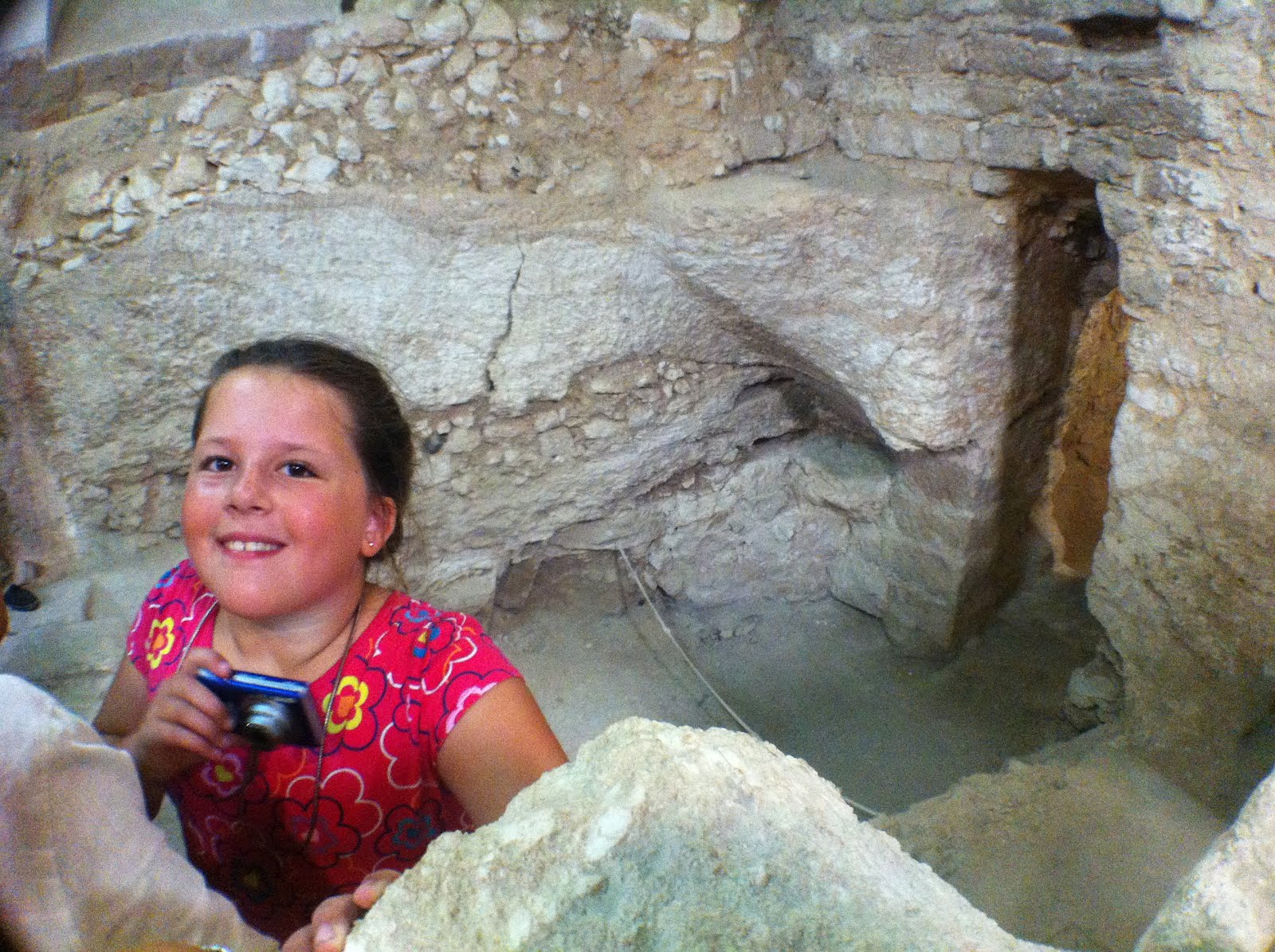 Visited mostly by pilgrims and other guests of the retreat house of the Religious Sisters of Nazareth, which shelters them, these ruins are known to include a Herodian grave complete with rolling stone (not Jesus's, of course; that was in Jerusalem), first-century as well as Byzantine and Crusader-era streets and floors, and remains of a first-century hillside residence (that's a cave to you and me, kids).
In Jesus's time, perhaps 200 people lived in Nazareth. So Jesus, Mary and Joseph and other members of their family probably at least walked through the portal into the front room behind pilgrim Brenna. Did they live here? There's not much on the web or even in guide books about this place. But there's evidence that people considered it holy for centuries.
More later. To follow our pilgrims' progress in the meantime, friend me on Facebook and check out the photos here.
Sunday, June 24, 2012
Five For The Road
 The St. John's Spirit of Jerusalem pilgrimage will begin its day (that's Monday to us) in the Judean desert and finish in Nazareth, land of occasionally sketchy wireless. To tide you over if necessary, some miscellaneous images, including our traveling Deb Neal fan club (that's Deb third from the right; out former Diocese of Los Angeles colleague, she's now the Bishop of Jerusalem's secretary).
 You want to have a truly blessed time in the Holy Land? Then travel with pilgrims Brenna (8), Steven (13), and Damian (12).
 Pilgrim Kathy gives pilgrim Cindy a back rub.
 In Episcopal churches everywhere, including St. Matthew's in Zababdeh, children proudly bring their Sunday school handwork into the great congregation when that long episode called the sermon is finally over.
 Singing one of my favorite hymns, "All Hail The Power Of Jesus' Name," with three of my favorite people, pilgrims Mike, Debbie, and Cindy? Words fail.
 Holy Land graffiti is always worth reading, noting, and inwardly digesting.
Subscribe to:
Posts (Atom)