All Holy Land pilgrims enjoy imagining that they're walking in the footsteps of Jesus Christ. A privileged few, including our recently returned St. John's cohort, can also say that they just may have stood in his living room.
On four trips since 2007, I and my fellow pilgrims have stayed at the guest house of the Religious Sisters of Nazareth, French nuns who began their ministry in Mary, Joseph, and Jesus's home town in 1855. As they began to build their convent, they discovered remnants of an Crusader-era church or monastery as well as a tomb with a rolled stone (like the one that would have been used for Jesus's burial in Jerusalem) that dates from the sixth century before Christ or even earlier. It's shown below with some of our pilgrims. Periodic excavations in the years since have uncovered cisterns, mosaics, and other features, including some from Byzantine times, which is to say from as early as the fourth and fifth centuries.
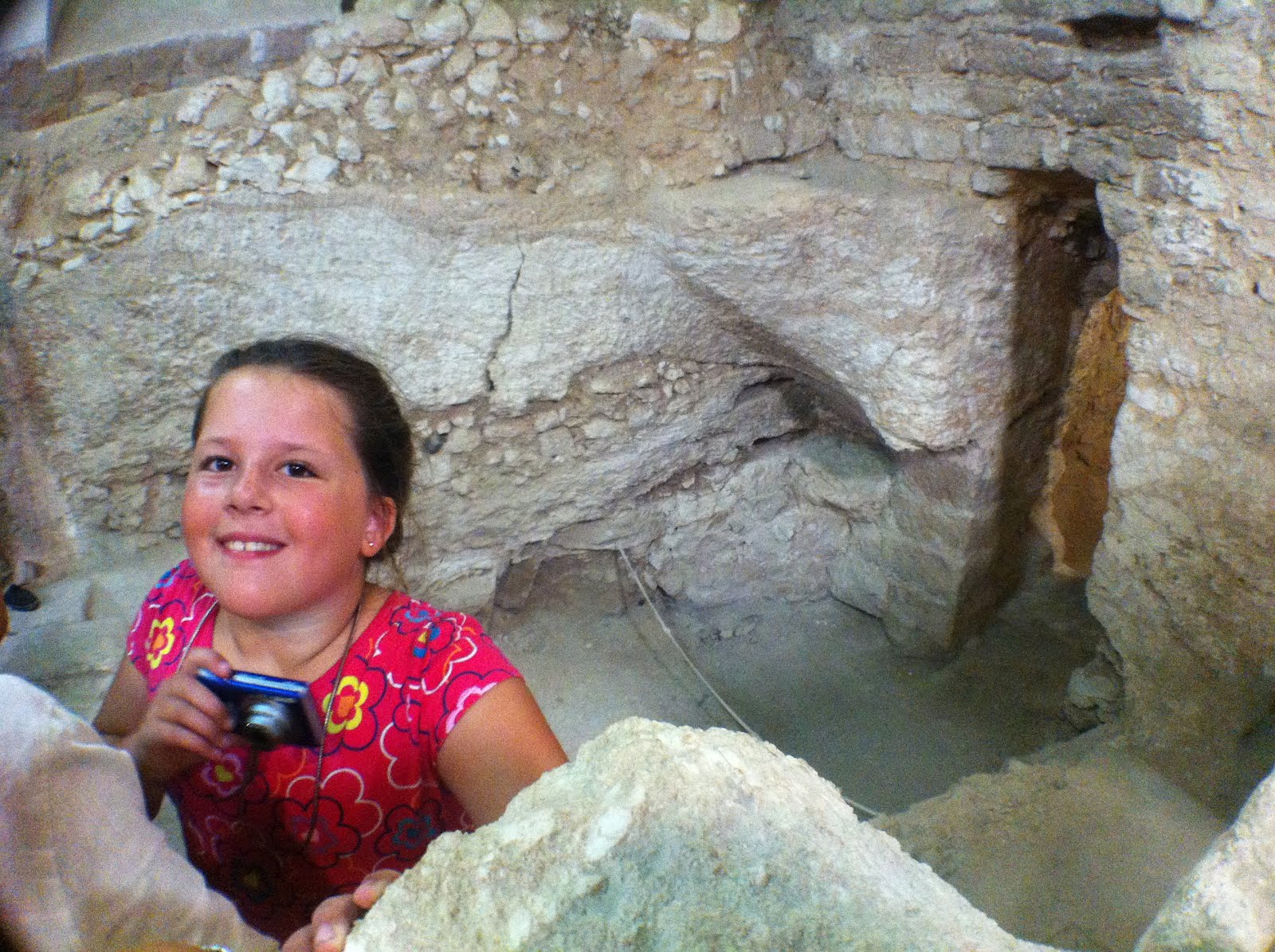
But the most intriguing finds are now thought to be from the first century, during Roman times -- street surfaces and a portion of a doorway that may have been a
 n entrance to the kind of cave dwelling that would have been common in Jesus's day, when as few as 200 people lived in Nazareth.
That's pilgrim Brenna Hayden above, with the doorway over her shoulder. She's standing in a first-century dwelling in the holy family's tiny home town. You begin to get the picture. Did Jesus visit or perhaps even live in this space?
Let's start with Mary and Joseph. Luke's gospel says they hailed from Nazareth and returned home soon after Jesus's birth. Matthew implies that they were from Bethlehem and says that they took the holy child to Egypt to escape Herod the Great's killers. Returning to Israel after Herod's death, Joseph was warned in a dream to take his family to Galilee (Matt. 2:22), where the Holy Spirit seems to have thoughtfully lined up work. In his archaeological history The Holy Land, Jerome Murphy-O'Connor writes that Joseph's arrival in Nazareth precisely coincided with Galilean tetrarch Herod Antipas's recruiting drive for artisans for a new capital he was building about three miles away, to be called Sephoris.
That would have given Joseph and eventually his young apprentice a way to afford a tidy little cave dwelling for themselves and Mary. But is it the spot under the Sisters? Perhaps not, or so we might conclude just from consulting Murphy-O'Connor. In his entry on the convent, he mentions the Second Temple-era tomb and Crusader ruins (circa 11th century) and also writes that the site was used by Muslims for worship after the Crusaders were driven out. But he doesn't mention any first-century ruins.
But all is not lost. During our visit in June, our guide, Canon Iyad Qumri, tantalized us by reading an excerpt from a seventh-century text describing the experiences of a pilgrim much like us that the Sisters take as evidence of the site's provenance:
The city of Nazareth, as Arculf who stayed in it relates, is situated on a mountain. It is, like Capharnaum, unwalled, yet it has large houses built of stone, and also two very large churches. One of these, in the middle of the city, is built upon two vaults, on the spot where there once stood the house in which our Lord the Saviour was brought up.The convent and guest house's central location (next door to the Roman Catholic Basilica of the Annunciation) and the description of the vaulting character of the site have inclined experts to believe that Arculf could have been talking about t
 he Sisters' spot, whose excavations are over two stories high. The reference to a church could account for the Byzantine ruins modern archaeologists have identified.
Who told Arculf that it had been Jesus's house? No one knows. Here's what we do know. We pilgrims were seeing, in one place, first century, Byzantine, and Crusader ruins. Add the mosque for good measure (remember that Muslims honor Jesus and his mother), and you have overwhelming evidence that the spot has been considered holy for 1500 years or more.
I asked the mother superior, Sister Stephania (shown here with pilgrim Debbie Bamberger), if she had more information about Arculf. She graciously provided a link to the full account of his visit to the Holy Land, which is thought to have taken place around 670.
My next stop was a volume I've rarely cracked since seminary. It turns out almost everything we know about Arculf comes from the Venerable Bede's Ecclesiastical History of the English People, which he completed in 731. Bede writes that Arculf was a French bishop who dictated the account of his travels in the Holy Land and around the Mediterranean to Adamnan, abbot of the famous monastery at Iona. Though he doesn't mention Nazareth, the meticulous Bede devotes three chapters to a summary of Arculf's pilgrimage, obviously considering it a document of considerable value.
So one of the church's greatest scholars put his blessing on a report that his era's Nazarenes were safeguarding the place Jesus grew up. It's a small-to-midsized leap of faith to believe that we were standing there, too. You know what? The place simply feels holy. In the end, if it's good enough Bede and the Sisters, it was good enough for Brenna and the pilgrims.