Showing posts with label Henry Kissinger. Show all posts

Tuesday, August 28, 2012

The Obama-First Foreign Policy

Roger Cohen hammers Barack Obama for surrounding himself with sycophants and comes pretty close to saying his foreign policy is a failure:

In the end the trust of a cool man who had sublimated abandonment into a singular willfulness was limited. The sense of a controlling leader, unable to provide connective tissue to fire the economy, lies behind the fact that many Obama voters will cast their ballot in November with more grudging respect than enthusiasm.

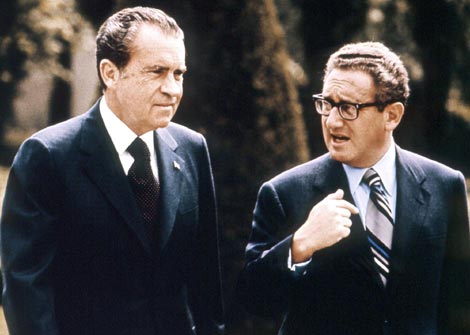
Nixon, like Obama, was a loner, but he had Kissinger generating ideas. Carter had Brzezinski. Reagan had Shultz. The first Bush had Baker. Obama has Tom Donilon as national security adviser. Donilon is an affable pro who has been described as a one-client lawyer. It is clear who the client is.

Then there is Hillary Clinton, a superb secretary of state. But for various reasons (her future is very much ahead of her), she has generally acquiesced to the White House being the locus of major foreign-policy decisions (salvaging things where necessary, as in Pakistan.)

The Obama inner circle remains a group of tough political tacticians: David Axelrod, David Plouffe and Valerie Jarrett. The White House national security team does not boast a single name of strategic stature. Anyone outside Washington would be hard pressed to name one.

The policy upshot has been predictable: cerebral, cool, and with one big exception, cautious. Obama has corrected big mistakes — abandoning the unwinnable global war on terror and pulling out of Iraq. To his immense credit he took a big gamble on killing Osama Bin Laden. But elsewhere he has been cautious to a fault, eyeing the political calendar.

He held out a hand to Iran but promptly reverted to tired old carrots and sticks; his response to the great popular uprising of 2009 was slow. He took half-steps on Israel and Palestine — criticizing Israeli settlements, saying the pre-1967 lines were the basis for a two-state peace — only to offer zero follow-through. Nothing changed.

On Egypt, he toyed with preserving Mubarak ad interim before the tide became irreversible. On Syria, he has in essence dithered. On Afghanistan, domestic politics dictated the agenda, at a cost in American lives.

Thursday, July 26, 2012

A Modified Olympian Hangout

Long before realizing he would be prematurely retired in San Clemente, Richard Nixon envisioned spending the last summer of his presidency presiding over a bicentennial Olympics in Los Angeles.

In this January 1970 memo from his national security adviser, Henry Kissinger, Nixon orders Secretary of State Bill Rogers to go all out getting the '76 games and promises to support a Moscow games in 1980 if the Soviets would back the U.S. bid. The Russians got 1980 anyway, and LA hosted in 1984.

The Nixon library has more documents at its Facebook page.

Wednesday, May 2, 2012

Obama Is The New Kissinger

Jacob Heilbrunn, writing at the National Interest, published by the former Nixon Center:

Can anyone doubt that the blind lawyer and dissident Chen Guangcheng, who says that he feels a "little" lied to by American embassy officials in Beijing, was, more or less, hustled out and dumped into a hospital before he could further disrupt Chinese-American relations, especially with high-level meetings coming up between Hillary Clinton, Timothy Geithner and their Chinese counterparts? If any episode crystallizes the ruthlessness of President Obama, it should be this one. Even as the GOP tries to depict him as an impotent president, he is acting more ruthlessly and decisively than almost any American president in recent memory, including George W. Bush.

Obama gives off every sign of taking coldly antiseptic positions in foreign affairs. Again and again, Obama has dismissed the notion that he should get involved in the internal affairs of other countries. The Arab Spring? He viewed it with caution. Libya? He tried to lead from behind. Syria? He wants nothing to do with it.

This approach might be called Obama's neo-Kissingerianism.

Thursday, February 16, 2012

Soft America, Hard China

Eugene Robinson urges the U.S. to take China and its leaders seriously, especially heir apparent Xi Jinping, because they are men (mostly) who have been tested by considerable hardship. Robinson is implying that our elites are soft and dilettantish by comparison:

Xi’s father, Xi Zhongxun, once one of Mao Zedong’s lieutenants, fell out of favor and was persecuted during much of that era. Xi Jinping is part of a remarkable generation that survived the apocalypse of the Cultural Revolution; as a teenager, he spent long, hard years living in a cave in the poor, remote Shaanxi province.

Xi fared better than the man considered his chief rival for power and influence in China — Bo Xilai, the Communist Party chief for the Chongqing metropolitan area, which is home to nearly 30 million people. Bo’s father, Bo Yibo, was one of Mao’s most trusted associates before being purged in the Cultural Revolution. The whole family was sent to a prison for five years, then to a labor camp for another five. Bo Xilai’s mother either committed suicide or was beaten to death.

I recount this history because it helps me understand why the men — and a few women — now running China are the way they are: impatient to make up for lost time, pathologically wary of the slightest instability, tough, resourceful, adaptable, coldly unsentimental and, as [Henry] Kissinger generalized in his introduction, convinced “that every solution is the beginning of a new set of problems.”

Photo: Zhou Enlai and Mao Zedong

Tuesday, February 14, 2012

Nixon's Thorough Thought Process

Writing at The National Interest, which is published by the former Nixon Center, Paul Pillar disputes David Ignatius's suggestion that the most remarkable thing about Richard Nixon's opening to communist China was that it was undertaken by a staunch anti-communist:

Nixon's initiative had its roots in his cogitation while out of power about great power politics and how it could be reshaped to America's advantage. When he entered the White House in 1969 it was with one of the most fully formed strategic outlooks about foreign affairs of any incoming U.S. president. A fundamental aspect of the China initiative that Ignatius does not mention is that it was one leg of triangular diplomacy in which Nixon intended to use the relationship with Beijing to gain leverage in his dealings with the Soviet Union. On the China part of his strategy, Nixon was even ahead of his geostrategic partner Henry Kissinger.

Nixon personally planned the negotiating approach toward China, inventorying on his yellow legal pad the objectives of each state and where they might find common ground. It was a thorough thought process that—especially in taking account of the perspectives and interests of the other side—is sorely missing from much of what passes for public debate about foreign policy today. Nixon and Kissinger's super-close-hold manner of handling the initiative, in which even Secretary of State William Rogers was kept in the dark, had its disadvantages. Some signals from the Chinese were missed, and there were some avoidable stumbles in the drafting of what became known as the Shanghai Communiqué. But to the extent the result was a positive accomplishment, which it was, the credit was all Nixon's.

TNI's new editor, Robert W. Merry, missed an opportunity to devote the January-February 2012 print edition to a look back and forward at Sino-U.S. relations through the prism of the Nixon initiative. I was glad to learn that the center itself has some programming planned.

Saturday, February 11, 2012

First Lord Of China

Later U.S. ambassador to China, Winston Lord served as an aide to NSC adviser Henry Kissinger in the Nixon White House. As the Shanghai Daily marks the 40th anniversary of Richard Nixon's 1972 visit, Lord trumpeted his own achievement during Kissinger's cloak-and-dagger advance trip the year before:
We were flying secretively from Pakistan to Beijing on a Pakistani plane, and as the plane got close to the Chinese...border, I was in the front of the plane, and Dr. Kissinger was in the back of the plane, so as we went into Chinese territory, I was the first. I always told everyone, and Kissinger agrees, that I was the first American official to visit China in 22 years.

Friday, December 16, 2011

St. Christopher's Mettle

David Frum on a great man of the middle:

If Christopher [Hitchens] quit the left...he never joined the right. Like his great hero George Orwell, he was a man whose most creative period of life was a period of constantly falling between two stools: his new hatred for George Galloway never dimmed his old animosity toward Henry Kissinger. He was for the Iraq war without ever much trusting or liking the leaders who led that war. The stock phrase of the 2000s on the right was "moral clarity." If moral clarity means hating cruelty and oppression, then Christopher Hitchens was above all things a man of moral clarity. But he was also a man of moral complexity, who would not submit to Lenin's demand that who says A must say B. Christopher was never more himself than when - after saying A - he adamantly refused to say B.

I wrote to Hitchens in June 2010, after I'd finished reading Hitch-22 and just before his cancer diagnosis. I never heard back. I'm not even sure I had the right address. Yesterday, before learning of his death, I'd been thinking of the e-mail as news came of the formal end of the U.S. war in Iraq:
Dear Mr. Hitchens:

Thank you for your wonderful memoir. I loved many things about it, but I'll confine my comments to some passages for which I was especially grateful.

As a seminarian, I preached a sermon about the Iraq war in the spring of 2003 (attached, not that you would possibly have time to read it) which, in our liberal Episcopal diocese, was viewed as bloodcurdlingly pro-war by virtue of not being antiwar. In the receiving line, a woman called me a liar for associating Saddam Hussein with Islamic totalitarianism. Since then, I've often wondered if I should've kept my intern's mouth shut, because of what our congregant said and also because of the way the war sometimes was going. Your summary of the evidence of Saddam's latter-day fundamentalism stanched one vein of second-guessing, and some patience about the ultimate outcome for the region and the people of Iraq should take care of the rest.

Thanks again.

Yours ever,

John Taylor

Sunday, April 10, 2011

Pragmatically Oblique

Henry Kissinger and James A. Baker adopt a policy of pragmatic skepticism about U.S. involvement in Libya:
[O]ur idealistic goals cannot be the sole motivation for the use of force in U.S. foreign policy. We cannot be the world’s policeman. We cannot use military force to meet every humanitarian challenge that might arise. Where would we stop? Syria, Yemen, Algeria or Iran? What about countries that have been strong allies but do not share all of our values, such as Bahrain, Morocco and Saudi Arabia? What about humanitarian violations in other countries, such as Ivory Coast?
Their "pragmatic idealism" paradigm was a favorite of Richard Nixon's, envisioned, ironically, as a critique of Kissinger's super-realism. Nixon's biographer, Jonathan Aitken, insisted that it was a contradiction in terms.

Wednesday, April 6, 2011

April Fools For Christ

On an Easter Sunday about 45 years ago, our little family was a little late for services at the Cathedral Church of St. Paul in Detroit. We found seats in a pew near the back, on the right near the aisle. The congregation was half a verse into "Jesus Christ Is Risen Today." As we reached for our hymnals, my English-born grandmother, Lily Sharley, sighed with pleasure and said, "I'm so glad we got here in time to sing this." It was a powerful moment for me, fixed in my memory and dreams; and this pew looks about right.

Kathy and I visited the cathedral Tuesday afternoon after I'd given a speech in nearby Dearborn to 300 funeral home managers. I received the invitation thanks to my musical buddy Gary "Boom" Baker, whom I've known since he assisted with President and Mrs. Nixon's funerals, which I oversaw in 1994 and 1993 as director of the Nixon library. Gary's now an executive of SCI, owner of over 2,000 funeral homes and cemeteries.

The funeral business is worried about losing customers, the mainline church about losing congregants. One brand-new solution we fixed on is good, old pastorship. The two keynoters at the SCI conference, celebrant trainer Glenda Stansbury and I, found ourselves in a degree of friendly opposition. She travels around the country training laypeople and the occasional atheist to celebrate and preach at funerals because, these days, many family member of decedents distrust the church, don't believe in God, or just assume we'll do a poor job. In my remarks, I said the church had better not be too willing to cede that ground.

Our hosts asked me to tell Kathy's and my Nixon funeral stories (you try getting Henry Kissinger to stay within five minutes for a eulogy sometime, plus there was that moment with G. Gordon Liddy) before talking about funeral ministry. It was a chance to really unwind, since they gave me an hour and 15 minutes (which will alarm the people of St. John's). As Episcopalians will, I mentioned the priesthood conferred on all Christians by baptism. Arriving at St. Paul's on Woodward Ave. a few hours later (not far from the Fox Theater, where my homey Eminem arrived in that fine new Chrysler in his Super Bowl ad), Kathy and I were warmly greeted by a genial man on his way to the parking lot. I announced a little boisterously that on April 1 I'd celebrated the 50th anniversary of my baptism at St. Paul's. He replied that he was the Very Rev. Scott Hunter, installed as dean of St. Paul's four years ago, also on April 1. Couple of April Fools for Christ, the dean and I.

Friday, March 18, 2011

How Not To Do More Than We Should In Libya

Former Pentagon official Dov Zakheim (whose name I used to mispronounce while MCing Nixon Center dinners in the old days; it does not, he finally told me genially, rhyme with l'chiam) describes how the Europeans and Arab League maneuvered the Obama administration into joining the anti-Qaddafi military coalition. Looking ahead:
Calling for Arab participation in military action is not enough; it will not get the U.S. off the military hook. The administration should make it clear that America's role will be limited to providing logistical and intelligence support, and enforcing a no-fly zone, while its allies attack Qaddafi's troops on the ground. The Arabs could do this, or the British, or the French, or some combination of all three and of others who wish to join in. At most, the U.S. should take out Libya's air defenses, which stand in the way of an effective no-fly zone. Even that operation could be conducted by the NATO allies.

Unless the administration specifies exactly what it is prepared to do, and not prepared to do, it will get called upon to do more than it should.
Zak-Heim is above left. Why do I include a photo of me in a rented tux at one of the last events I attended at the Center Formerly Known As Nixon? Because I can! On that occasion, and every day since the Nixon Center opened its doors in November 1994, the foreign policy institution which Nixon founded and to which he personally had lent his name -- housing experts with names like Kissinger, Schlesinger, Zacheim, Simes, Kemp, Saunders, and Rodman -- had something to say about vital events of the day such as the Libya intervention.

But on this historic day, Nixon's legacy is silent. His own center threw him over the side, and the lower-echelon, non-policy Nixon-Haldeman operatives now controlling Nixon's foundation -- also parties to the mysterious transaction that neutered Nixon's center -- have nothing to say about Libya.

Monday, February 21, 2011

Nixon's Best And Worst Ex-President's Days

Richard Nixon's best recent ex-president's day may have been the Feb. 2 Metropolitan Opera premiere of "Nixon In China." There's no doubt about his worst: The December 2010 opening of a secretly recorded White House conversation in which he and Henry Kissinger talk about whether it would've been an issue for the United States if the Soviet Union decided to murder all its Jews.

Reconciling the grand and tawdry in Nixon's complicated legacy should be the business of both historians and his dwindling cohort of intimates. Instead, Nixon's operatives chose to fight the battle of Yorba Linda over the contents of a Watergate gallery in which some of them play starring roles alongside 37. Here's hoping future Presidents Days will see that matter settled, at least, and historians hard at work in the Nixon library reading room, sifting through the immense record of the most copiously documented public person in the history of humankind.

As that record will show, Nixon was a great man, for good or ill. Being the subject of an opera makes him a grand one as well. In 1987, when I was his chief of staff, John Adams' "Nixon In China" was premiered in Houston and then in New York, at the Brooklyn Academy of Music. I conducted a reconnaissance by attending one of the BAM performances. I'd bragged to Nixon that I'd gone to prep school with the director, Peter Sellars, the infant phenomenon of 1980s international opera. But attending Sellars' one-man "Winnie-the-Pooh" in the Andover theater lab hadn't prepared me for the moment when a big, flat Air Force One glided onto the stage to thrilling orchestral fanfares and Nixon (baritone James Maddalena) stepped through the door and began to sing.

While I didn't care for the way the Nixons and especially Henry Kissinger were portrayed, I figured that having an opera written about you had to be a net plus unless your name happened to be Othello. But Nixon received my report with even more of his studied reserve than usual. He assumed his enemies were up to something, and besides, as he understood better than anyone, nothing could beat the drama of the real Nixon going to the real China in the real airplane.

At least to me, he never expressed any interest in seeing it himself. When his last chief of staff, Kathy O'Connor, was serving as acting executive director of the Nixon foundation in 2009, she also took a pass when the foundation was offered the opportunity to collaborate with a Long Beach Opera production. She feared that those closest to the Nixon family would appear to be blessing the opera's sometimes cartoonish characterizations. In particular, Kathy said the producers would have to be willing to change portions of the third act, in which Pat Nixon appeared to be drunk. The Nixon family had long battled against allegations that the first lady drank heavily in the White House during Watergate. One of my own first decisions as Nixon library director in 1990 was to remove the Nixon library cocktail glasses a marketing consultant had ordered for the gift shop.

Kathy's decision on the Long Beach production proved to be final. But some at Nixon's foundation still craved the spotlights, greasepaint, and mao tai (a fiery rice wine used by the Chinese for toasts that Nixon, as I saw during a 1985 trip to China, couldn't hold). They finally got the chance to raise their glasses in New York two weeks ago when assorted Nixon factotums, and even members of the Nixon family, attended the glittery Met premiere and were photographed backstage with Maddalena, who reprised his role as Nixon, and other cast members.

One especially knowledgeable guest, former Kissinger aide and ambassador to China Winston Lord, was deeply offended by what he saw. Like my theater critic father and godfather used to do, he was taking detailed notes on his program. Lord later found a sympathetic ear in journalist Gay Talese, who described his views in a "New Yorker" article:
[M]aking Kissinger a lecherous, cruel character is beyond the pale. It turns a heroic figure into a cardboard monster. There is no artistic rationale that explains this. One can only suspect a personal vendetta by the creators.
Lord stuck up for Kissinger where I'd failed to in my 1987 report to Nixon. Kissinger, in turn, had far more advocates than Nixon in December, when both attracted international condemnation for their taped remarks about Soviet Jews in 1973, in the midst of debates about Soviet emigration policy. Kissinger is heard saying that a Soviet holocaust would have been at best a humanitarian concern and by no means a U.S. interest; Nixon replies that it wouldn't be worth a thermonuclear war.

Their conversation was gross but not impossible to explain. Kissinger's friends weighed in, but no one now running Nixon's foundation stepped up to the plate to say that the Nixon they'd known and served wouldn't have permitted such a a foul genocide.

He wouldn't have. That the tapes make it appear otherwise pinpoints the greatest problem for Nixon's legacy and the greatest opportunity for scholars who are willing to open their minds to the ambiguity bequeathed to them by Nixon's tapes and temperament.

His taping system was the worst idea in the history of the modern presidency. He either had no idea how his private discourse would play publicly or no conception of ever losing control of the tapes. For someone who was so careful about his public persona, it was the ultimate nightmare. In the early 1990s, I got a call in Yorba Linda from Carlos Narvaez, who worked for Nixon in the National Archives. "The tapes must never come out," he said. "His reputation will never recover." After Nixon died in 1994, I prayed our friend Carlos was wrong as I negotiated a deal under which the tapes were opened beginning in 1996 and were supposed to be fully opened by 2000.

It now looks as though it will take the National Archives until at least 2012 to complete the laborious process. That's too bad. The battering Nixon's reputation takes from each successive tapes opening -- Watergate reporter Bob Woodward called it the gift that keeps on giving -- keeps a balanced view of his legacy under wraps. So does history's failure to appreciate his deeply introverted temperament, which made each of his public appearances a trial, each meeting with associates an intricate minuet of conflict avoidance, and each conversation with the few people he really trusted an opportunity to release all the tension and anger of being a wartime INTJ.

Nixon's toxic theories and statements about race are especially problematical. It will take scholars decades to sort it all out. When they do, I remain hopeful that they'll understand that he was a far more serious, diligent, and gracious person than history now remembers. For 37, there should be countless better Presidents Days ahead. In the meantime, remember that Nixon went to China, and they're still singing about it.

Above left: Nixon in Hangzhou, China in 1993 with his chief of staff, Kathy O'Connor. Behind them is a tree he planted during his historic 1972 visit.

Sunday, February 6, 2011

Obama Is The New Kissinger

Ross Douthat on our realist president:
Obama’s response to the Egyptian crisis has crystallized [Barack Obama's] entire foreign policy vision. Switch on Rush Limbaugh or Fox News, and you would assume that there’s a terrible left-wing naïveté — or worse, a sneaking anticolonial sympathy for the Muslim Brotherhood — at work in the White House’s attempts to usher Hosni Mubarak out the door. But look closer, and it’s clear that the administration’s real goal has been to dispense with Mubarak while keeping the dictator’s military subordinates very much in charge. If the Obama White House has its way, any opening to democracy will be carefully stage-managed by an insider like Omar Suleiman, the former general and Egyptian intelligence chief who’s best known in Washington for his cooperation with the C.I.A.’s rendition program. This isn’t softheaded peacenik dithering. It’s cold-blooded realpolitik.

Tuesday, December 28, 2010

Commander-In-Relief

I've been blogging more than usual about Mr. Nixon, I realize, what with the newly opened tapes and his White House aides' efforts to block the federal Nixon library's new Watergate exhibit. Even as I hiked through the Joshua Tree National Park this afternoon, there he was. I ran into Dr. Kissinger out here last year.

Monday, December 27, 2010

Oh, Henry!

Having failed to get Henry Kissinger arrested, tried, convicted, and keelhauled for what he did, Christopher Hitchens tries finally to close the deal with an explosion of outrage about what he said.

Sunday, December 26, 2010

These Two Stories Are Not In Concorde

Trying to find something to illustrate my post below about Maarja's Washington Home story, I ran across this photo of President Nixon with the Concorde. According to alternatehistory.com, it shows Nixon arriving in England in August 1970 after a brief hop from Paris.

That didn't seem right, since 1) I don't think the Secret Service would've let him ride on the Concorde in 1970 (though I accompanied him on it once many years later), 2) the guy meeting Nixon doesn't look like Prime Minister Edward Health, and 3) U.S. presidents and British prime ministers usually don't need translators (more about him in a moment).

It didn't take long to learn the real story at UPI.com, which displays the same photo with this caption:
President Nixon leaves after taking a five-minute tour on Dec. 14, 1971, of the Concorde, the British-French supersonic jet, and said: "I wish we had built it." Nixon looked through the sleek SST (background) at Lajes Field, the U.S. operated air base outside the capital of the Azores. Walking with Nixon (at right) is Portuguese Prime Minister Marcello Geatana. Man in center is unidentified. The Concorde brought French President George Pompidou to the Azores for the meeting with pres. Nixon. (UPI Photo/John Full/Files)
The man at center is the late diplomat and CIA official Gen. Vernon Walters, Nixon's friend, legendary language savant, and one of God's great gentlemen. You can also see Henry Kissinger at Nixon's left.

Saturday, December 25, 2010

Bashing Nixon To Build Up Reagan

On Tuesday, Michael Gerson used the distasteful Nixon-Kissinger conversation about a hypothetical Soviet holocaust against Jews to promote the ideology that Ronald Reagan brought about the fall of the Soviet Union. He goes so far as to imply, outrageously, that Nixon really would've let Soviet Jews be gassed:
[F]rom this historical episode, it is clear that repeated doses of foreign policy realism can deaden the conscience. In President Nixon's office, a lack of human sentiment was viewed as proof of mental toughness - an atmosphere that diminished the office itself. Realists are often dismissive of Manichean distinctions between good and evil, light and darkness. But in the world beyond good and evil, some may be lightly consigned to the gas chambers.
Gerson's comment is especially appalling in view of an historical reality which he neglects to mention, namely that Jewish emigration from the Soviet Union reached its Cold War apogee as the direct result of Nixon's policies. That means Russia's Jews were safer because of Nixon, and yet Gerson claims to have gotten a whiff of gas. While the taped Nix-Kiss exchange is impossible to defend on its merits, it's nothing but hot air.

Since the tape was opened earlier this month, Kissinger's friends have defended him strenuously. No word yet from Nixon's men -- except, now, Kissinger himself. Knowing him, I'd say his response became inevitable after Gerson used the opportunity of the tapes opening to suggest that the Jackson-Vanik amendment (which tied U.S.-Soviet trade relations to rates of emigration and ended up making it far harder for Jews to get out than it had been under Nixon) somehow helped end the Cold War. In response, Kissinger took to the Washington Post op-ed page on Christmas Eve. He began by apologizing for his loose talk in the White House and then took aim at his Reagan-boosting critic:

Gerson ascribes the collapse of the Soviet Union in part to the Jackson-Vanik Amendment. The amendment played no significant role in what resulted from imperial overstretch, incompetent economic management and the determined resistance of a succession of presidents from both parties, culminating in the Reagan period.

Gerson sneers at detente as if it were a kind of moral abdication. Memories are short. The conversation under discussion occurred on March 1, 1973. The Vietnam War had just ended; prisoners had not yet returned.

An effective global strategy was in place with the opening to China, a broad dialogue with the Soviet Union, and major progress in Egypt and on emigration. It was to preserve that policy that the conversation in the Oval Office took place, and it is in that context that it must be viewed.

Wednesday, December 22, 2010

Asleep Again

The self-styled friends of Richard Nixon's legacy have still said nothing about his controversial exchange about Soviet Jews with Henry Kissinger in May 1973, whereas Kissinger's friends, including Mort Zuckerman, wrote as follows to the New York Times on Tuesday:

Just several weeks before this conversation, Mr. Kissinger and Nixon agreed to provide Israel with 100 advanced aircraft and to remove Israeli issues from the State Department to the White House, something strongly sought by Golda Meir, who was then prime minister.

Earlier, in 1969, when only approximately 700 Jews were allowed to emigrate from the Soviet Union, Mr. Kissinger, then the national security adviser, broached the issue with the Soviet ambassador, Anatoly F. Dobrynin. As a result of this conversation, among others, the Soviets allowed the number of émigrés to increase to almost 40,000 by 1972.

Mr. Kissinger consistently played a constructive role vis-à-vis Israel both as national security adviser and secretary of state, especially when the United States extended dramatic assistance to Israel during the 1973 Yom Kippur War, when Israel’s very existence was at stake.

Over the decades, many of us have heard Mr. Kissinger speak out forcefully on behalf of the security and independence of Israel, and never have we heard him speak in a disparaging way about the Jewish community.

The critics of Mr. Kissinger should remember the context of his entire life and ask whether that judgment is fair. We think the answer is obvious.

Sunday, December 19, 2010

In Need Of One Good Book

It's easy to understand people's revulsion at the racial and ethnic commentary on the newly opened Nixon White House tapes, especially the exchange between Richard Nixon and Henry Kissinger about a hypothetical Soviet holocaust against Jews. As his chief of staff, library director, and legal co-executor, I cringe myself.

That being said, during thousands of hours of conversations with me over a 15-year association, he rarely if ever talked this way. Even as a former president, he devoted most of his time and energy to substance -- articles, books, and speeches, as well as his voracious consumption of and commentary about political and policy news.

Having spent plenty of time with the Nixon tapes, my sense is that their 4,000 hours embody a comparable disproportion between substance and triviality. But today's snarling editorial in the New York Times goes out of its way not to take a balanced view. Again, anger about racism and anti-Semitism is understandable. But I'm sure the Times also realizes that Nixon was a serious person of considerable accomplishment whose legacy of foreign policy innovation and domestic pragmatism can still teach us a lot in our era of terrorist threats from abroad and ideological warfare at home.

But frankly, I really shouldn't be picking on the Times, which has been left a clear field. With the exception of the measured insider's perspective at Maarja Krusten's new NixoNARA, it's astonishing how few people have piped up for 37 since the new tapes were opened. Pleased finally to find some relatively friendly commentary about Nixon on another, unfamiliar blog the other day, I went to the home page and realized it was operated by white nationalists. The Nixon White House aides who have devoted so much effort to trying to block the Nixon library Watergate exhibit in which some of them play starring roles appear to have gone home for Christmas now that the tapes beg for friends and associates to stand up and say, "That's not the totality of the man I knew."

One Nixon family member who was especially prone to defeatism repeatedly expressed a fear to me that Nixon's reputation would never recover from the rancor of his times and racism on the tapes. With each new records opening, I can see why someone could feel that way. The Times notes the devastating irony of tapes Nixon thought would cement his reputation instead having the effect of cement wingtips, dragging his historical standing further down. Having helped negotiate a three-party settlement that envisioned all the tapes being opened by 2000, I regret that the National Archives has taken this long to open the whole collection. The library now says it will take until 2012. Scholars used to blame us Nixonites for holding up the tapes. But we waved the white flag in 1996. Why will historians have had to wait at least more 16 years?

And yet all is not lost. The Nixon Center in Washington continues to promote Nixon's living principles of enlightened national interest as the foundation of the U.S.'s role in a changing world. Not only the thousands of hours of opened tapes but all the records are finally housed or available at the Nixon library -- the richest presidential collection about one of the most momentous eras in modern history. Thanks to my elder daughter Valerie, last Monday I had dinner with a young scholar from Italy who's studying relations between the U.S. and Brazil during 1971-73. She said there were four other readers working at the library last week alone.

If Nixon were still here and I could call to buck him up, I'd actually be the first to mention the Jews. I'd remind him that they wandered in the wilderness for at least 40 years. I'd say, "Mr. President, you've still got a shot at the promised land. All you need is a few historians and biographers who are willing to take the sweet with the bitter. Just one good book from an independent voice: Manna from heaven."

Tuesday, December 14, 2010

Scoop's Fault

JTA, the Jewish news service, on Henry Kissinger's 1973 comments about a hypothetical Soviet holocaust:

Kissinger in an e-mail to JTA would brook no request for an apology and did not even directly address his gas chambers remark. Instead he appeared to insist on context: His frustration at the time with the insistence of the Jewish community and U.S. senators such as Jacob Javits (R-N.Y.) and Henry "Scoop"Jackson (D-Wash.) on attaching human rights riders to dealings with the Soviets.

“The quotations ascribed to me in the transcript of the conversation with President Nixon must be viewed in the context of the time,” Kissinger wrote to JTA.

He and Nixon pursued the issue of Soviet Jewish emigration as a humanitarian matter separate from foreign policy issues in order to avoid questions of sovereignty and because normal diplomatic channels were closed, Kissinger wrote.

“By this method and the persistent private representation at the highest level we managed to raise emigration from 700 per year to close to 40,000 in 1972,” Kissinger wrote. “We disagreed with the Jackson Amendment, which made Jewish emigration a foreign policy issue. We feared that the Amendment would reduce emigration, which is exactly what happened. Jewish emigration never reached the level of 40,000 again until the Soviet Union collapsed. The conversation between Nixon and me must be seen in the context of that dispute and of our distinction between a foreign policy and a humanitarian approach.”

Hiss Or History?

Thirty-six years after Richard Nixon's resignation and and 16 years after his death, his rivalry continues with his partner in peacemaking, Henry Kissinger. One of the most successful in the history of the presidency, their collaboration was rooted in factors other than temperamental affinity.

It's true that they may have liked one another more than they let on. Kathy O'Connor, Nixon's last chief of staff, tells a story about being with him at an event in New York City in the 1990s. She was standing in a hotel hallway outside the men's room door listening to Nixon and Kissinger inside as they teased each other and told corny gags in their growly baritones. In 1986, I sat with them for a hour while they worked out their disagreements over the wording of an op-ed about arms control they were submitting to the New York Times. The almost affectionate quality of their banter showed that they had a brothers-from-other-dimensions thing going on. When the debate finally came down to a choice between two words, after an uncomfortable silence Kissinger looked at me and said, "Vat do you tink?"

While in office, they were wary of each other at best. One of the reasons Nixon installed his taping system was so he could show who had been the principal architect of his administration's foreign and war policies, he or his brilliant, self-promoting professor. It was an historically bad move, because the the tapes' loose talk and vulgarity are so far making a balanced view of Nixon and his presidency almost impossible.

But on the narrow issue of what he feared Kissinger would say about the policy process "to his fashionable, liberal friends" outside the White House, Nixon seems to have had a point. The latest episode in Kissinger/Nixon began last week, when the Nixon library opened a recording made in the spring of 1973 which contained this exchange:
"The emigration of Jews from the Soviet Union is not an objective of American foreign policy,” Mr. Kissinger said. “And if they put Jews into gas chambers in the Soviet Union, it is not an American concern. Maybe a humanitarian concern.”

“I know,” Nixon responded. “We can’t blow up the world because of it.”
Jeffrey Goldberg calls Kissinger's comments "among the most vile ever spoken by a Jew about his own people." Kissinger's severest critic, Christopher Hitchens, also piles on.

I wrote last week about the irony of Kissinger's fears that the tapes would show him reacting fawningly to Nixon's outrageousness. As distasteful as the exchange is, it's possible to see in Nixon's response (avoiding all-out nuclear war is surely an appropriate imperative for a U.S. president to mention, even in this revolting a hypothetical context) the vaguest glimmer of a demur to Kissinger's Frankensteinian realpolitik.

It's also important to note that the Anti-Defamation League, while not defending Kissinger's comments, says they don't mean much compared with his lifetime of support for Israel. (Hat tip to Goldberg for the ADL release.)

Besides, in the end, how much exegesis can one blast of hot air really withstand? Was there a Soviet holocaust? No. Would Nixon and Kissinger have stood by and let one happen? Their harshest critics may think so. But no, they wouldn't have let it happen. How do I know? Because I talked to Nixon for about 12,000 hours over the course of 14 years, and you get to know a person.

While it would seem obvious that this big-guy BS had no operational relevance whatsoever, Marty Peretz, one of the few to rise to Kissinger's defense, thinks otherwise:

I know something about Kissinger's maneuvering for the Jewish state and for the Jewish people. I and a few Harvard colleagues were in touch with him, actually met with him during the dread days of the Yom Kippur War when Israel's very survival was at peril. (Henry Rosovsky, Samuel Huntington, Michael Walzer, Thomas Schelling and I comprised the group.) Dr. K. confided to us how difficult it was to persuade his bigoted boss that a great deal of American arms (and sufficient Lockheed C-130s "Hercules" aircraft to deliver them) were needed and needed instantly. There is no doubt in my mind that Kissinger rescued the third commonwealth with these munitions....

So, if Kissinger needed to flatter Nixon in order to convince him, that flattery was also a blessing.

Yep, there goes Henry again, Mr. President, trying to impress his friends at your expense -- and, this time, succeeding spectacularly. Peretz's argument seems to be that Kissinger made his awful comment in order to burnish his credentials (would that be as a self-loathing Jew?) so that, when the time came, he would have enough leverage to maneuver the beast into an Israel-saving move. The problem (besides that it's a dopey idea) is that there's no evidence that Nixon had to be persuaded by Kissinger or anyone else to send massive aid to Israel during the Yom Kippur War in October 1973. Some actually think it was Kissinger who wanted to hold back on the arms shipments, to improve Egypt's position in ceasefire negotiations (the U.S. was in the process of wooing Egypt away from its reliance on the Soviet Union, a major win for the realpolitikians).

More evidence that the Nixon tapes are both boon and bane, sometimes history, sometimes just hiss.