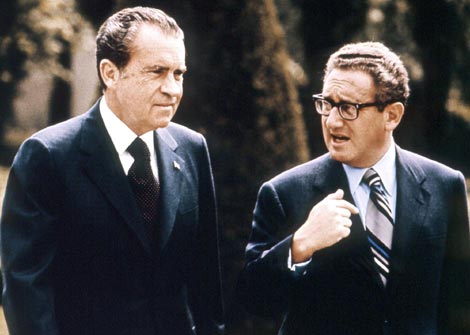
Richard Nixon's best recent ex-president's day may have been the Feb. 2
Metropolitan Opera premiere of "Nixon In China." There's no doubt about his worst: The December 2010 opening of a secretly recorded White House conversation in which
he and Henry Kissinger talk about whether it would've been an issue for the United States if the Soviet Union decided to murder all its Jews.
Reconciling the grand and tawdry in Nixon's complicated legacy should be the business of both historians and his dwindling cohort of intimates. Instead, Nixon's operatives chose to fight the
battle of Yorba Linda over the contents of a Watergate gallery in which some of them play
starring roles alongside 37. Here's hoping future Presidents Days will see that matter settled, at least, and historians hard at work in the
Nixon library reading room, sifting through the immense record of the most copiously documented public person in the history of humankind.
As that record will show, Nixon was a great man, for good or ill. Being the subject of an opera makes him a grand one as well. In 1987, when I was his chief of staff, John Adams' "Nixon In China" was premiered in Houston and then in New York, at the Brooklyn Academy of Music. I conducted a reconnaissance by attending one of the BAM performances. I'd bragged to Nixon that I'd gone to prep school with the director, Peter Sellars, the i

nfant phenomenon of 1980s international opera. But attending Sellars' one-man "Winnie-the-Pooh" in the Andover theater lab hadn't prepared me for the moment when a big, flat Air Force One glided onto the stage to thrilling orchestral fanfares and Nixon (baritone James Maddalena) stepped through the door and began to sing.
While I didn't care for the way the Nixons and especially Henry Kissinger were portrayed, I figured that having an opera written about you had to be a net plus unless your name happened to be Othello. But Nixon received my report with even more of his studied reserve than usual. He assumed his enemies were up to something, and besides, as he understood better than anyone, nothing could beat the drama of the real Nixon going to the real China in the real airplane.
At least to me, he never expressed any interest in seeing it himself. When his last chief of staff, Kathy O'Connor, was serving as acting executive director of the Nixon foundation in 2009, she also took a pass when the foundation was offered the opportunity to collaborate with a Long Beach Opera production. She feared that those closest to the Nixon family would appear to be blessing the opera's sometimes cartoonish

characterizations. In particular, Kathy said the producers would have to be willing to change portions of the third act, in which Pat Nixon appeared to be drunk. The Nixon family had long battled against allegations that the first lady drank heavily in the White House during Watergate. One of my own first decisions as Nixon library director in 1990 was to remove the Nixon library cocktail glasses a marketing consultant had ordered for the gift shop.
Kathy's decision on the Long Beach production proved to be final. But some at Nixon's foundation still craved the spotlights, greasepaint, and
mao tai (a fiery rice wine used by the Chinese for toasts that Nixon, as I saw during a 1985 trip to China, couldn't hold). They finally got the chance to
raise their glasses in New York two weeks ago when assorted Nixon factotums, and even members of the Nixon family, attended the glittery Met premiere and were photographed backstage with Maddalena, who reprised his role as Nixon, and other cast members.
One especially knowledgeable guest, former Kissinger aide and ambassador to China Winston Lord, was deeply offended by what he saw. Like my theater critic father and godfather used to do, he was taking detailed notes on his program. Lord later found a sympathetic ear in journalist Gay Talese, who
described his views in a "New Yorker" article:
[M]aking Kissinger a lecherous, cruel character is beyond the pale. It turns a heroic figure into a cardboard monster. There is no artistic rationale that explains this. One can only suspect a personal vendetta by the creators.
Lord stuck up for Kissinger where I'd failed to in my 1987 report to Nixon. Kissinger, in turn, had far more advocates than Nixon in December, when both attracted international
condemnation for their taped remarks about
Soviet Jews in 1973, in the midst of debates about Soviet emigration policy. Kissinger is heard saying that a Soviet holocaust would have been at best a humanitarian concern and by no means a U.S. interest; Nixon replies that

it wouldn't be worth a thermonuclear war.
Their conversation was gross but not impossible to explain.
Kissinger's friends weighed in, but no one now running Nixon's foundation stepped up to the plate to say that the Nixon they'd known and served wouldn't have permitted such a a foul genocide.
He wouldn't have. That the tapes make it appear otherwise pinpoints the greatest problem for Nixon's legacy and the greatest opportunity for scholars who are willing to open their minds to the ambiguity bequeathed to them by Nixon's tapes and temperament.
His taping system was the worst idea in the history of the modern presidency. He either had no idea how his private discourse would play publicly or no conception of ever losing control of the tapes. For someone who was so careful about his public persona, it was the ultimate nightmare. In the early 1990s, I got a call in Yorba Linda from Carlos Narvaez, who worked for Nixon in the National Archives. "The tapes must never come out," he said. "His reputation will never recover." After Nixon died in 1994, I prayed our friend Carlos was wrong as I
negotiated a deal under which the tapes were opened beginning in 1996 and were supposed to be fully opened by 2000.
It now looks as though it will take the National Archives until at least 2012 to complete the laborious process. That's too bad. The battering Nixon's reputation takes from each successive tapes opening -- Watergate reporter Bob Woodward called it the gift that keeps on giving -- keeps a balanced view of his legacy under wraps. So does history's failure to appreciate his
deeply introverted temperament, which made each of his public appearances a trial, each meeting with associates an intricate minuet of conflict avoidance, and each conversation with the few people he really trusted an opportunity to release all the tension and anger of being
a wartime INTJ.
Nixon's
toxic theories and statements about race are especially problematical. It will take scholars decades to sort it all out. When they do, I
remain hopeful that they'll understand that he was a far more serious, diligent, and gracious person than history now remembers. For 37, there should be countless better Presidents Days ahead. In the meantime, remember that Nixon went to China, and they're still singing about it.
Above left: Nixon in Hangzhou, China in 1993 with his chief of staff, Kathy O'Connor. Behind them is a tree he planted during his historic 1972 visit.
 Cheng Shi-Zheng grew up in China during the Cultural Revolution, when elites were ruthlessly persecuted by Communist Party leader Mao Zedong. Cheng is directing a new Paris production of the opera "Nixon in China." If Nixon is controversial in the U.S., imagine Mao in China, where victims of the Cultural Revolution are highly influential in politics and culture. The Bangkok Post:






.jpeg)