Saturday, July 7, 2012

My Episcopal Trifecta For The Day

Episcopal as in pertaining or relating to bishops and the historic episcopacy, that is.

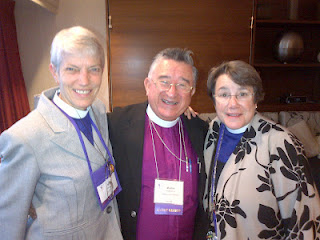
Deacons and priests tend to tell their ecclesiastical life stories with reference to bishops. For instance, take this photo, which appeared today on Bishop Suffragan Diane Jardine Bruce's blog showing her with her sister suffragan, Mary Douglas Glasspool (left) and Bishop Martin Barahona of the Episcopal Diocese of El Salvador at an event in his honor during our triennial General Convention in Indianapolis.

I was Bishop Mary's chaplain when she and Diane were participating in the process that led to their historic election as our diocese's first women bishops in 2009. Bishop Diane was a gracious and indispensable mentor in the late 1990s during my ministry study year at Church of the Messiah in Santa Ana, California, where she was associate rector. As a fellow Bloy House seminarian, she also gave me photocopies of her famous Charles Frazee church history index cards. For five points, what's the Shepherd of Hermas? And I had the blessing of serving as Bishop Barahona's chaplain when he paid a visit to St. Paul's Episcopal Church in Tustin, California one Sunday in 2002, where I was doing a field study internship.

We just love our bishops!

Limning Some Historic Limestone

From our diocese's daily e-mail from The Episcopal Church's triennial General Convention in Indianapolis, we learn that Bishop Suffragan Mary Douglas Glasspool is combining theology with geology:
Having arrived Monday night, I left the hotel early Tuesday morning to go for a run. The J.W. Marriott Hotel, where the Los Angeles deputation is staying, is adjacent to White River State Park, a lovely area that encompasses the Indianapolis Zoo, White River Gardens, and a limestone walkway along the (you guessed it) White River. As I was running on the walkway, I suddenly noticed several carvings and inscriptions in the wall that borders the walkway and one struck a chord of recognition: the Washington National Cathedral! For 24 hours I puzzled over why the Washington National Cathedral should have a place alongside the Indiana State Capitol Building and the Empire State Building, and it finally occurred to me (duh!) that perhaps our National Cathedral was built out of Indiana limestone. I checked out this supposition with the Bishop of Washington, Mariann Budde, and found that to be the case. Mystery solved!
Photo by Bishop Mary

Friday, July 6, 2012

Mitt Wit

The GOP candidate's logic on Obamacare is taxing.

You Think?

Headline on Kindle version of this New York Times article: "Jobs Numbers Could Affect Presidential Race."

Own Up, Reader!

The Episconixonian just had its 175,000th reader since I started keeping track a couple of years ago. Thanks, Mick. Or maybe Maarja? Paul? Linda? You know who you are! Anyway, thank you.

Realvestment

Want to make a real difference in the Middle East? Consider supporting the American Friends of the Episcopal Diocese of Jerusalem, which just made a $50,000 donation to the diocese's Al Ahli Arab Hospital, the only Christian hospital in Gaza, to help make up for a cutoff of UN funding. Read more about the Jerusalem diocese's work here.

Shedding Divestments

Mainline churches invest billions on behalf of their retired employees. Should they punish Israel for its occupation of the West Bank by selling stock in companies that do business in Israel or are accused of de facto support for the occupation? The Episcopal Church considers the question at its triennial General Convention this week and next in Indianapolis. Our bishop in Los Angeles, Jon Bruno, opposes divestment and boycotts, as does Presiding Bishop Katharine Jefferts Schori. From Indianapolis, Matthew Davies surveys all the pending proposals for the Episcopal News Service:

Jefferts Schori visited Israel and the West Bank in 2008. Asked about divestment, she told ENS in a recent interview that the Christian tradition “generally has not been to shun people. It has been to call people to greater engagement … and relationship, and I think that is especially needed in the land of the Holy One right now.”

During an Episcopal Diocese of Los Angeles gathering in March, Jefferts Schori urged Episcopalians to “invest in legitimate development in Palestine’s West Bank and in Gaza” rather than focus on divestment or boycotts of Israel.

If people have particular concerns about corporations’ policies, she told ENS, “then positive engagement would mean to become a shareholder and go to a shareholders meeting and challenge the administration of the corporation. It’s a positive response rather than a negative one.”

By a narrow margin, our Presbyterian brothers and sisters said no to divestment yesterday at their biennial meeting in Pittsburgh.

Thursday, July 5, 2012

Not Too Keynesian

In our four-year economic crisis, the U.S. has stuck with Keynesian economic stimulus while Great Britain abandoned it. According to John Maynard Keynes' biographer, Robert Skidelsky, the results are in:

Since May 2010, when U.S. and British fiscal policy diverged, the U.S. economy has grown—albeit slowly. The British economy is currently contracting. Unemployment in the United States has gone down by 1.4 percentage points; in Britain, it has gone up by 0.2 percentage points. And despite keeping up stimulus measures, the Obama administration has been more successful in reducing the government deficit—by 2.5 percentage points compared with [Chancellor of the Exchequer George] Osborne’s 1.9 percentage points.

Earlier this year, Paul Krugman wrote that “Britain . . . was supposed to be a showcase for ‘expansionary austerity,’ the notion that instead of increasing government spending to fight recessions, you should slash spending instead—and that this would lead to faster economic growth.” But, as Krugman wrote, “it turns out that . . . Britain is doing worse this time than it did during the Great Depression.”

For Keynesians, this is not surprising: By cutting its spending, the government is also cutting its income. Austerity policies have plunged most European economies (including Britain’s) into double-dip recessions. At last, opinion is starting to shift—but too slowly and too late to save the world from years of stagnation.

What Israel Is Learning In Kindergarten

The debate in Israel about how many Arabs and ultra-orthodox haredim should be expected to serve in the military draws attention once again to the country's shifting demographics. Jodi Rudoren reports:

While Haredim account for less than 10 percent of Israel’s seven million citizens, and Arabs 20 percent, their high birthrates mean that about 46 percent of today’s kindergartners come from the two groups, growth that is “challenging the basic formula” of Israeli society, according to Aluf Benn, editor of the left-leaning newspaper Haaretz.

“These groups don’t want a larger slice of the pie, they want a different recipe,” Mr. Benn said in an interview. “If Israel defines itself as a Jewish democratic state, the Arabs would do away with the Jewish part, and the ultra-Orthodox at least in their dream would get rid of the democracy. They respect the authority of the rabbis.”

Photo: Schoolchildren (including a girl) at the men's section of the Western Wall in Jerusalem, June 2012

Nixon And The Intensity Gap

Historian and former Nixon tapes archivist Maarja Krusten gets props from OC Weekly's Matt Coker for her recent article about Nixon foundation efforts to get rid of library director Tim Naftali:
Krusten ends her piece not by taking pot shots at the Nixon loyalists--her entire account is pretty matter-of-fact and snark-free--but she does take a swipe at others in her profession.

"Historians need to step up their game," she writes. "They need to embrace continual learning and educate themselves about the National Archives and what it faces in Washington. As it is, there is what Naftali calls an intensity gap. The Nixon side showed intense interest in the Watergate exhibit and used various means in an unsuccessful effort to limit it.

"This time around, knowledgeable Washington insiders such as I had Tim's back. Who will fight for the next Tim Naftali, if complacency among historians on presidential libraries issues continues?"