Williams is a scholar (philosophy and theology), a teacher (Oxford and Cambridge), and a writer (more than thirty books, including a poetry collection, a biography of Dostoyevsky, and a luminous reflection on the nature of art and love, called “Grace and Necessity”), as well as a priest. In other words, he is a thinker in a world of increasingly harsh theologies. His critics liked to compare him to Barack Obama, because he saw “three sides of any argument” and, as often as not, chose none. The comparison was apt, because, like the President, Williams “reached out” across the aisle—or the transept—to the people most likely to ignore him. He believed that with reason, compassion, and accommodation, he could reconcile a warring clergy.
Showing posts with label The New Yorker. Show all posts
Showing posts with label The New Yorker. Show all posts
Wednesday, March 28, 2012
The Church's Barack Obama
And Jane Kramer at the New Yorker on Rowan Williams and why he resigned (hat tip to Norris Battin for this and all the RW links):


Monday, March 26, 2012
Taking Charge In Dallas
 The April 2 New Yorker presents a meticulously researched account by LBJ biographer Robert Caro of the day Lyndon Johnson became president. It culminates with his stage-managing this iconic scene above Air Force One as it idled on the tarmac in Dallas -- making sure Mrs. Kennedy and her husband's casket were aboard and that she would be present to lend her legitimacy to the transition of power, for the same reason demanding that as many Kennedy assistants as possible cram into the stiflingly hot stateroom, arranging the placement of the photographer and witnesses, researching the words of the oath, and deciding that it would be administered a federal judge, Sarah T. Hughes, whose appointment he'd favored as vice president but whom the Kennedys at first had blocked:
The scene was still eerie: the gloom, the heat, the whispering, the low, insistent whine of the jet engine, the mass of dim faces crowded so close together. But one element had vanished: the confusion. Watching Lyndon Johnson arrange the crowd, give orders, deal with [Kennedy aides Ken] O'Donnell and [Larry] O'Brien, [Johnson aide] Liz Carpenter, dazed by the rush of events, realized that there was at least one person in the room who wasn't dazed, who was, however hectic the situation might be, in complete command of it.In the agony of the moment, Johnson encountered resistance from Kennedy aides, some of whom didn't like him and didn't think having the ceremony in Dallas was necessary. Johnson had become president the moment Kennedy died; wasn't that enough? But Johnson understood the stricken country needed to witness the continuity of authority, and there was no better way than to conduct this sacred ritual. His left hand rested not on a Bible but a pocket-sized Roman Catholic missal.
Saturday, March 10, 2012
Shaggy Dog Stories

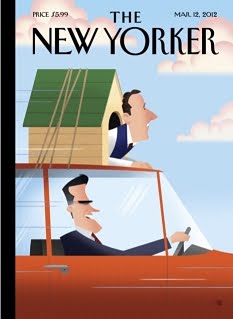 Every time New York Times columnist Gail Collins writes about Mitt Romney, she mentions Seamus's wild and uncomfortable ride atop the Romneymobile 28 years ago. It's the basis for the cover of the current The New Yorker, where Amy Davidson writes on-line that if a journalist as fearsome and relentless as Collins had been covering Richard Nixon's Checkers speech in 1952, the world might've been been saved from 37. It sounds as if Davidson hopes that Romney, at least, will end up going to the dogs. "There are character issues at stake here," she writes.
Monday, January 16, 2012
The GOP, Nixon, And "The Whole People"
 Writing in the Jan. 23 New Yorker about the state of the GOP, Jeffrey Frank raises the ghost of the last winning Republican to endorse moderation for moderation's sake:
In 1959, Vice President Nixon, speaking to members of California’s Commonwealth Club, was asked if he’d like to see the parties undergo an ideological realignment—the sort that has since taken place—and he replied, “I think it would be a great tragedy . . . if we had our two major political parties divide on what we would call a conservative-liberal line.” He continued, “I think one of the attributes of our political system has been that we have avoided generally violent swings in Administrations from one extreme to the other. And the reason we have avoided that is that in both parties there has been room for a broad spectrum of opinion.” Therefore, “when your Administrations come to power, they will represent the whole people rather than just one segment of the people.” Ten months before the general election, the increasingly angry, suspicious, and divided party of Romney, Gingrich, Santorum, and Perry seems ever more immersed in its current orthodoxies. None of the candidates, though, seem the least bit interested in even addressing how they, or their party, might actually govern the “whole people” of a fractious nation.
Friday, March 11, 2011
Their Nixon
OUR NIXON (trailer) from Penny Lane on Vimeo.
You saw it here first (unless you visited "The New Yorker"s blog before I did): Filmmakers Penny Lane and Brian Frye are making a Nixon documentary based on the home movies of the late H. R. "Bob" Haldeman and his operatives. Since they're now in control of Nixon's foundation, maybe this will end up being the new orientation film at the Nixon library.
Tuesday, February 22, 2011
Steve Coll Didn't Get The Memo
 In the Feb. 28 "New Yorker," Steve Coll reveals that the Obama administration has begun secret talks with the Taliban in Afghanistan:
The discussions are continuing; they are of an exploratory nature and do not yet amount to a peace negotiation. That may take some time: the first secret talks between the United States and representatives of North Vietnam took place in 1968; the Paris Peace Accords, intended to end direct U.S. military involvement in the war, were not agreed on until 1973.I'm pretty sure the magazine's position all these years has been that Richard Nixon could've gotten the same deal in 1969 that he got in 1973 and that tens of thousands of Americans died as a result. It's not true. I'm not complaining. But I'll bet someone else will, in the letters column next week.
Friday, November 12, 2010
Radio, Radio
 Another reason to love Elvis Costello: His influences, according to Nick Paumgarten's wonderful profile in the Nov. 8 "New Yorker":
His [jazz musician] father turned him on to the Grateful Dead, which became Costello's band, in part because it was no one else's. (While Costello makes no apologies for his Deadhead phase, his biographers always seem to.) It was through the Dead, and subsequently the Band and Gram Parsons, among others, that he discovered the traditional American music they'd tapped into, such as Hank Williams and Merle Haggard. This in turn became the foundation, along with the likes of Van Morrison, for the kind of music he was starting to write and perform himself...The Band's Rick Danko was a major influence on Costello's style of singing.
Friday, October 1, 2010
A Nut Case
 In the Oct. 4 "New Yorker," Rebecca Mead (left) begins an article about Delaware's GOP candidate for U.S. Senate, Christine O'Donnell (for whom I wouldn't vote, incidentally), and other Tea Party conservatives with a long paragraph about Great Britain's Official Monster Raving Loony Party. "One [candidate] promised to stick juvenile delinquents together with Super Glue," Mead writes, "and one...campaigned on an anti-gravity platform." Mead explicitly puts O'Donnell in this category and lists the reasons: She wears a beehive hairdo at times, went through a Goth phase, is an evangelical Christian who opposes premarital sex and homosexuality, and defaulted on a mortgage.
It troubles me when people call those with whom they disagree crazy. The Soviet Union took the concept to its logical extreme by imprisoning dissidents in mental hospitals. "The New Yorker" just thought it was being funny. But its Googleicious attack on O'Donnell didn't contribute anything to the reader's understanding of her popularity. Calling somebody nuts in tendentious 15-sentence paragraphs is the Upper East Side equivalent of Tea Party signs attacking President Obama. Whether written on a MacBook or poster board from Michael's, they contribute in equal measure to everybody's favorite subject (besides their rivals' moral unworthiness, of course): Declining civility.
Monday, August 16, 2010
Five And A Half Feet Over
 "The Big C," in which Laura Linney shined brilliantly tonight, is Showtime's madcap take on soberer insights, such those in Atul Gawande's arresting "New Yorker" article, about the choices terminally ill people have between savoring the time they have left or submitting to debilitating, ultimately hopeless treatment regimes. "I'm here all year, appearing at stage four," Linney's character, Cathy Jamison, says defiantly at the end of tonight's first episode. Then the camera rises straight up, showing her on a couch she's dragged into the backyard and dropped into the hole she's just ordered dug for the swimming pool she always wanted. It's one ominously shaped rectangle. But this great new show is all about this side of six feet under.
Monday, March 16, 2009
"Magnificent," That 'Surely'"
 The March 16 "New Yorker" contains ten poems, collectively titled "Endpoint," by John Updike, Episcopalian, who died of lung cancer on Jan. 27. The last in the series (his last poem?) was written on Dec. 22:
FINE POINT
Why go to Sunday school, though surlily,
and not believe a bit of what was taught?
The desert shepherds in their scratchy robes
undoubtedly existed, and Israel's defeats--
the Temple in its sacredness destroyed
By Babylon and Rome. Yet Jews kept faith
and passed the prayers, the crabbed rites,
from table to table as Christians mocked.
We mocked, but took. The timbrel creed of praise
gives spirit to the daily; blood tinges lips.
The tongue reposes in papyrus pleas,
saying, Surely--magnificent, that "surely"--
goodness and mercy shall follow me all
the days of my life, my life, forever.
Subscribe to:
Posts (Atom)