Tuesday, December 13, 2011

One More Landslide, Just For Drill

Struck by President Obama's strength in South Carolina and Florida polls, Michael Tomasky speculates about a Democratic landslide in 2o12 but advises Republicans to keep doing what they're doing:
I am not here to say the GOP had better grow up fast. Quite the contrary. If this tantrum lasts through the election, and if 2012 is for the Republicans what 1984 was for the Democrats, then finally our polity stands a chance of functioning again. The Tea Party will be dead and buried. Grover Norquist’s vise lock on the GOP will loosen. Someone will start a centrist Republican Leadership Council, just as people started the centrist DLC back in 1985. A certain number of elected Republicans will understand that being the Party of No didn’t get them much of anywhere. So this poll should not be a wake-up call for Republican voters. Hit the snooze button, folks, and keep fuming away.

Turning On The Fawcetts

This morning historian and blogger Maarja Krusten writes:
John Fawcett retired in 1994 and became an archival consultant. NARA staff told me in the 1990s that he was advising the Nixon Foundation at one point but I only have anecdotal evidence of that. (I know John Taylor worked with Fawcett. I’ll have to ask John if this occurred in the form of a consultancy in addition to Fawcett having worked at NARA.) I thought of that, when I read [journalist Andrew] Gumbel state that the Nixon Foundation offered Sharon Fawcett a consultancy after she retired from NARA late this spring. Interesting echo, perhaps. Given the wording in Gumbel’s article, I don’t know if Sharon actually accepted the offer.
John and Sharon used to be married. John finished his long National Archives career at the beginning of the Clinton administration. His last post was assistant archivist for presidential libraries. Sharon served in the same capacity for many years and retired earlier this year. Both ended up being offered consultancies by the private Nixon foundation. Krusten is struck by the symmetry. I don't blame her.

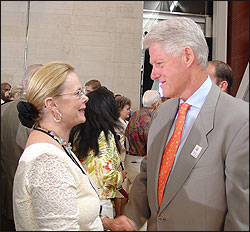
Despite their considerable influence across many years over how White House records are handled, they've managed to stay more or less below the radar. Though she's shown here with Bill Clinton, most of Sharon's Internet hits are consequences of the Nixon wars. A cursory Google search reveals no photos of John.

To answer Krusten's question, in the early 2000s, when I was Nixon foundation chief, I hired John (by then retired from NARA, where he helped engineer a curious, brief tilt to Nixon) as we prepared for the handover of the private Nixon library to the National Archives. Since 1991, our private reading room and archives had been operated by Susan Naulty. She was doggedly opposed to making the Nixon library part of NARA and later became a critic of director Tim Naftali, associating him with the left for inviting former White House counsel John Dean to Yorba Linda. Years before, during the battle between the Nixon foundation and Tricia Cox over the $19 million bequest of Nixon buddy Bebe Rebozo, Naulty developed a unwonted media profile by discussing the size of her staff with the Los Angeles Times. Her comments dovetailed with attacks by Cox ally Irv Gellman, who claimed that the library was poorly managed because we didn't give Naulty more resources. Gellman, Naulty, and her assistant had worked together closely when he was researching his book The Contender.

When we'd settled our lawsuit against Cox and Rebozo's money was safely ensconced in our endowment, we began to focus on facilitating a government handover. The headline on an earlier post reflects our midset: "Take My Library. Please." I became more curious about the differences between Naulty and NARA practice. Would we be able to stretch our resources further if she stopped refusing to use computers and processing records document by document, typing up one or more index cards for each letter, telegram, or memo (yes, Virginia, we had a card catalog)? The government processed folder by folder. So I invited John Fawcett, then working as an archival consultant, to take a look. He concluded that it would take Naulty hundreds of years to finish preparing our small cache of Nixon's pre-presidential records for scholars. When I hired a former Reagan library archivist to oversee a transition toward NARA practice, Naulty quit.

We don't know anything about the consultancy those now controlling Nixon's foundation have reportedly offered Sharon Fawcett. She and I agreed in 2006 that Naftali should redo the library's Watergate exhibit. I'm curious (and no doubt Krusten is as well) about why in 2010 she, as a top National Archives official, seems to have sided against Naftali in favor of the Nixon-turned-Haldeman foundation and a Watergate truth panel that included perjurer Dwight Chapin. As for John Fawcett, ironically enough, back in the day he helped the Nixon foundation nudge a little closer to National Archives practice and procedure.

Saturday, December 10, 2011

Separating The Woman From The Boys

Journalist Andrew Gumbel has published an article about the last battle of Watergate: Impotent efforts by aging acolytes of disgraced Nixon chief of staff Bob Haldeman to chase off Nixon library director Tim Naftali before he could install a new Watergate gallery. Importantly, Gumbel reveals what happened after I left my job as Nixon foundation chief in February 2009 and was replaced by Richard Nixon's longtime aide and last chief of staff, Kathy O'Connor. Among her first (and last) challenges was managing the outrage of Haldeman's minions over Naftali's speaking invitation to former White House counsel John Dean in June 2009:
She established a more fruitful working relationship with Naftali, but quickly met a wall of resistance from some at the foundation because she expressed understanding for the Dean invitation. Naftali said she was called a “wimp” in a meeting he attended and effectively frozen out by her foundation colleagues.
That sounds just like the Haldeman boys' name-calling. But she's nobody's wimp. Instead, she was encountering the Watergate generation at their weakest and angriest. To Kathy, Dean was an inevitable if ill-timed choice as a speaker at the newly federalized library -- a major historical figure, after all, thanks to his pivotal Watergate testimony. But to those who soon seized control of Nixon's foundation, he was a rat who had helped send their buddies to jail for their Watergate crimes. One operative's wife complained on the foundation web site about how hard the criminal investigations and trials had been on the defendants and proclaimed that perjury wasn't even a crime -- pleasing news, one imagines, to Dwight Chapin, newly influential at the foundation, who was among those who did federal time for perjury. He's shown here telling Naftali in an oral history interview that Nixon was in on the 1972 campaign's dirty tricks from the very beginning.

Kathy went to work for Nixon six years after his resignation and was holding his hand when he died 14 years later in April 1994. It's true she hadn't been with the old man in the White House when it really counted, as Watergate-era veterans often grumbled. By the same token, she hadn't organized any dirty tricks, ordered any burglaries, participated in any coverups, counted any Jews in federal agencies, or sicced the FBI on any journalists. As a result, her focus was on the old man's peacemaking legacy, not his aides' spotty reputations. Besides, over the years a few of them had kept scheming. Kathy and I were frequently pressured to get Nixon's campaign and non-policy aides more involved. The Nixon foundation had plenty of involvement with highly-respected heavyweights such as Henry Kissinger, George Shultz, Jim Schlesinger, and Pete Wilson. But we'd spent too much time protecting Nixon and his library from certain lower-level elements of the so-called old guard to be enthusiastic about letting them near the safe in Yorba Linda.

As Gumbel suggests, Kathy's advocacy of a mature response to the Dean invitation presented an opportunity for Nixonian payback. An operative publicly denounced Dean for being disgraced and disbarred, failing perhaps to recall that the same could be said of the library's namesake. Soon Kathy's career of distinguished, confidential service to 37 and his fractious family was drowned in a post-Watergate gusher of twilight testosterone as the good old boys massed in Yorba Linda. Ironically enough, Naftali's decision to commemorate the 37th anniversary of the Watergate break-in with a visit from Dean helped transform the Nixon foundation into the Haldeman foundation. A key if unwitting player in this process was a socially ambitious Orange County printer then serving as the foundation chairman who quit in a huff in 2010 after the operatives spurned his bid for a new, jumbo-salary foundation "president" job.

Their first move against Naftali was the secret enlistment of powerful friends in Washington to get him fired, but the wiry youngster from Quebec outmaneuvered the lumbering veterans. Then they assembled a truth squad featuring perjurer Chapin and tried to force the feds to water down the Watergate exhibit. In this effort, Andrew Gumbel and others report, they won key support from Sharon Fawcett, the National Archives official in charge of presidential libraries. Gumbel reveals that the archivist of the U.S., David Ferriero (a stand-up dude, as historian and blogger Maarja Krusten might say), sided with Naftali against Fawcett, who quickly retired and was offered a consultancy by Haldeman's operatives.

We need more details about how they won Fawcett (shown here with Kathy in happier times, at a Nixon Center dinner). If her pivot had worked, Naftali would have been finished. Instead, he finished the work he was called to do: Establishing the Nixon library as an equal partner among other presidential libraries by moving Nixon’s records home to Yorba Linda and installing a Watergate exhibit that would pass muster with the scholarly community. In that accomplishment, Kathy O'Connor, who had served Nixon best of all by being tough enough to protect him and his library from more than one scheme and embarrassment, shares considerable credit.

Friday, December 9, 2011

I On Newt

The impression I have of GOP dynamics at the moment is that many conservative activists fear nothing more than Mitt Romney's election. In a second term, President Obama would be a lame duck almost immediately. A President Romney would marginalize conservatives with business-friendly, relatively moderate policies appealing to a congressional coalition of center-right Republicans and centrist Democrats. To avert the wholesale reinvention (some would say restoration) of what it means to be a mainstream Republican, activists backed Palin, then Bachmann, Perry, and Cain. Intentionally or not, they're now flirting with the unthinkable: Nominating the unelectable, namely the attention-challenged Newt Gingrich. Nixon put it best: "The right would rather be right than president."

Monday, October 10, 2011

99,000 Bloggers Here On The Wall

I happened to check in tonight to do a little housekeeping and saw that the page-view odometer clicked over on the way to 100K. Thank you, dear readers; sorry that ministry, reading, and practicing my scales have kept me away from The Episconixonian. I'll be back!

Monday, September 12, 2011

Pauline Faultline

In the middle of the first century, within about 20 years of the death and Resurrection of Jesus Christ, the great apostle Paul of Tarsus wrote these words to a community of Christians living in Rome [Rom. 12:14-21, NRSV]:
Bless those who persecute you; bless and do not curse them. Rejoice with those who rejoice, weep with those who weep. Live in harmony with one another; do not be haughty, but associate with the lowly; do not claim to be wiser than you are. Do not repay anyone evil for evil, but take thought for what is noble in the sight of all. If it is possible, so far as it depends on you, live peaceably with all. Beloved, never avenge yourselves, but leave room for the wrath of God; for it is written, "Vengeance is mine, I will repay, says the Lord." No, "if your enemies are hungry, feed them; if they are thirsty, give them something to drink; for by doing this you will heap burning coals on their heads." Do not be overcome by evil, but overcome evil with good.
I remember how overcome by evil I felt that morning, and those weeks, and all those months. Almost all of us remember. The smoke and fire. The faces of the missing, lost, and fallen. The anxiety about what might come next. Many people felt a parchedness of the spirit, even the temptation to perceive God’s silence, indifference, or absence.

Then there was the rage. Do you remember feeling the rage?

Imagine St. Paul coming to town in the weeks after Sept. 11, preaching his bold sermons about blessing those who persecute us. A considerable number would have stood up in church and assured Paul that that vengeance wouldn’t be God’s anywhere near as soon as it would be ours.

If we feel more secure on this anniversary than we did five years ago or nine years ago, it’s because of the methodical, bloody work undertaken by United States military and intelligence services against al-Qaeda and the Taliban. They haven’t eliminated the threat, but they’ve reduced it.

We may not call this vengeance. We may call it a just and proportionate response to the evil our enemies have done.

Yet I will tell you – I’m not proud, but it’s true -- that my heart leaped with satisfaction at the news, which came not long after the joy of Easter, that Osama bin Laden had been killed by an American who pulled the trigger in that compound in Abbottabad and shouted, “For God and country.”

We pause to thank all the men and women who protect us – those who by their diligence and valor have purchased the blessing we enjoy this afternoon of remembering and reflecting in freedom and in relative security.

Yet we Christians still have to contend with St. Paul. Pacifism may be your witness. Perhaps it should be mine, but it isn’t.

But how do the faithful do violence?

Can we love and kill our enemies at the same time?

Are we too prone to mistaking our neighbor for our enemy?

What risks do we run by insisting that we are wise and holy enough ever to extend the arm of God’s own justice?

In Rome during the Emperor Claudius’s time, when Paul wrote his letter, observant Jews were arguing with Christians. Jewish Christians were arguing with non-Jewish Christians. Rome was persecuting both Jews and Christians.

Can you imagine what it was like back in the day -- the fear and mutual suspicion, the scapegoating and the name-calling?

As a matter of fact, you probably can – if you remember the aftermath of Sept. 11.

If we are to achieve justice without vengeance – if we are to act as God would have us act so far as it depends on us – then the call of the gospel is to a relentless discipline of humility and forgiveness. Angry and hurt as we may be, whether in our national life or our daily lives, these virtues are supposed be our default settings.

Paul went so far as to imagine an improbable Roman paradise in which Jews, Christians, and pagans set aside their enmity for the sake of their humanity – a paradise he understood would be populated one proud, reluctant soul at a time.

Today, Paul might well promote harmony among Jews, Christians, Muslims, and all believers – even harmony between Democrats and Republicans.

My wife, Kathy, and I have attorney friends named Harry Waizer and Karen Walsh. Harry grew up in Brooklyn as an orthodox Jew. Karen grew up Roman Catholic in Westchester County. Many of their family members boycotted their wedding. Their Jewish and Catholic mothers shunned one another.

Harry worked for Cantor Fitzgerald in the World Trade Center and was burned by jet fuel over most of his body after the terrorists attacked. He was in a coma for weeks. Doctors gave him a 5% chance, but he beat those odds, and he’s back at work.

A few weeks ago, Karen told us about the night in late September 2001 when she arrived at the hospital after a long day of working and caring for their children. Walking down the darkened hall toward Harry’s room, she saw two small figures walking ahead, hand in hand.

If you knew instinctively that the two figures were Harry and Karen’s mothers, then you already have a profound understanding of the glory of which humanity is capable, the fellowship, joy, and peace to which we are all called by our Creator.

Karen said that she worried that if Harry had awakened as his two mothers leaned over him, their worried faces looming side by side, he would have assumed that he was dead.

Harry didn’t have to wait that long. Neither do we.

I made these remarks at an interfaith service at St. John's Episcopal Church and School in Rancho Santa Margarita on the afternoon of Sunday, Sept. 11.

Monday, August 22, 2011

Bending Notes And The Constitution

Before I was a frustrated pianist, I came to George Gershwin's thrilling jazz concerto, "Rhapsody in Blue," as an underachieving 11-year-old clarinetist. The piece begins with an almost impossible to believe two and a half-octave clarinet glissando blasting off from the F below middle C and bending slowly, in an aching blue note, toward a high B-flat. I can bend notes on an harmonica, but I never developed the embouchure of iron required to do it on the clarinet. I wish I'd practiced more.

I also wish I could say I'd heard it performed by my teacher, the Detroit Symphony Orchestra's first-chair clarinetist, Vincent Melidon, a buddy of my father the music critic. I still have the old B-flat Selmer Mr. Melidon sold my mother, but unfortunately the only thing that rubbed off on me was cork grease. Besides, if he ever played the Gershwin run during his DSO years, it probably wasn't on my instrument, since he would've used an A clarinet for his orchestral work.

Instead, I listened over and over again to the 1959 recording by the Columbia Symphony Orchestra conducted by Leonard Bernstein, who also played piano. And of course "Rhapsody" is all about the ivories, not the licorice stick. The story goes that Gershwin hadn't finished writing portions of the piece for its first performance, with a jazz band, in Boston in 1924, so he improvised. It's now a staple of the classical repertoire.

While the Bernstein performance will be in my head forever, I also love the two associated with Woody Allen's 1979 film "Manhattan," Gary Graffman's on the soundtrack album and Paul Jacobs' in the film itself. The movie's titles, featuring Jacobs' and conductor Zubin Mehta's "Rhapsody" plus black and white images of the streets of the city, Central Park, Yankee Stadium, and fireworks over the East River, are exquisite; pretty much the high point of the movie. You can also get performances of the piece for solo piano, including this one by French pianist Vera Tsybakov.

Gershwin said the work's rhythms were inspired by the clickety-clack of New York's subways and ELs. Thanks to a church friend, I had the chance to rhapsodize about "Rhapsody" to my Bronx-born wife, Kathy, before, during, and after a June performance by Orange County's Pacific Symphony and pianist Orion Weiss, whose rendering was as lyrical and modern as Bernstein's was muscularly classical.

Thumbing through the program before the concert, I was startled by another contrast, not between an old pianist and a young one but an old Nixon hand and his younger self. The program contained an interview with Nixon operative Larry Higby (above), now chairman of the Orange County Performing Arts Center, which includes the Pacific Symphony's home, the Renee and Henry Segerstrom Concert Hall. The article, which didn't mention Higby's Nixon service, contained this statement by the impresario:
The arts are for all of us. They enrich our lives and add meaning and dimension to our daily experiences.
True enough, now and in 1971, when Higby was adjutant to Richard Nixon's soon-to-be-disgraced chief of staff, H.R. Haldeman. But back then, in the midst of the Vietnam war, the only artistic meaning and dimension the White House cared about was whether the artist in question was pro or con. As documented in the Nixon library's new Watergate gallery and the on-line background available at the library's web site, Higby asked the FBI's J. Edgar Hoover to provide dirt about CBS's Daniel Schorr, participated in the notorious Jew-counting scandal, and facilitated the process by which counsel John Dean's enemies list made its way to a desk within a few feet of the Oval Office. Among other great and decent Americans enriching and adding meaning to our lives in that era and yet ending up on the enemies list assembled for the president of the United States was none other than Leonard Bernstein.

In a thoughtful post earlier this summer at NixoNARA, historian Maarja Krusten reflected on Nixon and Haldeman's practice of hiring young men as aides. It was true that they were energetic and eager to please, and they looked good. Haldeman's acolytes have often made a fetish of looking well-dressed and clean cut (though the last time I met the desperately ailing Haldeman, on the streets of Santa Barbara, he told me cheerfully that he'd never wear a tie again). But as Krusten relates, they lacked wisdom, as younger people sometimes do. That was probably the way Nixon and Haldeman wanted it. You tell an ambitious young man in a free nation to sic a federal police agency on a journalist, and he may actually do it. Nixon knew that older advisers were more likely to push back. Nixon's advocates often say that the enemies list was de minimis because no one on the list had his taxes audited, as Nixon vowed to do. That may be because when Nixon's boys tried to line up the IRS to harass his enemies, they encountered a man, Treasury secretary George Shultz (shown with Nixon), who told them to pound sand.

I served former President Nixon and, at his direction, his estate and presidential library for nearly 30 years; Kathy equaled that, for a total of 60 between us. I was his chief of staff from 1984-90. I admired him for his peacemaking achievements and relentless diligence as an elder statesman. But even in those quieter years, he had his weaker moments. One morning, sitting opposite me in his office in 26 Federal Plaza in New York City, he ordered a little dirty trick. Angry at a prominent journalist, he told me to send the person an anonymous note saying that "we" knew something embarrassing. I didn't do it, and I hoped he wouldn't mention it again, which he didn't. If he had, I pray that I would've done the right thing.

Kathy, who succeeded me as Nixon's chief aide and was holding his hand when he died in 1994, also saved him from a humiliating crisis or two by saying no. It wasn't easy. Once, she reports, he was speechless with anger. She was afraid he was about to fire her. She's tougher than I am, and she held her ground. I can imagine it was a lot harder when Nixon was powerful and his young men wanted to keep their West Wing offices.

My apologies to Vincent Melidon for calling him "the late" in an earlier iteration of this post, and my thanks to his nurse, who corrected my error in a gracious comment.

Sunday, May 22, 2011

BTO Watch

Huckabee, Daniels, and Trump are all out. Gingrich? As if. Palin has done little if anything to build an organization. So why isn't Michele Bachmann the top dark horse contender for the GOP nomination in 2012? Dan Rather thinks so.

Friday, May 13, 2011