Showing posts with label Episcopal Theological School at Claremont. Show all posts

Saturday, July 7, 2012

My Episcopal Trifecta For The Day

Episcopal as in pertaining or relating to bishops and the historic episcopacy, that is.

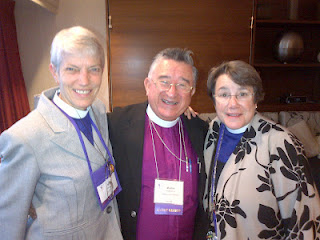
Deacons and priests tend to tell their ecclesiastical life stories with reference to bishops. For instance, take this photo, which appeared today on Bishop Suffragan Diane Jardine Bruce's blog showing her with her sister suffragan, Mary Douglas Glasspool (left) and Bishop Martin Barahona of the Episcopal Diocese of El Salvador at an event in his honor during our triennial General Convention in Indianapolis.

I was Bishop Mary's chaplain when she and Diane were participating in the process that led to their historic election as our diocese's first women bishops in 2009. Bishop Diane was a gracious and indispensable mentor in the late 1990s during my ministry study year at Church of the Messiah in Santa Ana, California, where she was associate rector. As a fellow Bloy House seminarian, she also gave me photocopies of her famous Charles Frazee church history index cards. For five points, what's the Shepherd of Hermas? And I had the blessing of serving as Bishop Barahona's chaplain when he paid a visit to St. Paul's Episcopal Church in Tustin, California one Sunday in 2002, where I was doing a field study internship.

We just love our bishops!

Sunday, September 12, 2010

Yes Without The Possibility Of No

My Episcopal clergy brother, the Rev. Canon Robert J. Gaestel, rector of Church of the Angels in Pasadena, is also a police chaplain. Preaching on Sept. 11 at the Episcopal Theological School at Claremont, he probed the correlation between the work of clergy, cops, and the Cross. An excerpt from his sermon:
The real stress of law enforcement is not weird hours, having to work on Christmas, or negative contacts with the public. The real stress is living at the boundary where order collapses in a matter of moments. It is something most people will never experience.

What was September 11 but the complete breakdown of order, a breakdown that led to horrendous destruction and death? I remember my wife Tracy coming to my office and telling me that the country had been attacked. I could not comprehend what she was saying. What did it take to restore order? A lot of people gave up their lives, people in public safety, people on Flight 93.

What is the Cross but the paradox of chaos and order in the same place? The Cross is the ultimate loss of safety and truth because on it we seek to destroy and we succeed in destroying the one who for us is ultimate safety and ultimate truth. We destroy the source of ultimate order thinking that by doing so we are restoring order. Jesus is accused of threatening the order of both Judaism and Rome. To put Christ to death is to impose and preserve order. But putting Christ to death is to destroy the only source from which all order comes and where it all leads.

The Cross is truly the sum of all fears, the worst that can possibly be done. It is the triumph of chaos over order, the ultimate suicide bombing. We suddenly behold that, that which we suffer is that which we perpetrate. We human beings are the ones who fly the planes into the buildings and we human beings are the ones who perish at our own hands, all the while thinking taking control, we are imposing order.

Yet in the further paradox no one could imagine until it actually happened, when chaos exacted its full measure, in the moment of its triumph, it destroyed itself. A life threatening illness like cancer, at the moment of its victory, being the moment its victim dies, it dies too.

That’s what St. John in his account of Christ’s Passion saw with absolute clarity. The moment when Christ was lifted up, he would draw all to himself. In the moment of his death, Jesus is glorified, that is revealed for who and what he really is. And when all was said and done, and nothing more could be done, what remains is yes without possibility of no, of life with no death at all, because what remains after we have done our worst is the Risen One.

Friday, May 1, 2009

The Shepherd Of Episcopalians

Before leaving this morning for one of my periodic lunches with church historian Charles Frazee, I jokingly wrote on Facebook that I expected a conversation about the Coptic church. While we went much further afield, as any conversation with Dr. Frazee must because of the astonishing extent of his interests and gifts, I did come away with a copy of his latest manuscript, An Historical Introduction to the Eastern Christian Churches, Copts, of course, included, exam, I pray, not.

My Facebook post prompted a half-dozen comments from fellow Episcopal priests who, like me, learned their church history from Charlie. "Yea, Dr. Frazee," said the Rev. Kay Sylvester. "He rocks." Wrote the Rev. Cn. Diane Jardine Bruce, "Give him my best...and tell him someone (not me!) lost all my 3x5 cards that I made from his classes!" When I passed these greetings along, Charlie's always cheerful face brightened a little more at the mention of each name. He even remembered Diane's copious index cards, photocopied and studied, thanks to her devout Christian pity, by a whole generation of M.Div. students at the Episcopal Theological School at Claremont, California.

Dr. Frazee, you see, didn't use a textbook. At the beginning of his two-semester course in late August, he's say, "The church of Christ was born the moment Mary Magdalene received the news of Jesus's Resurrection..." At the end of the last class in May, he'd say, "...and though Warren's church is Southern Baptist to the core, it takes pains to present a non-threatening, post-denominational face." In between we would have experienced 20 centuries of Christian history and practice -- the Gnostics, ecumenical councils, Crusades, Liturgy of St. John Chrysostom, and perhaps 500 other topics. He would never have looked at a note, missed a name or date, grasped hesitantly for a word, or failed to utter a graceful, perfectly formed sentence.

If you had his class after lunch on Saturday, which I always did, students' energies might flag, but his never did. Each semester, he assigned four or five books and book reports -- The Rule of St. Benedict, The Imitation of Christ, that kind of thing. As for the core material, while he was always pleased to hear his often middle-aged students talk about the Holy Spirit or challenge him with their views on post-structural gender semiotics as applied to the gospel narratives, he said his job was making sure we future ministers knew when the First Letter of Clement had been written what Martin Luther's dates were. I lost five points on the fall 1998 final because I didn't remember the Shepherd of Hermas. Not that I'm licking old wounds.

Speaking of Br. Martin, I wouldn't say that Charlie spent a lot of time on the Reformation. He figured we'd get plenty in our Anglican history and theology classes. He also believes that the mother church would probably have managed to reform without the Protestant reformers. An inactive Catholic priest with a brilliant wife and two brilliant daughters, Charlie served in the Archdiocese of Indianapolis during the 1960s and early 1970s, earning the scorn of his bishop for helping lead protests against the Vietnam War. After he, Kathy, Sara, and Jill came to California, he taught at California State University, Fullerton and, of course, ETSC.

Though retired from both posts, he teaches and lectures frequently and writes incessantly. Some of his prior books are listed here. In September, he's leading a pilgrimage to Catholic Greece. Did you know there were 50,000 Roman Catholics in Greece? You do now, and watch out: It'll be on the test.