Showing posts with label Bethlehem. Show all posts

Wednesday, July 25, 2012

Massive Question

Those who think that anything goes in The Episcopal Church should read Mary Frances Schjonberg's coverage (supported by my Diocese of Los Angeles colleague, Pulitzer Prize-winning journalist the Rev. Pat McCaughan) of the painstaking debate about open communion that took place at our recently concluded General Convention in Indianapolis.

According to our national church's canons [I. 17. 7], only baptized persons are eligible to receive the consecrated body and blood of Christ. Feeling that the canonical requirement might impede the movement of the Holy Spirit in a spiritual searcher's life, some priests and parishes invite everyone to come to the table, baptized or not.

No one checks congregants' baptism IDs at the altar rail. The question is whether priests
err by failing to articulate the rule or by flying in the face of it.

In Indianapolis, the Rev. Anna Carmichael, rector of St. Mark's in Hood River, Oregon, was part of an unsuccessful effort to persuade General Convention to abandon the requirement altogether. Her reasoning, as Schjonberg and her colleagues reported:
“While I understand that as a priest I have taken a vow to uphold the rubrics of the prayer book, I feel that sometimes pastoral care and pastoral sensitivity are equally as important as our theology behind what we do,” she said, adding that the Episcopal Church is always striving to extend its welcome to all people “and I hope that at some point our welcome will include unbaptized at the communion rail.”
In the end, the convention preserved the requirement. It even turned aside a resolution containing this sentence: “We also acknowledge that in various local contexts there is the exercise of pastoral sensitivity with those who are not yet baptized.” Opponents of the wording argued that while priests always reserve the right to make pastoral judgment calls, being that explicit would have amounted to a proclamation of open communion. At the core of the debate is TEC's passion for baptism as the first and greatest sacrament, the irreducible outward sign of membership in Christ. Some fear diluting its power by eliminating it as a condition for participating in Holy Eucharist.

Yet I'm sure most priests have a story about someone who probably wouldn't have decided to be baptized without first being welcomed to the table. At St. John's, the wording in our Sunday bulletin (inspired by another LA Diocese colleague, the Very Rev. Canon Michael Bamberger; that's he above, celebrating mass for us pilgrims last month at Emmaus-Nicopolis in Israel) probably wouldn't pass muster with the canonical cops:
Episcopalians consider all baptized persons to be members of Christ's Church. Wherever you are on your journey of faith, you are invited to come to the Lord's table and receive the Lord Jesus Christ in the consecrated Bread (or Host) and Wine.
The first sentence is designed to do two things. Roman Catholics and members of other denominations often come to an Episcopal parish wondering if they're allowed to receive. We want to be sure to tell them yes. It also implies that membership has its altar privileges, while the second sentence creates ambiguity by implying that membership doesn't matter when it comes to Holy Communion. Folks have asked me about the ambiguity and ended up baptized, marked as Christ's own forever, as a result. The more traditional approach, of course, is to honor baptism by refusing Holy Eucharist to the unbaptized. That's the way my Roman Catholic wife and fellow St. John's minister, Kathy O'Connor, grew up.

Even though TEC doesn't require it, some families prefer to wait until their baptized children are old enough to understand the significance of Holy Eucharist. For such families at St. John's, Randall and Kristen Lanham offer wonderful early communion classes each spring, the Episcopal equivalent of the first communion process in Roman Catholic parishes.

If parents are willing, I and most priests will give communion to anyone old enough to exhibit the curiosity and a tooth or two. We figure that people are more likely to make a habit of church attendance if they can't remember a time when they weren't welcome at the Lord's table. And welcome is the operative word. In an era of mounting skepticism about the institutional church, it's unwise for any denomination or parish to fail to make hospitality a core value.

Besides, if we should stick slavishly to I. 17. 7 and try to keep the unbaptized from the communion rail, our Roman Catholic brothers and sisters may have done us one better. Many have had the experience of being told one has to be a baptized Roman Catholic to receive communion. God bless those priests, especially at funerals, who make a point of saying that all are welcome, even though by doing so they're violating Vatican rules. That's why I never ask for the sacrament in a Catholic church when there's a chance that the priest knows I'm not one of his own. Why force my brother either to deny me the body of Christ or violate canon law?

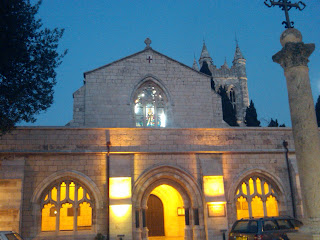
For whatever reason, in late June we St. John's pilgrims didn't have to display that kind of sensitivity during an early-morning mass in the grotto at the Church of the Nativity in Bethlehem. We stood a few steps from the traditional place of Jesus's birth as a Franciscan priest from Italy served us each Holy Communion. The photo at right above shows pilgrim Christian Kassoff being communicated.

The priest may have thought we were Roman. He may not have cared. But when I blogged about the experience, my friend Charles Frazee, a specialist in church history and his Roman Catholic church, wanted to be sure I understood that no Catholic priest is permitted to deny the sacrament to someone who seeks it, baptized Catholic or not, unless the person is known to be guilty of a grave sin (being Episcopalian isn't included). TEC doesn't have that kind of universal access stipulation in our canons. So, um, are we really stricter than the pope?

Tuesday, January 10, 2012

"Merry Christmas," Said The Jew And Muslim

Deb Neal, my Diocese of Los Angeles colleague, is serving as assistant to the Episcopal Bishop of Jerusalem at St. George's Cathedral in East Jerusalem. She's written a moving post about Christmas in the Holy Land, including the trip back to Jerusalem from Bethlehem's Church of the Nativity on Christmas Eve:
And because God is Good, and to remind me what it is really truly all about, and to make the evening truly blessed, as we passed through the horrid wall on our way home, the young Israeli guard wished me Merry Christmas. As you can imagine, I welled up and thought: This is where I see the hope. And oddly enough, the only other person to say Merry Christmas to me (other than in the church) was a Muslim shop keeper in Nablus. Aaah, Peace and Goodwill to all. I like it!

Monday, January 24, 2011

The End Of Christians In The Holy Land

Marty Peretz says radical Muslims want Christians to leave the Middle East:
There are various depopulating processes now going on against Christians virtually everywhere in the Muslim Middle East, including notably Bethlehem where Jesus was born, this particular end-stage of religious history having started when Yassir Arafat's authority took over. And the truth is that nobody cares much about Armenian, Greek or Roman Catholic Christians. Yes, like they didn't care about the Jews. Maybe it is not quite a Holocaust. O.K., no damn exaggerations. It is just a catastrophe, a human, historical, demographic, religious catastrophe.
Photo: Mass in St. Jerome chapel, Church of the Nativity in Bethlehem, January 2011

Thursday, January 13, 2011

Sunday Sermon: "The Street Lights Are On"

The Epiphany light from the manager must have been wondrous. It surely shown in the faces of pilgrims Jan and Deb yesterday morning in the Church of the Nativity in Bethlehem. But not every light bulb that goes off in our heads illuminates the path that goes in the right direction in our lives. Whether in the eyes of babies on their baptism day or from automatic weapons fire in a supermarket parking lot in Tucson, all the flashes of light we may see give us an opportunity to discern what is best for others as well as ourselves. My sermon for the first Sunday after the Epiphany is here.

Pilgrims' Progress, Day 3: Birth To Death To Life

Visiting Bethlehem from Jerusalem means that pilgrims see beautiful and ugly things the same day -- the face of pilgrim Loreen beholding the sights in the Church of the Nativity, for instance, and the forbidding face of the Israeli security and separation wall hemming in the city of David.

It's been an even busier day than we expected, the result of pilgrim Pam slipping on a sidewalk this morning and suffering a small fracture in her left tibia. Treated by doctors in Bethlehem and Jerusalem, Pam was back among us at St. George's by dinnertime, with a bright red cast (she picked it to match her toenails). The good news is that she'll still head to Nazareth with us tomorrow.
Pam's accident notwithstanding (we give thanks it wasn't worse), a day in the Middle East is full enough if it encompasses the birth and death of Christ. We reached the Church of the Nativity early enough that, thanks to one of Canon Iyad Qumri's famous and ubiquitous cousins, each pilgrim was able to visit the grotto where the church believes Jesus was born.Iyad could only accomplish this by asking us to crowd onto the steps leading to the grotto and wait for a young man who was purposely blocking the way to decide to let us through. He was protecting the prerogatives of the Greek Orthodox priest who was celebrating mass in this, the heart of the Church. The Armenian Orthodox were planning a service immediately afterward, so Iyad wedged the pilgrims through the tiny space in under five minutes. From the other side, we watched the Armenians get under way.
Then we went to the nearby St. Joseph chapel, read from Luke's birth account, and sang "O Come all Ye Faithful." After taking care of Pam, we returned to Jerusalem and Easter: A glimpse at the magnificent model of Second Temple Jerusalem at the newly renovated Israel Museum, which shows, experts believe, an exhausted rock quarry that was used both for Mt. Calvary and Jesus's burial and which became the site of his resurrection. Here a pilgrim points at the spot.

Friday, August 14, 2009

"Hamas Is Crazy"

We St. John's pilgrims ended up visiting Bethlelem a day earlier than planned because Canon Iyad Qumri got a hint about the massive security effort being mounted for Fatah's first-ever party conference inside the West Bank. From the "Economist," a vaguely optimistic conference postmortem:

National elections are set for January 2010. The new Fatah leadership will still face a strong challenge from Hamas, but even before the conference in Bethlehem Fatah had been enjoying a surge in popular support in the West Bank. This was due partly to the improved economic situation and also to the increased calm on the streets, attributed to the intensive American training of the PA’s security forces. Israel’s massive onslaught on Hamas-controlled Gaza earlier this year also seems to have validated Mr Abbas’s more moderate approach. “I like Fatah more now,” said a young man who was selling roast chicken in the market in front of the Nativity church in Bethlehem. “There are a lot of scary things going on in Gaza. Hamas is crazy. Palestine is Fatahland.”

Monday, August 3, 2009

Jerusalem Vesper Light

We began our day with a reading from Mark 4, where Jesus beseeches us to let our divine lights, our singular and most authentic selves, shine in the world. Tonight, St. George's Cathedral was making the most of its true lamp stand nature, glowing brightly on a cool, breezy Jerusalem evening.

The first full day of a retreat can feel like a lifetime. So much happens to enliven the senses and spirit and banish the everyday. As the Palestinian National Authority prepares to convene a summit meeting beginning on Tuesday in Bethlehem, the light of Christ shone like a light bulb going off in Canon Iyad's head. With 4,000 PNA soldiers gathering to protect their fractious politicians (as of today, Hamas said it wouldn't permit Fatah members from Gaza to attend), he said we should probably visit Bethlehem today instead of tomorrow. How wise he was, as always. The place was already crawling with soldiers. Tomorrow we might actually have been turned away.

The afternoon light shone in the window of St. Jerome's chapel in Bethlehem's Church of the Nativity, where tradition holds that the great scholar produced the indispensable Latin Bible known as the Vulgate. As a group of Spanish pilgrims sang "Adeste Fideles" during mass in the Franciscan church upstairs, we sang "O Come All Ye Faithful" downstairs. When seven of us took a late-evening walk through darkened maze of the Old City, the fresh-squeezed orange and grapefruit juice we enjoyed seemed to be sunlight itself. I even saw a twinkle in the eye of the young Israeli soldier who came onto our bus at a checkpoint to inspect our passports. Her semiautomatic rifle, half as long as she was tall, banged against our shoulders as she walked down the aisle. She smiled sweetly as she asked how we had enjoyed Bethlehem.

And yet her qualities would have been lost on those West Bank Palestinians whose lives are disrupted by Israeli security measures. Iyad said he used to take groups to Bethlehem just to get ice cream after lunch. Nowadays the eight-mile round trip can take half a day. Palestinian Catholic priests have to show movies about the Church of the Holy Sepulcher because their Arab students find it to hard to visit it in person. So many lovely, gracious people here. So much light and hope. So much faith. So much work to do.
Sent from my Verizon Wireless BlackBerry

Birth Rite

Touching the spot deep beneath Bethlehem's Church of the Nativity where tradition holds that Jesus was born.
Sent from my Verizon Wireless BlackBerry

Angels In August

On a rocky, terraced hillside near Bethlehem, pilgrim David read to us about Ruth and Boaz, Saul and David, and, from Luke's gospel, about the angels' announcement of Jesus's birth. It's thought the shepherds were gathered in this very field. On a hot afternoon in August, we sang "It Came Upon A Midnight Clear," including this call to warring humankind: "O hush the noise and cease your strife and hear the angels sing!"
Sent from my Verizon Wireless BlackBerry